
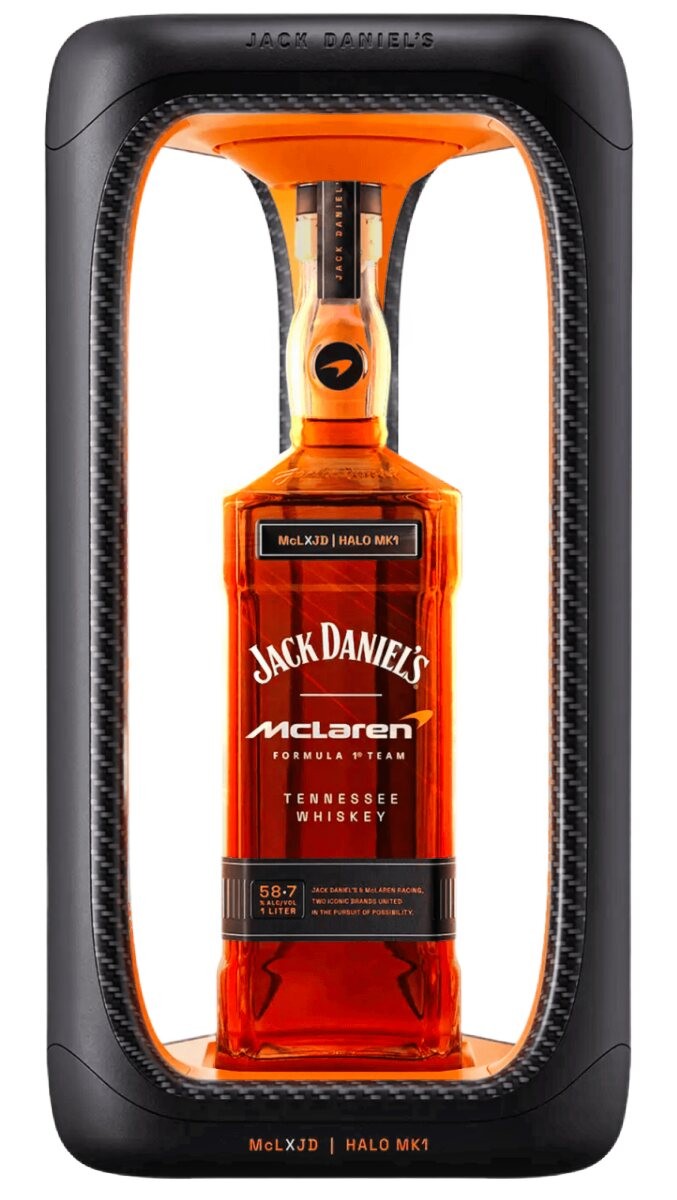
The asphalt shimmering in the Florida heat, the low rumble of the single-seaters, and—standing out sharply against the crowd in the paddock—that very specific shade of papaya orange. The Miami Grand Prix regularly serves as the stage for spectacular displays of power. Yet one of the event’s most talked-about presentations wasn’t about a new chassis or an aerodynamic upgrade. It was about a case. An object initially designed to hold a bottle, but which has clearly decided to break free from its status as mere packaging and venture into the realm of precision engineering.
The result of a partnership between the Jack Daniel’s distillery and the McLaren racing team, the Halo MK1 redefines the boundaries of what the industry euphemistically calls “secondary packaging.” Created by Hunter Luxury, this sculptural piece poses a blunt and fascinating question to the premium spirits sector: Is the liquid alone still enough to justify the prestige of a limited edition? In a market saturated with cross-brand collaborations, the answer leans toward no. The bottle, however rare it may be, now demands a narrative framework worthy of its stature.
The Mechanics of Fluids and Solids
The project is built on technical foundations that bear more resemblance to the specifications of an automotive parts manufacturer than to those of a luxury packaging company. To bring this limited edition to life, the designers utilized eight distinct materials, each requiring a different manufacturing process. The final assembly involves coordinating more than fifty individual components. This accumulation of industrial constraints is designed to fade into the background when the bottle is handled, leaving only fluidity in its wake.
Paul Hamilton, head of sales and marketing at Hunter Luxury, sums up this approach with a chillingly effective phrase: it involves applying cutting-edge engineering to the creation of a single moment. Opening the box is no longer viewed as a utilitarian action to access the product. It becomes a choreographed sequence. The gliding of the parts, the calculated resistance of the hinges, and the muted sound of materials interlocking all contribute to a mechanical drama designed to set the buyer’s expectations even before they lay eyes on the bottle.
A Repurposed Survival Device
The most striking aspect of this creation undoubtedly lies in its original inspiration. The design draws directly from the lines of the Halo, the titanium frame mandated for Formula 1 cockpits since the 2018 season to protect drivers’ heads. Transforming a roll bar—born of a vital necessity and initially a source of aesthetic controversy—into a luxury display required a certain amount of confidence.
Here, the protective silhouette is reinterpreted to envelop the bottle. It retains its function as a shield but shifts toward becoming a visual focal point. Sam Gardner, Global Senior Art Director at Brown-Forman, emphasizes that this project required absolute precision for the analogy to work. The illusion of a race-engineered part had to be perfect, incorporating the visual precision of the exposed fibers and McLaren’s strict color codes. The brutality of the racetrack is thus tamed, polished, and transposed into the refined world of tasting rooms.
The Track as Visual Grammar
This shift from Formula 1 to high-end collections reveals a profound transformation. The auto racing championship has ceased to be a mere sporting competition and has established itself as a language of luxury in its own right. Its aesthetic attributes speak to an audience that extends far beyond the circle of motorsports enthusiasts. Carbon fiber, micron-precise machining, and metal anodization constitute the new vocabulary of a clientele seeking tangibility and implied performance.

The reception the Halo MK1 received from design professionals perfectly illustrates this crossover between sectors. In London, the Design Awards jury awarded it the gold medal, judging it based on criteria specific to wine and spirits packaging. In Tokyo, the product swept the gold and silver awards in the partnerships and collaborations category, praised for its technical sophistication. These successive accolades do not merely reward a beautiful box; they validate a design approach where industrial design merges with the art of living.
The Dizziness of Sophistication
However, this race toward hyper-engineering raises a nagging question. By using an ever-increasing variety of materials, complicating opening mechanisms, and borrowing heavily from the world of auto racing, how far can the industry go before it descends into a mere display of resources? The line between a museum-worthy piece justified by its design and an ostentatious object is blurred.
The challenge for these monumental masterpieces lies in their longevity. For the investment and technical virtuosity to retain their meaning, the final object must survive the initial surprise of first encounter. It must escape the obsolescence of a mere seasonal trend to establish itself as a credible collector’s item over time.
For Hunter Luxury, the critical success of this McLaren and Jack Daniel’s collaboration confirms a strong strategic stance: the luxury of tomorrow will be filtered through heightened technical sophistication. The presentation box is no longer relegated to the status of a fleeting prop destined for the trash. In today’s ecosystem of ultra-premium spirits, the hierarchy has been turned on its head. The container has taken center stage, dictating its own rules and effectively establishing itself as the central narrative of the object it houses.