Make Texture a preferred source on Google to support us
Add Texture to GoogleThe days when interiors were conceived as static showrooms, impervious to the ravages of time and the mishaps of everyday life, seem to be well and truly over. A hand brushing against the edge of a shelf, a glance lingering on the corner of a coffee table, the instinctive gesture of moving a container to catch the morning light: it is in this silent choreography that the true relevance of contemporary design now unfolds. The pieces that share our intimate spaces can no longer be content with a mere utilitarian function, nor should they be reduced to silent decoration. They take on a more complex role: that of memory capture, of silent witnesses to our moods. It is precisely on this fine line—where material meets memory—that the collaboration between the furniture brand Kave and the French artist Justine Franco unfolds. Titled *A Celebration of Everyday Beauty*, this limited edition of thirteen objects eschews grandiosity to focus on a materiality designed for wear and the passing of time.
This new chapter extends an intellectual and aesthetic dialogue previously initiated through the Kave Gallery project. But here, the approach shifts in scale and tone. The aim is not to present creations intended to overwhelm a space with their presence, but to introduce familiar elements capable of blending into the interior architecture. Ordinary beauty—the kind that settles in slowly, almost without our noticing—requires a design that embraces the passage of time. From this perspective, wear and tear loses its status as deterioration and takes on that of a patina. It signifies the owner’s appropriation of the object, thereby validating its profound utility.
The Transposition of a Pictorial Language
The starting point for this collection is a bold shift: extracting Justine Franco’s visual grammar from its usual context and infusing it into the domestic sphere. Based in A Coruña, the artist has patiently built a body of work in which scenes of daily life, flashes of memory, and fragmented images are recomposed through the prism of abstraction and color. Her artistic vocabulary, fundamentally centered on identity and reminiscence, is here confronted with the roughness of the physical world.
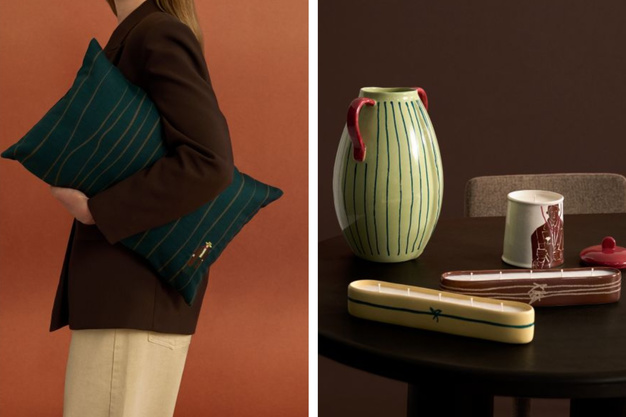
Moving from a flat surface to a three-dimensional object requires adhering to strict requirements. Dimensions, weight, texture, ergonomics, and the need for artisanal replication all impose a rigid framework. Yet these technical constraints, far from stifling the creative process, provide it with a foundation. The artist finds in the functionality of the objects produced by Kave a new realm of expression where her abstract compositions are no longer merely viewed, but handled, touched, and integrated into domestic rituals.
Clay, Fire, and the Imprint of the Hand
The most sculptural aspect of this collection is embodied in the working of clay. The choice of Portugal for the production of the ceramic pieces stems from a desire to ground the project in a specific manufacturing tradition, renowned for its mastery of firing techniques and glazes. Among this collection, a hand-painted vase epitomizes this approach. Human intervention—with its micro-variations in pressure, its minute hesitations, and the unpredictable reaction of pigments to the heat of the kiln—ensures that no two pieces will be exact replicas of one another. Slight imperfections become irrefutable proof of the artisanal process.
This reflection on longevity finds a striking—albeit utterly understated—illustration in the treatment of olfactory light. The collection features a series of six scented candles, poured into glazed ceramic containers. The approach anticipates the end of the product’s primary use: once the wax has been completely burned, the container avoids the trash and begins a new cycle. It becomes a trinket dish, a jar, or an undefined receptacle. Without claiming to reinvent the wheel, this design philosophy illustrates a crucial shift in the way we think about home accessories. The transience of the consumable object is offset by the durability of its container. The understated nature of this second life is precisely what gives it its value.


A Geography of European Textiles
The dialogue extends beyond ceramics to encompass the realm of warp and weft. Textile production has been entrusted to Spanish workshops, thereby weaving a network of geographic and cultural proximity across the Iberian Peninsula. Spain and Portugal do not appear on the label merely as vague administrative endorsements or choices driven by cost-cutting. These regions bring clarity—a history of craftsmanship and tools—that provides a concrete foundation for the thirteen creations.
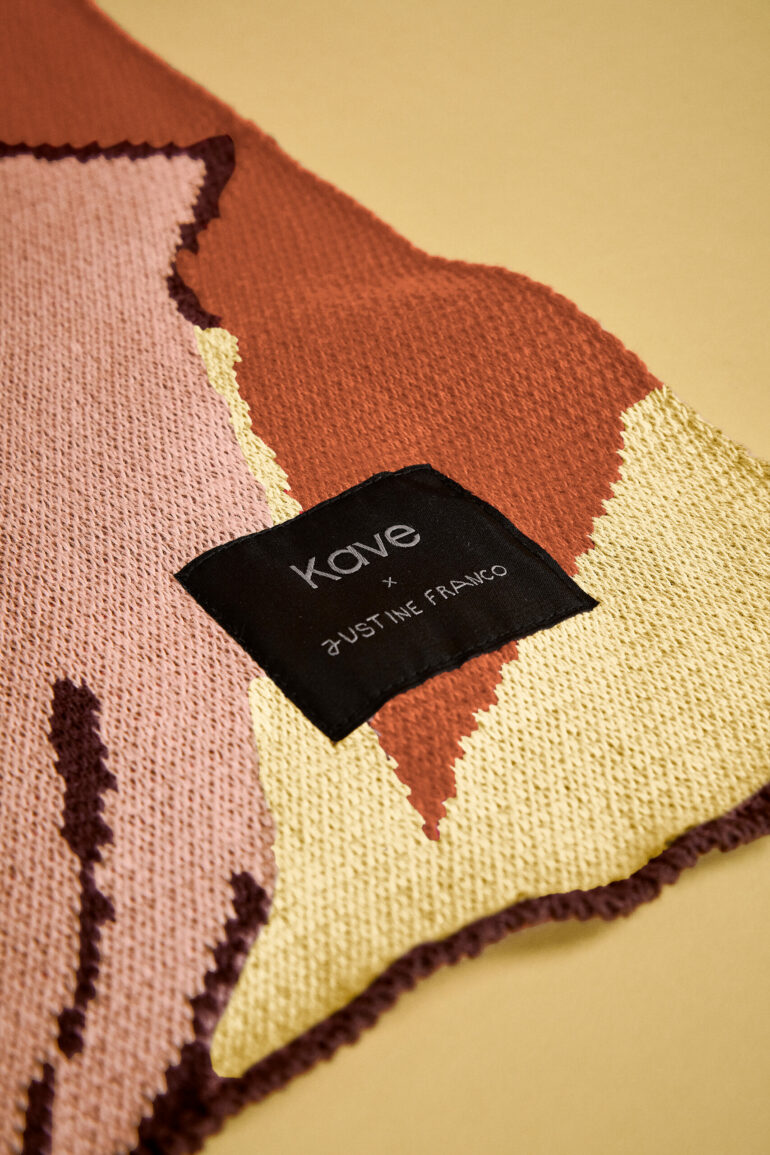
The centerpiece of this textile collection is a multicolored jacquard blanket. The interweaving of the fibers creates a blend of the crispness of cotton and the smoothness of cashmere. The tactile and visual result categorically rejects ostentation, favoring a warm density that invites touch. It is a piece designed to drape over the arm of a sofa, to be crumpled, stretched, and used in everyday life. Cotton cushion covers complement this setting. Their embroidery and patterns act as discreet extensions of Justine Franco’s canvases, balancing the graphic impact with precision that prevents the space from feeling visually overwhelming.
The luxury of restraint and the long term
What ultimately stands out in the presentation of *A Celebration of Everyday Beauty* is its extreme balance in the face of a furniture market often intoxicated by new releases and disposable capsule collections. A collection demonstrates its relevance not through the volume of its pieces, but through the strength of its design choices. The objects gathered here do not attempt to grab attention with flashy silhouettes. Instead, they prefer to whisper, waiting for daily use to reveal their true value.
The distribution strategy adopted by Kave and the artist reinforces this counter-cultural positioning. Aside from digital channels, the collection is physically available only through a hyper-selective network of seven locations, spread across Milan, Barcelona, Madrid, and Paris. This distribution network, centered on European creative capitals, safeguards the collection’s status. Rejecting the flood of store shelves in favor of specific points of contact reflects a discerning approach to sales. Silence, scarcity, and anticipation once again become drivers of desire. In a frenetic industry, choosing limited editions, extended production times, and sparing distribution constitutes, in and of itself, a signature aesthetic of the highest order.