
Make Texture a preferred source on Google to support us
Add Texture to GoogleApproximately 800,000 euros: in Leonardo Del Vecchio’s estate, this amount is enough to shift the balance of power. Not to take control of the family empire, but to break the tie among his heirs and provide a new argument in a dispute over ownership of the shares. The sale of a small stake by Rocco Basilico to Clemente Del Vecchio thus highlights the challenges of the post-founder era. Behind the percentages, one question remains unanswered: What can each heir decide regarding their share of the inheritance when it is part of a whole that the family must still manage?
Arithmetical Equality, Not a Family Agreement
The assets in question are held within Delfin, the family’s Luxembourg-based holding company. It is through this structure that the heirs hold the largest block of EssilorLuxottica shares, without owning an absolute majority of its capital. Delfin also holds stakes in Generali, Monte dei Paschi, UniCredit, and the real estate company Covivio. Family disagreements thus arise at the level where interests in the optical, financial, and real estate sectors converge.
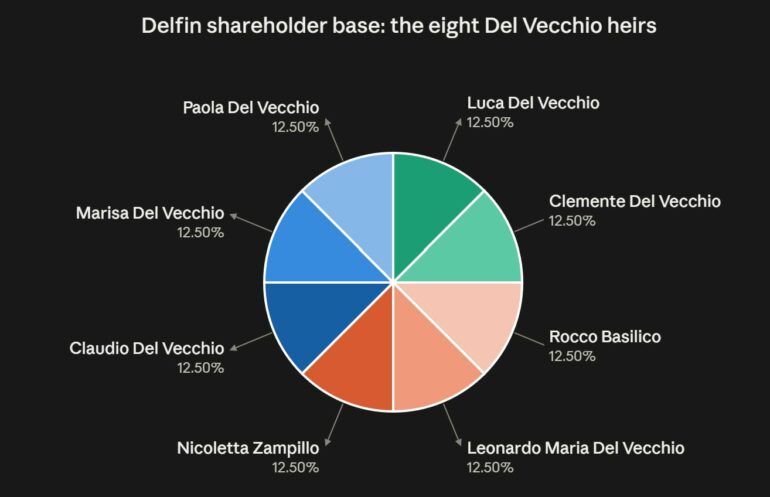
The estate of Luxottica’s founder had established a simple rule: eight beneficiaries, each receiving 12.5% of Delfin. In addition to his widow, Nicoletta Zampillo, and his six children, there was Rocco Basilico, the son of Nicoletta Zampillo and banker Paolo Basilico. This distribution ensured that no single heir would have an advantage over the others based solely on the size of their stake.
But dividing the capital equally does not resolve how it should be used. Disagreements center in particular on dividends, the possibility of transferring shares into personal investment vehicles, and Delfin’s investments. These are all decisions that reflect differing conceptions of the inheritance: the income it generates, the freedom to manage it, and how to grow it. More than four years after Leonardo Del Vecchio’s death in June 2022, the reorganization of the holding company remains incomplete.
Share Ownership: A Battleground
To gauge the significance of the transaction between Basilico and Clemente, one must first examine the dispute surrounding it. Rocco Basilico’s shares were subject to a usufruct in favor of his mother. Nicoletta Zampillo waived this right, but Leonardo Maria Del Vecchio contested the validity of this waiver. He therefore also challenged his half-brother’s ability to freely transfer his shares.
The sale, therefore, is not merely about the identity of the buyer. It concerns the seller’s very right to dispose of his shares. According to the interpretation put forward by Basilico’s associates, Delfin’s registration of the transfer amounts to an acknowledgment that it holds full ownership of the shares. This is an argument in the dispute, not a court ruling that would have definitively settled it. The distinction is important: the holding company’s validation of a transaction and the resolution of a legal dispute are not one and the same.
There is another aspect to the dispute. Basilico himself had filed an appeal against the resolution authorizing Leonardo Maria to acquire the shares held by Luca and Paola Del Vecchio. By combining these two stakes with his own, Leonardo Maria could reach a 37.5% stake in Delfin. This scenario would alter the distribution of equity in an entirely different way. However, it remains a contested possibility, not a concentration that has already been completed.
Clemente Takes the Lead, by a Narrow Margin
The change that was actually recorded is much more modest. Rocco Basilico sold 550 common shares and 22 Class A preferred shares (PESCs) to Clemente. The price, valued at approximately 800,000 euros, was based on Delfin’s net assets as of October 16, 2025, without a discount. The transaction is therefore limited in size, but it is sufficient to move both parties out of the initial 12.5% threshold.
Clemente now slightly exceeds this threshold and becomes Delfin’s largest shareholder by the size of his stake. The founder’s youngest son, an engineering student at the Politecnico di Milano, is—like his brother Luca—the son of Leonardo Del Vecchio and Sabina Grossi. His new position in the company’s capital attracts attention but does not, on its own, grant him decisive decision-making power.
Above all, this move to the top must be distinguished from a takeover. The lead is slim. The initial assumption was for a sale of approximately 0.4%; the block ultimately sold is significantly smaller. Basilico therefore remains a shareholder, with a stake that is virtually unchanged. Nor does any information currently available regarding the transaction suggest a lasting alliance between the seller and the buyer.
A Letter Specifying Payment, but Silent on Voting Rights
The agreement between the two men dates back to July 23. Delfin was not informed of it until October 12, via a letter bearing both of their signatures. In it, they requested that the transfer be recorded in the register of shareholders and that the formalities required under Luxembourg law be completed. The board of directors granted its authorization, and the registration was completed.

This document does not mention the amount paid. It does, however, specify that payment was made in full and that Basilico signed a final receipt. The sale is thus presented as having been completed, rather than as a mere promise still contingent on payment.
Regarding the vote, the letter makes no mention of any commitment. Will Clemente and Basilico choose the same strategic direction for Delfin? The transaction does not answer this question. Their alignment in this deal is not sufficient to establish a common strategy regarding dividends or future investments. This is precisely the limitation of this new snapshot of the ownership structure: it shows who owns what, not how the heirs will make decisions together.
The announced reconciliation has yet to materialize
Leonardo Maria has recently adopted a more conciliatory tone. During a radio interview, he stated that he wanted to put an end to the conflicts between the brothers and had instructed his lawyers to withdraw all legal actions filed against them. He particularly regretted the deterioration of his relationship with Luca and Clemente. Following the disputes over shares and buyout plans, this stated intention marks the beginning of a new phase, though it does not yet constitute a comprehensive agreement.
Moreover, the timeline precludes presenting the sale to Clemente as the result of this reconciliation: it was finalized before these statements were made. Nor does the announced withdrawal of the legal proceedings, on its own, resolve the disagreements regarding the organization of the estate. The heirs must still find common ground on each person’s rights and on the holding company’s decisions.
One option under consideration would shift the focus of the negotiations: Delfin could itself buy out the stakes held by one or more partners. The restructuring would then no longer rely solely on sales among family members, but would involve mobilizing the holding company’s resources. To explore the financing of such a transaction, the holding company has reportedly already initiated preliminary discussions with banks. Following the small sale that put Clemente in the lead, it may be through these financial discussions that the next major shift in scale will be prepared.