
Make Texture a preferred source on Google to support us
Add Texture to GoogleFor the same project, quotes ranged from 30,000 to 450,000 euros. Faced with such a wide range, said Luca Sburlati, president of Confindustria Moda and CEO of the Pattern Group, entrepreneurs often ended up making no decision at all. This anecdote speaks volumes about the relationship between “Made in Italy” and artificial intelligence: promises abound, but how can one invest in a transformation when it’s still difficult to determine its true value? For fashion and design houses, the question is no longer simply about trying out these tools. It is about knowing what they are willing to entrust to them—and for what benefit.
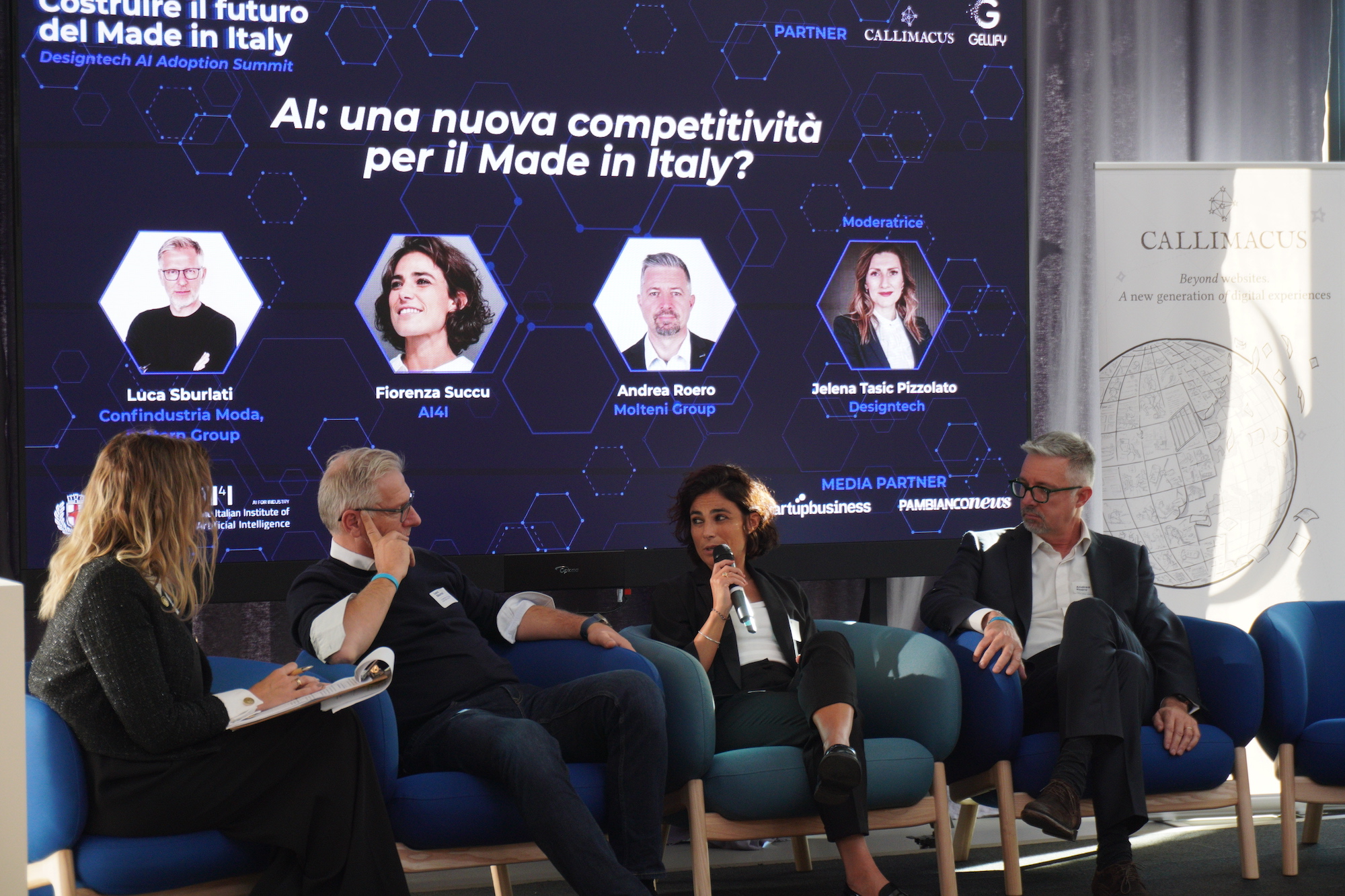
Gathered on Thursday, October 22, at CoFactory in Milan, participants at the first Designtech AI Adoption Summit addressed this uncertainty without reducing it to a mere IT issue. Organized by Designtech in collaboration with Gellify and in partnership with Callimacus, the event brought together executives facing the same dilemma: how to increase efficiency without trivializing what sets their companies apart. A clear distinction emerges between an online store’s interface and the organization of a workshop: AI must adapt to the company, not the other way around.
The Store Changes the Conversation
At Brunello Cucinelli, this approach has already taken visible form. Presented by Camilla Zappalà, Head of Business Development and Partnerships at Callimacus, the Solomeo-based brand’s conversational e-commerce platform—launched in January—breaks away from the usual sequence of pages and categories. The experience is tailored in real time based on the visitor’s intent. Behind the interface, multiple agents draw from a brand-specific knowledge base, with one key constraint: they must provide only information that the brand has approved, in language that aligns with its brand voice.
This system addresses a less-than-flattering reality for traditional digital storefronts: according to data presented by Zappalà, the average time spent on these sites remains under four minutes. It is therefore not enough to simply accumulate content; visitors must also be able to find their way around. Cucinelli was Callimacus’s first investor, and Salesforce Ventures recently joined the company’s shareholder base.
The transformation could also take place on the other side of the screen. Andrea Cinelli, head of AI and digital transformation at TakeAI, cited Gartner data showing that 47% of shoppers had begun, over the previous nine months, to select products using conversational tools. He thus envisions that, in the future, an agent will become the customer’s intermediary. For a home, making its identity understandable to these systems then becomes a business challenge: being accurately described and recognized, without getting lost in a generic response.
Protecting the design, accelerating everything around it
In design, this requirement calls for separating the creative process from the means of presenting it. Andrea Bocchiola, Cassina’s director of product, marketing, and e-commerce, sees the value of AI in the speed with which a project can be visualized, contextualized, and communicated. Its origin, however, remains the dialogue between the designer and the company. The distinction is crucial: producing a representation more quickly is not the same as designing what it represents.
With Trace, unveiled publicly at the summit, Federico Crociani, CEO of R3PLICA, proposes linking a brand’s certified digital catalog to the production of content for its catalogs, social media, and showrooms. A creative direction framework based on the brand’s identity guides the content generation. The product must be recognizable, searchable, and verifiable, while remaining under the company’s control.
Replay is also working toward this consistency. Roberto Conte, head of IT development and deployment, described a proprietary AI project designed to produce brand-aligned content while controlling costs and data usage. At the same time, an in-house lab is developing tools in a matter of weeks that previously took several months to create. An order-assignment solution is currently in the testing phase. This framework also helps limit scattered, unsupervised experiments.
The Less Spectacular Prerequisite of Data
The fact remains that these applications require organized raw data. Yet Luca Sburlati described a fashion and textile industry worth approximately 90 billion euros, 85% of which depends on exports, and a portion of which still lacks databases. According to him, the problem also affects large companies known for their quality. Manufacturing excellence does not guarantee digital maturity.
Alongside major brands and companies with revenue ranging from 50 to 300 million euros, some 30,000 microenterprises collectively generate 30 billion euros. With eight to twelve employees and an average revenue of one million euros, they cannot approach these investments in the same way as large corporations. Uncertainty about pricing quickly becomes paralyzing for them.
The program developed by Confindustria Moda in collaboration with AI4I, the Italian Institute for Artificial Intelligence, therefore calls for four pilot projects in four areas, followed by their replication at comparable companies. Fiorenza Succu, who is responsible for promoting AI4I’s activities, highlighted recurring needs: quality inspection, automatic generation of component bills of materials, and automation of purchase order and supplier invoice processing. The institute has asked service providers to offer regulated rates and offers the opportunity to test models on its computing infrastructure, hosted at Leonardo in Turin.

Adopting a tool does not yet guarantee a profitable investment
The figures presented by Michele Giordani, co-founder and CEO of Gellify, temper this initial enthusiasm. Nine out of ten companies reportedly have at least one user of ChatGPT, Gemini, or Copilot. However, 37% say they see some benefit, and only 6% report a significant impact on their financial results. Usage and profitability remain two distinct realities.

For Carlo Alberto Balzanelli, CFO of Pal Zileri, traditional metrics must be supplemented by an assessment of time to market, competitive advantage, and the cost of inaction. He would prioritize an initial project combining demand stimulation and inventory control: results can be measured in this area, with resources freed up and cash flow generated. At Liu Jo, Sebastiano di Camillo, Director of Innovation and Transformation, advocates for initiatives that improve multiple stages of a process rather than a single, isolated task.
Andrea Roero, Director of Information Systems at the Molteni Group, places technology at the end of the process. The starting point is the organizational structure the family envisions for the next ten years; next comes the development of teams, followed by the digital platform. This sequence prevents a tool from automatically dictating how the company operates.
In the warehouse, results to be tested
Robotics gives these discussions a tangible dimension. Isacco Zappa of ABB Robotics presented a logistics solution for the fashion industry capable of processing up to 1,300 products per hour, with a picking reliability of up to 99.5%. The use of a digital twin could reduce commissioning times by up to 75%. A partnership with Nvidia also focuses on training robots using synthetic data generated through simulation.
Marcello Chiurazzi, CEO of AuraSensae, addressed another limitation of automation: so-called collaborative robots are often separated from people by cages. His company presented a sensor that enables 360-degree human-like perception. Here, the challenge is directly related to the workspace and the conditions under which humans and machines coexist.
Pooling Resources Rather Than Duplicating Efforts
For smaller organizations, moving forward also means sharing certain resources. Stefano Venturi of Assolombarda noted that the first year of the four-year Forgia program was dedicated to creating an ecosystem that enables secure data exchange between companies. His remarks highlight two goals: reducing the cost of unchanged products—at the risk of price competition—or developing more innovative offerings with higher margins that require specialized skills.
The Designtech AI Adoption Hub is intended to build on the discussions held in Milan within a permanent framework that brings together companies, startups, technology partners, and universities. Acceleration and training programs will be eligible for grants covering up to 80% of their funding. For executives faced with unbeatable quotes, this offers a concrete solution: access to a shared testing ground before embarking on their own transformation.