
Make Texture a preferred source on Google to support us
Add Texture to GoogleAt 30 seconds, the hand stops abruptly, reverses direction in a flash, and sets off on a new cycle. This almost nervous movement has become H. Moser & Cie.’s most instantly recognizable signature. Since the debut of the Pioneer Retrograde Seconds in 2024, the Schaffhausen-based watchmaker has elevated this mechanism to a complication in its own right: not merely a decorative effect relegated to the status of a curiosity, but a way of showcasing time. Today, it applies this principle across three collections with distinct personalities: Pioneer, Streamliner, and Endeavour.
The focus, therefore, is not merely on the arrival of three additional models. It is a demonstration of a rather rare consistency: starting from the same 30-second retrograde seconds display, H. Moser & Cie. has created three watches that each tell a different story. The first showcases its mechanism, the second features a fluid, industrial aesthetic, and the third emphasizes a more formal presence. Each features a 40-mm stainless steel case, but the proportions, dials, and intended uses differ significantly.
A second hand that defies the straight line
In traditional watchmaking, the seconds hand is often discreet: a small hand on a sub-dial, a steady central seconds hand, or a peripheral indicator. Here, it becomes the focal point of the dial. Positioned at 6 o’clock, the hand traverses its sector for half a minute before instantly returning to its starting point. The motion is not continuous, and that is precisely what catches the eye.
This retrograde mechanism injects a sense of tension into watches that are otherwise very different. Time does not merely march forward here: it surges forward, reaches a limit, and then begins anew. H. Moser & Cie. had already established this design language with the 2024 Pioneer Retrograde Seconds, equipped with the HMC 250 caliber. The new interpretations mark a significant technical milestone with slimmer movements—the HMC 251 and HMC 252—which are announced to be 5.5 mm thick, compared to 6.5 mm for the previous movement.
This 1-mm reduction is by no means trivial. It makes it possible to use 40-mm cases, whereas the 2024 Pioneer measured 42.8 mm in diameter and 14.2 mm in thickness. H. Moser & Cie. is thus bringing its spectacular complication into a more understated, versatile realm, without compromising its character.
The Pioneer: An Open-Air Laboratory
The Pioneer Skeleton Retrograde Seconds is the model that most openly embraces the mechanical aspect of the project. Its dial is entirely openworked: the eye travels through the dark gray and anthracite bridges, while the rose gold elements add touches of warmth. The leaf-shaped central hands, the faceted applied hour markers, and the retrograde indicator echo this golden hue. Super-LumiNova completes a design crafted to remain legible despite the profusion of visible details.

The new HMC 251 caliber—an automatic, skeletonized movement—is directly visible beneath the sapphire crystal. The retrograde seconds complication thus takes on an almost demonstrative quality: its rapid rhythm is no longer perceived solely on the surface of the dial; it interacts with the architecture of the movement that drives it. For a brand typically known for the understated elegance of its smoked dials, this transparency marks a more bold visual shift.
The steel case measures 40 mm in diameter and 12 mm in thickness, including the crystal. It features a screw-down crown and is water-resistant to 120 meters, or 12 bar. H. Moser & Cie. pairs it with a steel bracelet as well as a khaki rubber strap—a dual offering that keeps the Pioneer firmly in the realm of sports watchmaking, even when its movement takes center stage.
Beating at 21,600 vibrations per hour (3 Hz), the HMC 251 offers a 72-hour power reserve. Its only displays are retrograde hours, minutes, and seconds. This functional simplicity heightens the contrast with the movement’s construction. Reference 3251-1200, this Pioneer Skeleton is priced at 37,726 Swiss francs, or approximately 44,200 euros, including taxes.
The Streamliner Sets the Movement in Motion
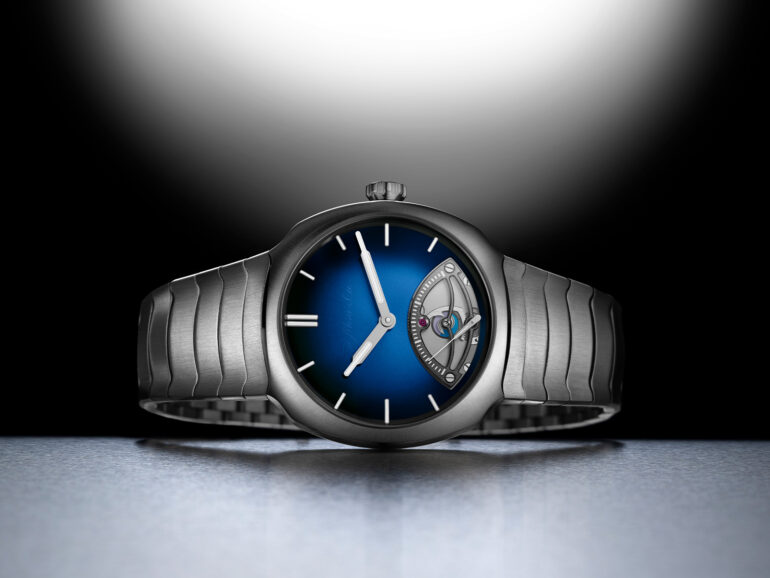
The Streamliner Retrograde Seconds takes a different approach to visual appeal. Here, the eye is drawn not to the skeletonized movement, but to the cushion-shaped case and the integrated steel bracelet. The collection does not draw its design language from the integrated bracelet styles of the 1970s and 1980s, nor from the legacy of Gerald Genta. Instead, it takes its inspiration from the Streamliner trains of the 1930s and their Art Deco aesthetic.
This connection lends a special resonance to the retrograde hand. Its back-and-forth motion every 30 seconds seems to extend the sense of movement already embedded in the watch’s design. Where the Pioneer reveals its inner workings, the Streamliner emphasizes a continuity of lines and surfaces, with its metal bracelet serving as a direct extension of the case.
The Midnight smoky blue dial features a sunburst finish. It retains the chromatic depth so cherished by H. Moser & Cie., but the movement of the seconds hand disrupts this seemingly calm surface. Beneath the dial, the HMC 252 automatic caliber operates, incorporating the 30-second retrograde seconds module developed by Agenhor SA. Like the HMC 251, it is 5.5 mm thick, beats at 3 Hz, and offers a 72-hour power reserve.

The watch, reference 6252-1200, measures 40 mm in diameter and 12.1 mm thick. It features a screw-down crown and is water-resistant to 120 meters. It comes exclusively with its integrated steel bracelet—a logical choice for a timepiece whose identity relies heavily on this seamless construction. Its price is set at 32,300 Swiss francs, approximately 37,800 euros, including taxes.
The Endeavour: A More Dressy, Understated Style
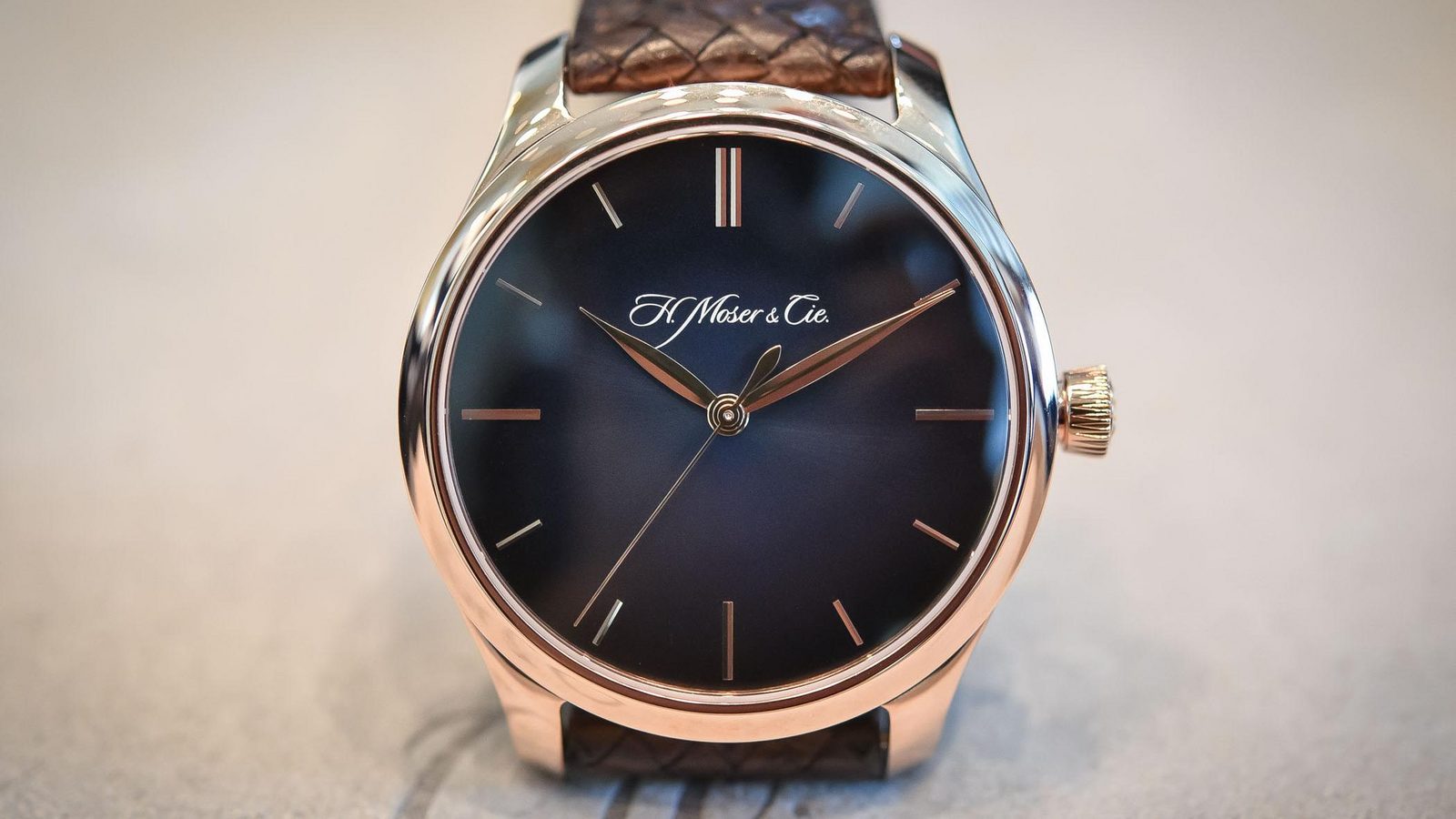
At the other end of the trio, the Endeavour Retrograde Seconds is more compact and has a softer aesthetic. Its 40-mm steel case is only 11.2 mm thick. Its smoother lines and more delicate silhouette give it a dressier look than the Pioneer. This is also reflected in its water resistance of 30 meters, or 3 bars—a far cry from the more rugged 120-meter water resistance of the other two models.
The smoked Blackor dial features a gradient ranging from gray to black, enhanced by a sunburst finish. The retrograde seconds hand at 6 o’clock takes center stage without being highlighted by the skeletonized case or the integrated bracelet. It’s a more understated take on the same complication: the mechanism remains lively, but its presentation is more subdued.
It, too, is powered by the HMC 252 caliber with an Agenhor SA module, featuring automatic winding, a frequency of 21,600 vibrations per hour, and a 72-hour power reserve. The functions are deliberately limited to hours, minutes, and retrograde seconds. A midnight blue nubuck alligator leather strap, fastened with a steel pin buckle, underscores the watch’s positioning. The reference 1252-1200 is priced at 30,160 Swiss francs, or approximately 35,300 euros, including taxes.
The Price of a Complication That Has Become a Collection
This expansion of the lineup does more than simply offer new designs. It establishes the retrograde seconds as a unifying design language across the H. Moser & Cie. collection. The Pioneer treats this feature as visible technical architecture; the Streamliner incorporates it into an aesthetic of speed and continuity; the Endeavour integrates it into a more subdued smoked dial. The three watches share the same concept, but each organizes the relationship between movement, proportions, and materials differently.
The point of comparison, however, remains striking. The 2024 Pioneer Retrograde Seconds was priced at 19,900 Swiss francs, or approximately 18,000 British pounds. The three new models are all significantly more expensive: 30,160 Swiss francs for the Endeavour, 32,300 for the Streamliner, and 37,726 for the Pioneer Skeleton. This price increase reflects the refined movements, the skeletonization work on the Pioneer, and the integration of the complication into collections with more distinct identities.
To discover the pieces in the Endeavour collection and the world of the manufacture, visit the H. Moser & Cie. website. Measuring between 11.2 mm and 12.1 mm in thickness, these three cases demonstrate that even such a complex complication can now be accommodated within much more compact dimensions.