
Make Texture a preferred source on Google to support us
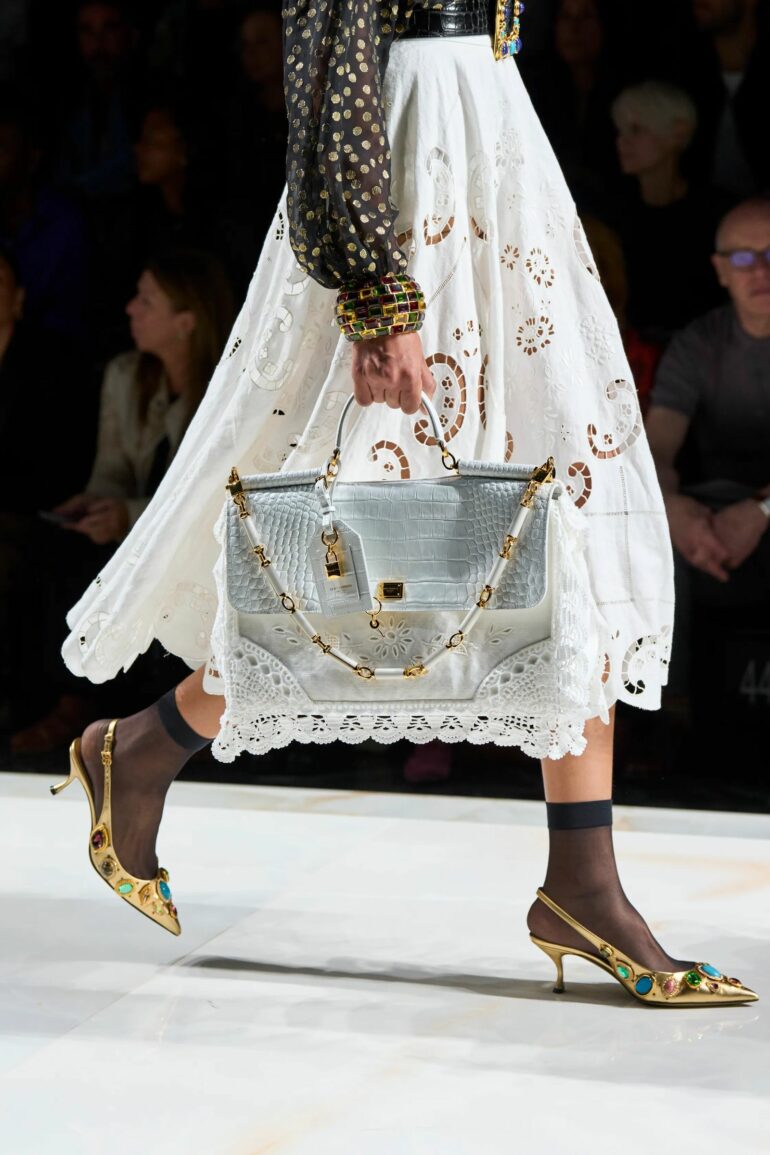
Add Texture to GoogleMilan has just sealed the fate of subtlety. On the Spring/Summer 2027 runways, restrained color palettes and understated silhouettes have given way to a bold, almost flashy expressiveness. The eye is no longer invited to glide over fluid, monochromatic silhouettes; it is immediately drawn to a shade of magenta, the sparkle of a sculptural brooch, or the dizzying profile of a shoe. The language of luxury is undergoing a decisive shift here. Clothing takes a back seat, becoming a backdrop—a streamlined foundation—while ceding the leading role to accessories designed to hog the spotlight.
This shift in power upends the traditional logic of the wardrobe. An outfit is no longer built around a formal coat or a suit, but is constructed around a spectacular detail. At the end of this week in Lombardy, international buyers took stock of a shift in attitude among a clientele that now rejects anonymity. Joseph Tang, a leading buyer at Holt Renfrew, views these new pieces as stylistic exclamation points. This perspective is shared by the teams at Net-a-Porter and Harrods, who observe shoppers actively seeking uniqueness—a far cry from the mere reassurance of a recognizable logo.
Color as a New Status Symbol
To make a lasting impression, designers have largely abandoned the monogram in favor of a radical approach to color. Sharp cobalt, acid chartreuse, spearmint green, magenta, and deep purple infuse the collections with unprecedented authority. Linda Fargo, a trend expert at Bergdorf Goodman, predicts that these unexpected hues will be the main driver of sales in the coming months. Color is no longer used in timid, subtle touches; it is embraced in bold blocks, saturating the fabric to become the very object of desire.
This color strategy addresses a market impasse. The proliferation of logos has ultimately blurred visual identities. By introducing icy shades and bags in saturated hues—as noted by critics at *Vogue France* during Celine’s show—the fashion houses are proposing a new code of recognition. Owning the right shade of green or the exact purple of the season signals a much more refined sense of belonging than a brass buckle stamped with an initial. The colorful accessory draws its power from this paradox: it manages to recreate a sense of exclusivity within an industry saturated with visual cues.
Shoes are overtaking leather goods
While the handbag has long reigned at the top of the luxury purchasing pyramid, the Spring/Summer 2027 season is reshuffling the deck in favor of footwear. WWD’s analyses highlight a strategic shift: shoes, in addition to their strong appeal, offer a more affordable entry point than a bulky leather goods item. On the Milan runways, the foot is the focal point of all technical and narrative boldness.
Historic fashion houses are competing in virtuosity in this arena. Chanel reinvents its slingbacks with an abundance of delicate embroidery, while Saint Laurent elongates the leg line with sandals featuring serpentine straps. Elsewhere, theatricality takes precedence over understated elegance. Dries Van Noten deliberately weighs down his mules with integrated jewelry. Marni and Thom Browne explore a decidedly more playful style, proving that contemporary luxury tolerates—or even demands—a dose of irony in the design of a heel or the construction of an upper.
The Wide Gap in Sizes
Faced with this competition from footwear, the handbag survives by polarizing itself to the extreme. There is no longer any room for the medium-sized, understated style. The designs split into two diametrically opposed visions of everyday life. On one hand, the fantasy of absolute utilitarianism translates into soft tote bags, pleated designs, and the return to favor of carrying a bag under the arm. Vogue France highlights this trend toward XXL styles, particularly at Celine, which address a practical need to carry one’s entire life with you.
At the other end of the spectrum, the bag abandons all practical pretensions to become a pure work of art. Tiny, rigid, and treated like display pieces, these sculptural clutches and evening bags require their wearers to carry nothing essential. This constant tension between raw functionality and pure fantasy reveals a consumer who refuses to choose. She demands hyper-practicality for the day and a portable work of art for the evening.
Ornament as an Architectural Principle
Jewelry follows this same trajectory of controlled excess. Statement necklaces, massive earrings, long necklaces, and brooches move beyond mere embellishment to dictate the architecture of the silhouette. At Miu Miu, Prada, and Chanel, these metallic and mineral pieces act as structural supports. They cinch a fabric, secure a drape, and frame a face.

Vogue Arabia has particularly highlighted the presence of beaded jewelry and complex shapes. The ornamentation of 2027 takes on an almost couture-like function. A well-placed metal detail sculpts the look far more effectively than a sophisticated cut. The garment recedes into the background, becoming merely a backdrop for precious and ostentatious hardware.
The Necessity of Handcrafting
However, this visual profusion would run the risk of descending into mere glitz if the fashion houses did not take care to anchor its value in the material itself. To justify prices that are increasingly scrutinized by an extremely selective clientele, the piece must tell the story of its craftsmanship. Industry professionals interviewed by WWD note an immediate enthusiasm for anything that reveals the artisan’s touch. Meticulous weaving, fringe work, the treatment of raffia straw, or bead inlay reassure the buyer of the legitimacy of their investment.
Bottega Veneta and Loewe continue to dominate this arena, where technical virtuosity is presented as a natural given, closely followed by the impeccable craftsmanship of the Dior and Chanel ateliers. But this appetite for precise craftsmanship and a strong identity also benefits a new generation of designers. The market is making more and more room for niche labels with bold, distinctive styles. Names like Ananyan, Kiana Ghavidel, Neous, Nomasei, Christen, and Jude are making their mark in curated selections, proving that a clear identity withstands market saturation far better than a mere passing trend.
The Price of Style
This reinvention of the silhouette is accompanied by cold economic calculation. Replacing one’s entire wardrobe with every seasonal change is now considered an anachronism. The contemporary customer prefers to invest in a striking belt, a pair of boldly framed glasses, or a versatile bag to inject new life into an existing wardrobe. The accessory thus bears the full brunt of novelty. It is the exact point of friction where the desire for fashion clashes with function and budgetary reality.
Poppy Lomax, writing for Harrods, notes that this accessory-driven trend works precisely because clothing has never been more versatile. The Milanese collections don’t impose a full-body armor look. Instead, they suggest fluid, lightweight, comfortable basics onto which these bold, colorful, tactile pieces are layered.
Refinement hasn’t disappeared from the radar; it has simply evolved. It’s moving away from monastic simplicity to embrace a more ironic and infinitely more textured aesthetic. Spring-Summer 2027 will be remembered as the season when the customer stopped trying to prove their taste through asceticism. The time is no longer for the silent contemplation of a clean-cut silhouette, but for the immediate impact of an object that, on its own, can tell the entire story of an era.