
Make Texture a preferred source on Google to support us
Add Texture to GoogleOn Saturday, September 26, 2026, the hushed silence of the luxury boutiques in the Quadrilatero della moda was shattered by an unusual commotion. In the midst of Milan Fashion Week, as buyers and journalists flocked to the Spring/Summer 2027 ready-to-wear shows, a massive protest transformed the streets of the Lombard capital into a political stage. At the call of the Coalition to Abolish the Fur Trade (CAFT), hundreds of activists—at least a thousand, according to the organizers—marched to demand a permanent end to fur on Italian runways.
The demonstration, the culmination of a week of protests that began on September 22, went beyond traditional slogans. Amid banners reading “Milan Fashion Week, Ban Fur Now” and “Their Lives Are Worth More Than Your Outfit,” protesters played audio recordings of the cries of suffering farm animals. A sit-in blocked part of the street, while tensions flared outside certain stores. While a police cordon protected the Fendi store, the area around the Philipp Plein store was the scene of scuffles between staff and activists. This day marks a critical juncture in a standoff that now pits a segment of public opinion against the leadership of the Italian fashion industry.
A Non-Binding Recommendation
At the heart of the conflict lies the regulatory ambiguity of the Camera Nazionale della Moda Italiana (CNMI). In May 2026, the institution issued a recommendation urging fashion houses to stop showcasing animal fur starting with the September 2026 show season. However, this recommendation is not binding. Unlike London Fashion Week and New York Fashion Week, which have implemented a formal, enforceable ban, Milan—alongside Paris—maintains a principled stance without coercive measures.
This situation places Italy in a unique position. While the country officially enacted a permanent ban on fur farms within its borders in mid-2022, the law still permits the import, sale, and display of fur products. CAFT activists denounce what they consider to be legislative hypocrisy, demanding that Milan Fashion Week align with the standards of its Anglo-Saxon counterparts.
Fendi and the Weight of Its Legacy
In this changing landscape, one fashion house has become the focal point of all criticism: Fendi. Founded in 1925 as a fur and leather goods workshop, the Rome-based label—owned by the LVMH Group—continues to champion its historic craftsmanship. During its Spring/Summer 2027 runway show, presented on September 23, 2026, the brand once again featured pieces made of real fur, including raw-hide jackets, Afghan coats, and astrakhan.
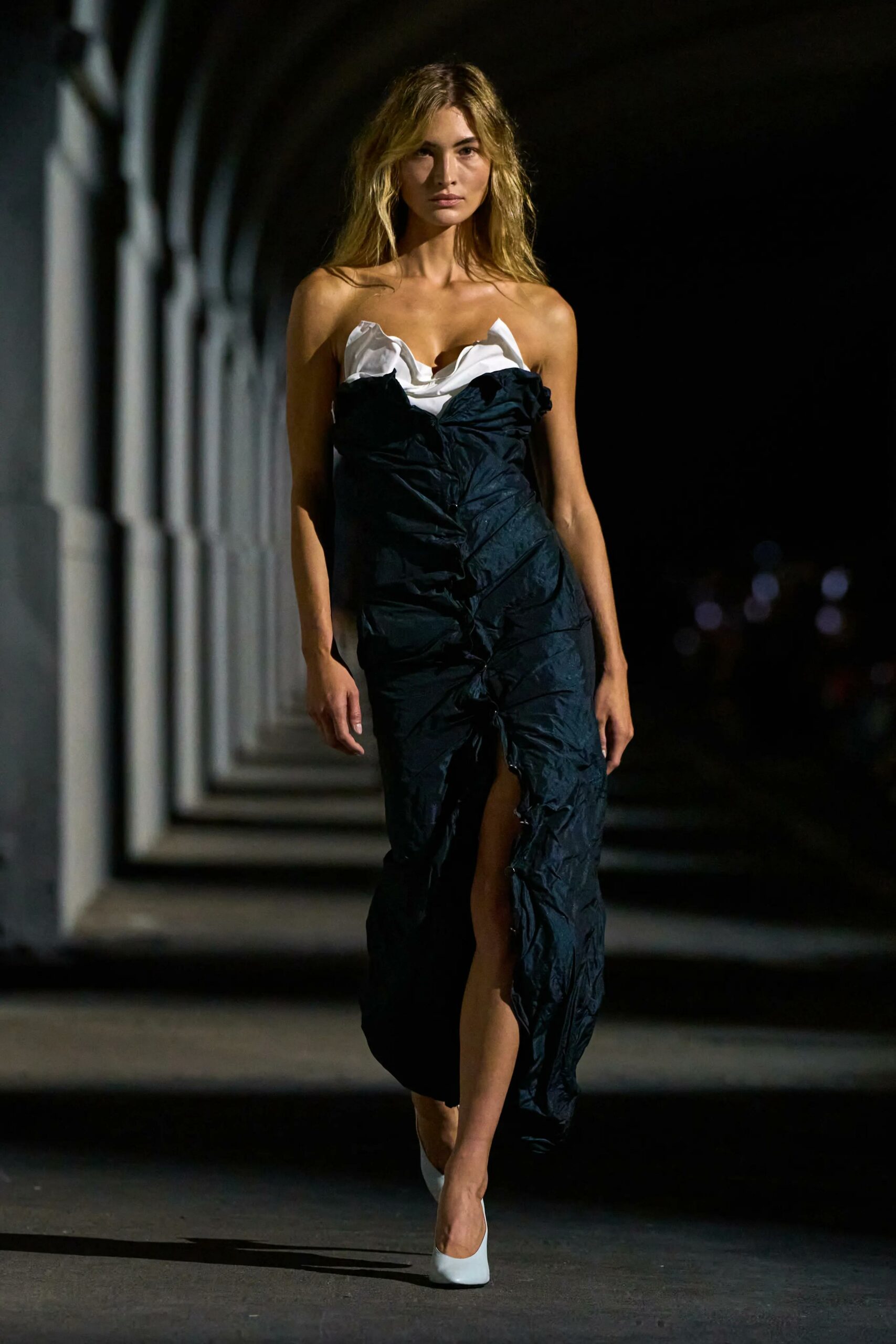
For the event’s organizers, Fendi represents the main political obstacle preventing a transition to a completely “fur-free” Milan. The fashion house’s influence is structural: its CEO, Pierre-Emmanuel Angeloglou, sits on the CNMI’s board of directors. The CAFT collective specifically points to the pressure exerted by LVMH within the Camera’s governance structure as the factor blocking the adoption of a ban. While activists firmly maintain this accusation of systematic obstruction, the CNMI has not yet specified whether internal debates or votes have formally pitted member brands against one another on this issue.

Fendi’s position stands out all the more given that the majority of major Italian fashion houses have already taken the plunge. Giorgio Armani phased out fur as early as 2016, followed by Gucci and Prada in 2020, and then by Dolce & Gabbana in 2022. By continuing down this path, Fendi—along with Max Mara and Philipp Plein—now find themselves isolated in the face of a pressure campaign that is no longer limited to the streets of Milan.
The Exodus of Sponsors
The campaign led by CAFT took on a direct economic dimension in 2026. Unable to secure an immediate commitment from the CNMI, the collective shifted its focus to Fashion Week’s financial partners. This strategy of targeting sponsors led to a series of notable defections within a few months.
By the end of January 2026, logistics giant DHL announced it was ending its partnership. Wella followed suit shortly thereafter. In April, Visa confirmed the termination of its contract following a targeted harassment campaign outside its headquarters and the homes of its executives. More recently, in June 2026, Acqua Fiuggi and LMDV Capital also ended their sponsorship. These successive withdrawals are weakening the event’s funding structure and forcing organizers to reassess the cost of their neutrality on the issue.
The activists’ new target is now the Fondazione Altagamma, which brings together companies representing Italian cultural and creative excellence. By increasing pressure on the foundation’s board members, the CAFT hopes to secure direct intervention from Carlo Capasa, president of the CNMI, to transform the mere recommendation into a total ban. As Milan Fashion Week comes to a close, the industry finds itself facing a dilemma: preserve the artisanal traditions of its historic houses or yield to the demand for ethical transformation, which has become non-negotiable for its financial partners.