
Make Texture a preferred source on Google to support us
Add Texture to GoogleAt 6 o’clock, where one might expect to find a small seconds hand, a pushpiece activates a chronograph. This detail is found on an Omega watch from 1913, revived more than a century after its original production in a limited edition of 18 pieces. There is nothing nostalgic about this move in the decorative sense of the term: inside the 47.5-mm white gold case, it is indeed vintage movements that are back in action. This is what collectors refer to as “New Old Stock,” or NOS: vintage calibers, never used, discovered in a manufacturer’s archives or among old industrial stockpiles, then restored to power brand-new watches.
This practice challenges the usual logic of reissues. A contemporary watch may incorporate a historic dial, bezel, or case while retaining a modern movement. A watch with an NOS movement operates differently: it builds the present around a component that has stood the test of time. Its appeal, therefore, lies not only in its appearance. It resides in the slower frequency of a balance wheel, in the distinctive resistance of a cam-operated chronograph pusher, and in a bridge architecture designed for other purposes and other tools.
Time rediscovered is not mere decoration
Contemporary mechanization produces components of extreme precision. Frequencies of 28,800 or 36,000 vibrations per hour have become commonplace; materials derived from recent technologies enhance the reliability of movements; and the industry knows how to precisely reproduce the forms of the past. But an NOS watch retains an element of unpredictability and materiality that current production no longer necessarily seeks to simulate.
Many of these calibers beat at 18,000 vibrations per hour. The second hand moves with a less smooth, more legible pulse. Manual winding and the activation of a vintage chronograph also have their own distinct characteristics: the travel of a pusher, a certain resistance, a mechanical click. These sensations are not merely an abstract concept. They stem from components manufactured in an era when adjustment relied more on the watchmaker’s hand and eye.
This paradox is what makes the whole endeavor so appealing. The movement is historic, but its case can offer modern protection: a water-resistant case, a sapphire crystal, and components that are restored or replaced when their condition requires it. Because bringing a forgotten caliber back to life isn’t simply a matter of pulling it out of a drawer. It must be disassembled, cleaned, its components inspected, and sometimes replacement parts—which are no longer available—must be fabricated, before its operation can be adjusted. The original stock imposes its own limitations: once the blanks are exhausted, no workshop can exactly replicate the series.
Omega, or Memory Preserved in the Archives
Major watchmakers sometimes enjoy a rare privilege: they do not need to source their movements from former suppliers or liquidated stock. Omega demonstrated this with the First Omega Wrist-Chronograph Limited Edition. For this 18-piece series, the brand rediscovered 18''' CHRO pocket watch movements dating from 1913. This caliber corresponds to that of its first wrist chronographs.
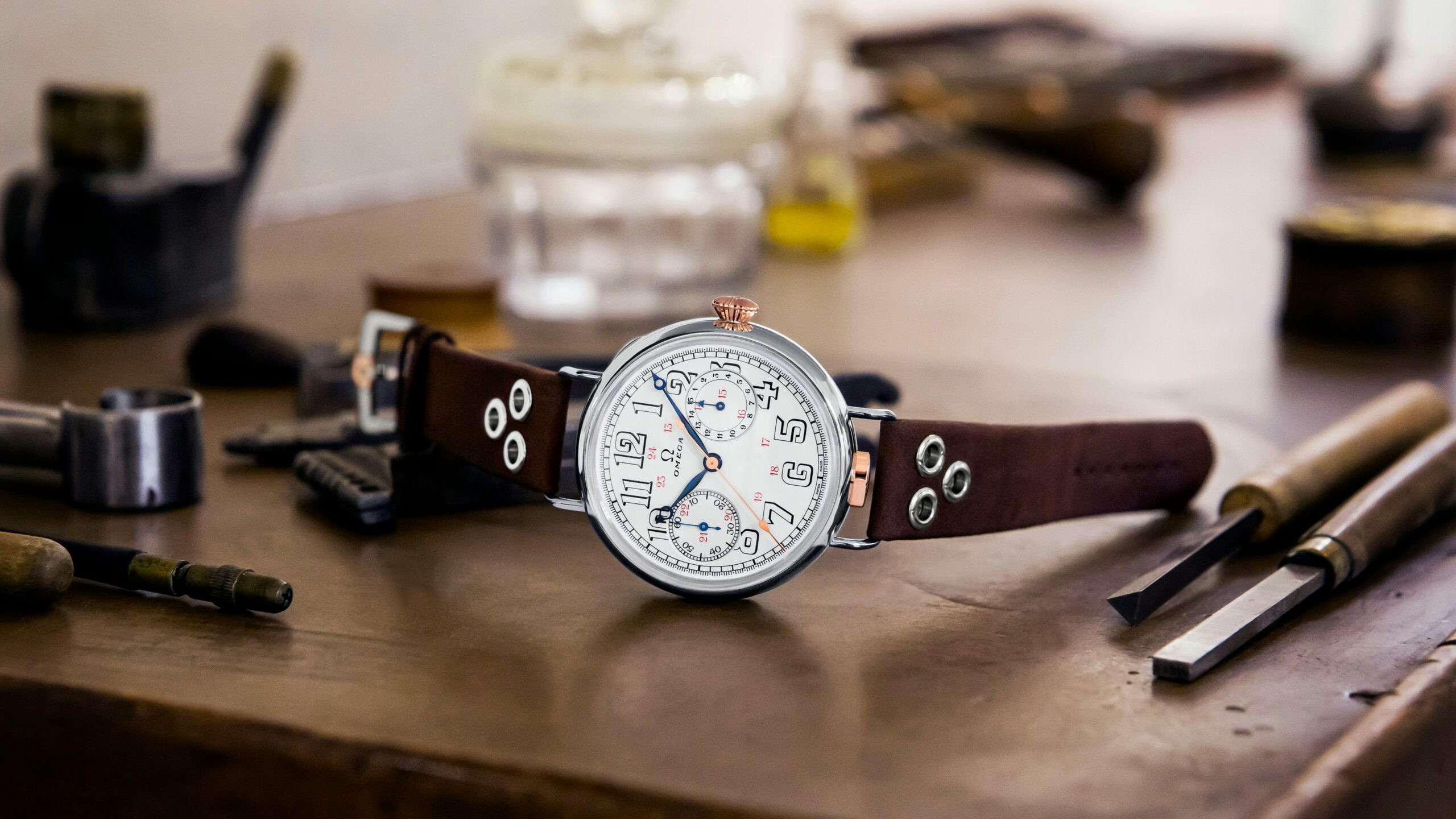
The restored movement, renamed Caliber 3018, underwent restoration work at the Atelier Tourbillon: the jewels were leveled, the finishes were reworked, and the original components were restored. Its distinctive feature is the placement of its single pusher at the 6 o’clock position, which activates the chronograph, whereas many models placed this control within the crown.
Omega chose to adopt the proportions of an early 20th-century military conversion watch. The 47.5-mm-wide white gold case features welded wire lugs and a hinged caseback. On the Grand Feu enamel dial, the Arabic numerals further reinforce this period-accurate design. This approach echoes the recent reappearance of the Caliber 321 in certain high-end Speedmaster models, but the 3018 project goes further: it does not simply reissue a movement design; it brings back into circulation a series of mechanisms that are truly a century old.
Calibers that define a brand’s identity
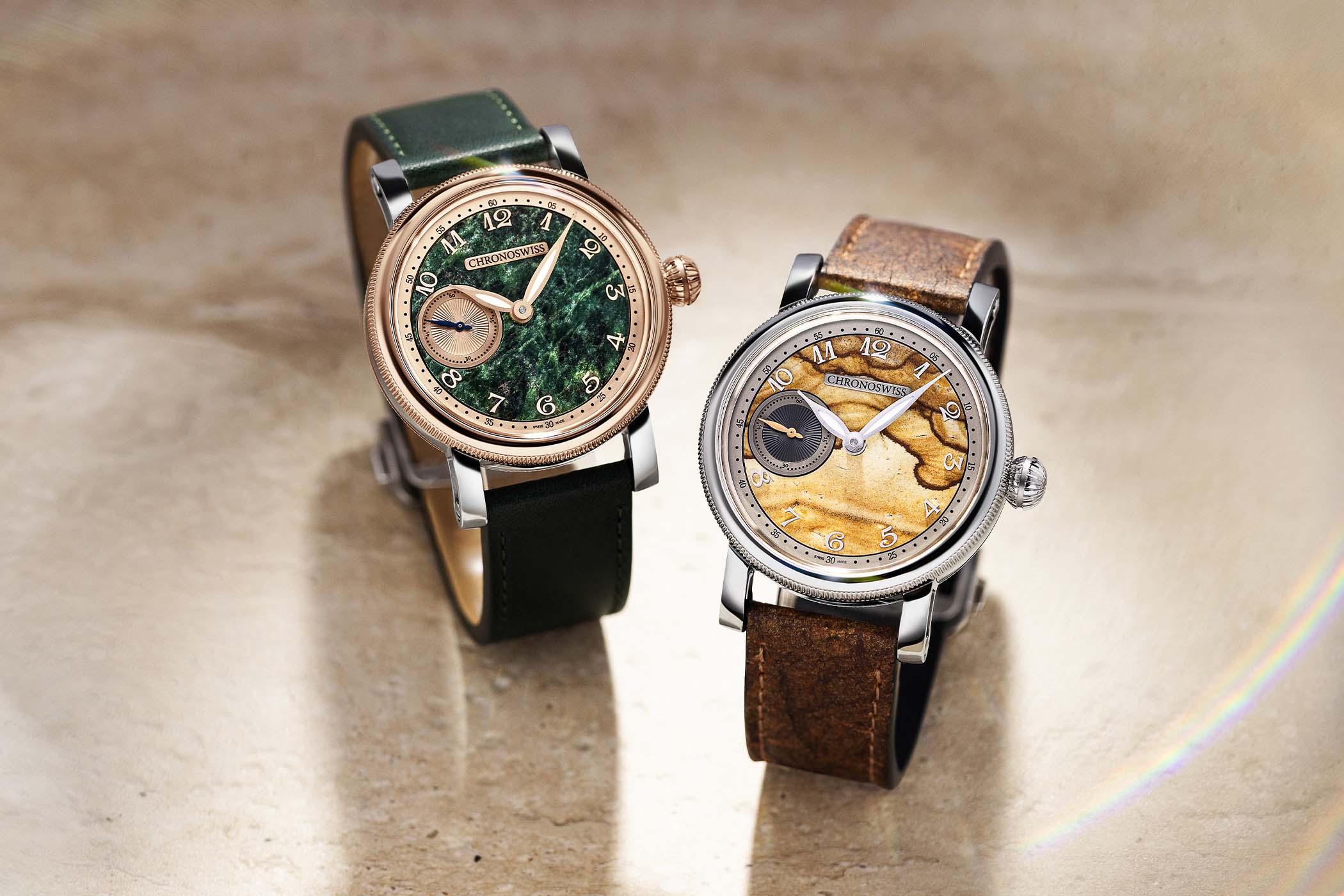
At Chronoswiss, the use of NOS components was not a commemorative interlude, but a founding principle. In the late 1980s, following Enicar’s closure in 1987, Gerd-Rüdiger Lang acquired all the mechanical movements still available from that manufacturer. This decision provided the fledgling brand with a stock of calibers and, above all, an aesthetic language.
The Enicar 165 caliber was radically modified. Lang reconfigured its gear train to separate the hour, minute, and second displays along a vertical line. Renamed the C.122, this movement—beating at 21,600 vibrations per hour—powered the first mass-produced Chronoswiss Régulateur watches. The display broke with convention: the large central hand indicated the minutes, while the hour was displayed in a sub-dial at the 12 o’clock position.
The case design complements this movement, conceived as a workshop instrument. The first Régulateur models featured a 38-mm diameter, a fluted bezel resembling a coin’s edge, an onion-shaped crown, and straight lugs secured by screw-down bars. The NOS movement is therefore not hidden behind a historical reference: it is the very foundation of the silhouette that Chronoswiss still retains today.
The Panerai Radiomir PAM00021 fulfills another ambition: to establish, in 1997, a direct link between the brand’s relaunch under the Vendôme Group—which later became Richemont—and its military instruments from the 1930s and 1940s. Limited to 60 pieces, it is equipped with Rolex Caliber 618 manual-winding movements, found brand-new and unallocated. These 16-ligne movements, with 17 jewels, beat at 18,000 vibrations per hour and feature a Breguet balance spring as well as a characteristic bridge construction.
This choice holds deep significance for Panerai: at the time, Rolex supplied the Florentine watchmaker with water-resistant cases and robust movements intended for divers in the Italian Royal Navy. The PAM00021 encapsulates this history in a 47-mm Radiomir case made of polished platinum, featuring an onion-shaped crown and wire-style lugs. Its black sandwich dial, whose luminous material is visible through the openings in the upper plate, retains the brand’s visual language. Here, the platinum adds weight to the wrist; the caliber, meanwhile, lends historical depth.

The sports chronograph confronts its own archives
The NOS movement is particularly compelling when it avoids the pitfall of a flawless recreation. Doxa understood this in 2019, on the occasion of its 130th anniversary, with the SUB 200 T.Graph. The watch is a reimagining of the model launched in 1969, which combined a two-counter chronograph with the brand’s patented decompression bezel. Rather than fitting it with a contemporary automatic movement, Doxa used a preserved batch of hand-wound Valjoux 7734 movements.
This cam-driven caliber hails from the golden age of sports chronographs. Designed to withstand shocks, it is also recognizable by the crisp response of its controls. The movements, now about fifty years old, were completely disassembled and rebuilt before being housed in the case. They are set in a 43-mm cushion-shaped case, available in stainless steel or 18-karat rose gold.
The orange “Professional” dial—Doxa’s signature—remains the model’s visual focal point. The black minute counter is positioned at 3 o’clock, and the small seconds sub-dial at 9 o’clock. The watch thus combines a new case with a movement dating back to 1969. It does not claim to be a vintage piece preserved under glass; rather, it offers the chance to wear a mechanical movement from that era without having to put up with all the fragility of an antique watch.
The Alpina Case: Patience as the Raw Material
Alpina’s Heritage Carrée Mechanical 140 Years exemplifies a more intimate take on this kind of timepiece. In 2023, to mark the brand’s 140th anniversary, the series is limited to 28 watches: fourteen with black dials and fourteen with silver dials. Their Caliber 490 was not recreated for the occasion. It was manufactured by Alpina in 1938.
This manual-winding movement, protected against dust and featuring a construction that was patented at the time, also beats at 18,000 vibrations per hour. Finding examples in sufficiently good condition and then restoring them to meet today’s standards of use has limited the very small number available. This rarity is not a marketing decision added after the fact: it stems from the number of movements that could be salvaged.
The rectangular polished silver case measures 29.5 mm by 35.7 mm. Its stepped sides evoke late Art Deco architecture, while the Arabic numerals and the small seconds sub-dial at 6 o’clock adhere to the design codes of a dress watch from the 1930s. After decades of an obsession with large diameters, these proportions serve as a reminder that a vintage watch did not need to dominate the entire wrist to make a statement.
The market for NOS movements relies on a resource that grows scarcer with every restoration. Inventories are dwindling, intact parts are becoming hard to find, and each project depends on a finite number of calibers. That is what makes these watches unique: they possess more than just a reference number or a design inspired by the past. Their ticking literally comes from another era.