Make Texture a preferred source on Google to support us
Add Texture to GoogleGeneva, early April. Beneath the vast halls of Palexpo, the thick carpet muffles the sound of footsteps, but the buzz of conversation remains constant, almost electric. The great annual ritual unfolds once again: the Swiss watchmaking ecosystem brings together retailers, collectors, and industry observers to unveil the timepieces that will feature in catalogs for the coming months. The paradox strikes with the same force as ever. How can an industry whose fundamental promise rests on tradition, longevity, and a relative aesthetic consistency yield, season after season, to the demand for novelty? The answer often lies in the minutest details. A novel brushing pattern on a case side, the return of a long-forgotten alloy, a subtly redesigned bridge architecture. This year, the tense economic climate could have dictated a cautious retreat—an endless succession of gray dials and tried-and-true movements. The opposite has happened. Manufacturers have opted for radical polarization, oscillating between utterly unapologetic material opulence and a mechanical arms race that pushes the physical limits of micro-engineering.
The audacity of materials
Austere minimalism will have to wait. One of the most striking trends of this season lies in the return to favor of yellow gold, no longer used in small, discreet touches but in massive, sculptural blocks. Piaget offers the most unapologetic interpretation of this trend by reviving its Polo 79. Gone are the sport-chic steel variations of the past decade. The Geneva-based house makes a bold return to its original 1979 design—the one that captured attention under the strobe lights of Studio 54 and graced the wrists of Andy Warhol and Björn Borg. The 38-millimeter case and bracelet blend into one seamless visual whole, ribbed with polished fluting that catches the light with unapologetic boldness. Weighing in at its full 18-karat solid gold weight, the timepiece houses the ultra-thin 1200P1 caliber. On the wrist, the feel is heavy, warm, and ever-present. It is a material statement of intent that turns its back on discretion.
In a style that is diametrically opposed in terms of use, yet just as symbolically charged, Rolex creates a conceptual short circuit with its new iteration of the Deepsea. Until now, this model—designed for the depths and guaranteed water-resistant to 3,900 meters—embodied the ultimate tool. A rugged, functional object, forged from Oystersteel or titanium. This time, the brand with the crown presents it entirely clad in yellow gold, contrasted by a deep blue dial and a matching Cerachrom bezel. The stark contrast between the watch’s ultra-professional purpose—it’s still equipped with its thick helium valve—and the opulence of its design (the piece easily tips the scales at over 320 grams) creates a truly fascinating object. No one is going to dive four kilometers deep with such a chunk of gold on their wrist. That’s not the point. The aim is to demonstrate audacious industrial mastery, ensuring resistance to extreme pressure thanks to an RLX titanium case back, while propelling the dive watch into the realm of brutalist luxury.
The Elegance of Forgotten Proportions
Amid the flurry of solid gold, the pursuit of pure geometry continues to reign supreme among specialists in classic elegance. The traditional round dial is no longer the ultimate benchmark. Cartier draws from its vast archives to enrich its Privé collection, the design laboratory reserved for the brand’s most discerning collectors. La Tortue, a design born in 1912, resurfaces in a single-push-button chronograph version that borders on proportional perfection. The apple-shaped hands, Roman numerals, and railway-track minute track: the brand’s stylistic vocabulary remains intact. The highlight of the watch lies beneath the sapphire caseback: the hand-wound 1928 MC caliber. This custom-shaped movement, finished with obsessive attention to detail, precisely follows the non-standard curves of the case. The chronograph is activated—from start to stop, then to reset—via a single pusher integrated into the crown’s axis. The manual operation is precise, with a crisp click. This is fine watchmaking at its most refined.
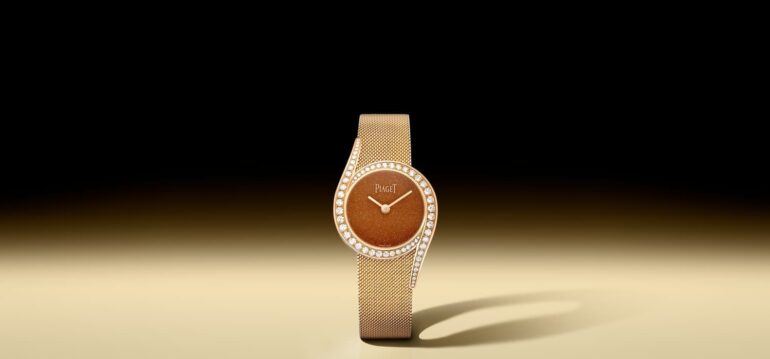
The quest for formal precision finds another spectacular expression at Patek Philippe with the unexpected redesign of the Ellipse d’Or. The 5738 features a rose gold “teardrop”-style link bracelet that completely transforms the watch’s appearance on the wrist. It took fifteen years of in-house development and durability testing to modernize this complex structure, composed of more than 300 links assembled and finished one by one by hand. The result wraps around the wrist with the fluidity of a heavy fabric, supporting the ultra-thin case originally designed in the 1960s according to the exact proportions of the golden ratio. No technical complications, no subsidiary dials to distract the eye. The sunburst ebony-black dial stands on its own, protected by its beveled sapphire crystal.

Mechanical Extremism
While aesthetics and textures dominate part of the display cases, pure mechanics remain the crux of the matter. The great historic houses continue to wage a silent battle on the rocky terrain of astronomical complexity. Vacheron Constantin has undoubtedly made the most resounding statement of the decade with its Berkley Grand Complication. Created by the ultra-confidential Les Cabinotiers department, this bespoke pocket watch—commissioned by an American collector—features 63 complications. It thus surpasses the previous world record held by reference 57260. Beyond the dizzying array of functions—Gregorian perpetual calendar, split-seconds chronograph, multi-gong Westminster chime—the feat lies in the unprecedented integration of a traditional Chinese perpetual calendar. Mechanically managing highly irregular lunisolar cycles—without requiring a single manual correction until the year 2200—took eleven years of research by a trio of dedicated master watchmakers. With its 2,877 components and a weight nearing one kilogram, the timepiece transcends everyday use to become a demonstration of absolute mastery.
In a more compact yet equally intricate format, A. Lange & Söhne unveils the Datograph Perpetual Tourbillon Honeygold “Lumen.” The Saxon manufacture combines its famous flyback chronograph with a perpetual calendar and a tourbillon, all housed beneath a smoked sapphire dial. Natural light filters through this semi-transparent surface to illuminate the luminescent discs of the L952.4 movement. When plunged into darkness, the normally hidden architecture of the chronograph levers, natural nickel-silver bridges, and date levers glows with a green light. The mechanics are no longer merely functional; they transform into a nocturnal theatrical spectacle.
The Deconstructed Time of Creators
The watchmaking ecosystem would be incomplete without the brilliance of independent creators—those free spirits who shatter conventions with infectious joy. MB&F, a pillar of this watchmaking counterculture, continues its exploration of three-dimensional chronometry with the HM11 Architect. This time, Max Büsser has designed a rotating case inspired by the organic architecture of the 1960s. A central flying tourbillon, housed beneath a sapphire dome, serves as the beating heart. It distributes energy to four distinct “components” attached to the central core: the hour and minute display, the power reserve indicator, a mechanical bimetallic thermometer, and the winding crown. The interaction is total. The wearer must physically rotate the entire structure on its base to wind the barrel. The watch demands engagement—a tactile interaction that brings the object back to its most primitive mechanical form.
This overall vitality of the sector, evident from one booth to the next, demonstrates the resilience of a unique art form. The time can now be read anywhere, on any connected screen, with absolute precision calculated by remote servers. The challenge of fine watchmaking has definitively moved beyond the simple indication of time. It is about sculpting the ephemeral, mastering micro-energies, and polishing metal edges to the point of obsession. Behind the exhibition’s bulletproof display cases, every exposed gear bears witness to a fierce determination to defy planned obsolescence. The ticking of a Swiss anchor escapement remains, in the face of the cold silence of quartz and microchips, the only rhythm that still has a pulse.