Make Texture a preferred source on Google to support us
Add Texture to GoogleThe narrow alleys and courtyard houses of Fareej Al Asmakh embody the rhythm of an ancient way of life. Starting November 5, 2026, this historic neighborhood in Doha will serve as the setting for a silent dialogue between the vernacular architecture of the Gulf and contemporary design. Scheduled as part of the second Doha Design Biennial under the auspices of Qatar Museums, the exhibition *Interlaced: Dialogues in Design* uses this setting not to illustrate it, but to question it. Curated by Etienne Bastormagi, the event shifts the focus: it is no longer a matter of plundering a formal repertoire or imprinting Orientalist motifs on modern furniture, but of dissecting rituals, places, and manufacturing methods to extract a new grammar from them.
The intellectual challenge of the curation rests on a demand for translation. The twelve pieces on view through January 31, 2027, act as seismographs of a regional memory confronted with the imperatives of contemporary production. How can a fleeting gesture, a nomadic habit, or a bodily posture be crystallized in glass, metal, or stone? The selected designers answer this question by rejecting mere quotation in favor of the engineering of transposition.
The Imperative of Taking Action
This conceptual maturity is no accident. It is the result of a long incubation process led by FROMM.Lab, the creative development platform backed by the FROMM brand. It all began during Milan Design Week 2025, when this first international competition was launched. Faced with a massive influx of entries—more than 120 proposals from some 50 countries—the jury narrowed its selection down to twelve projects. This was followed by a full year of technical support.
The focus of this mentorship goes beyond pure theory. Designing a concept is one thing; resolving assembly challenges, defining material tolerances, and ensuring manufacturability is quite another. This rigorous testing process also enabled four of these pieces (SARJ, Bastion, Minara, and Dusk-Dawn Dune) to be previewed at Alcova during Milan’s major design event in the spring of 2026. The merit of this approach has also resonated with institutions: Minara made it to the finals of the Arab World Institute’s design award, while Dusk-Dawn Dune caught the attention of the Isola Design Awards.
Solidifying the Ephemeral and Movement
At the heart of the exhibition, several designers explore the notion of transience, seeking to give weight and density to what, by its very nature, unfolds and folds back. The Japanese studio KURANOIE perfectly illustrates this dynamic with the Unfurl coffee table. The piece draws its inspiration from the sufra, a traditional cloth spread directly on the floor to host shared meals. The designers have frozen the drapes and folds of this ephemeral textile in a juxtaposition of cold, immutable materials: glass and travertine. Its original purpose is preserved, but its embodiment shifts into a mineral-like permanence.
Italian designer Cecilia Rinaldi achieves a similar shift with SARJ. Drawing on the ergonomics of the Bedouin saddle, she orchestrates a technical fusion. Its seat creates a dialogue between the warmth of hand-knitted leather and the clinical precision of a laser-cut aluminum frame. The final piece documents the clash between the roughness of ancestral craftsmanship and the precision of industrial machinery. On another scale, G&L Studio takes on the khoos—the meticulous weaving of palm fronds—to reimagine it as a modular system available as a bench and a console table, thereby transforming the status of a rural technique to adapt it to the standards of interior design.
Intimate Architectures and Social Choreographies
While materials and craftsmanship form a central theme, the human body and its built environment provide the focus for another section of the exhibition. In *Bastion*, Daniel Heilig defies fate by orchestrating an unlikely encounter. The designer fuses the geometric austerity of Qatari fortifications with the mathematical complexity of Japanese wood joinery. The hybridization of these two architectural languages—which had no prior connection—generates an aesthetic of robustness characterized by great precision.
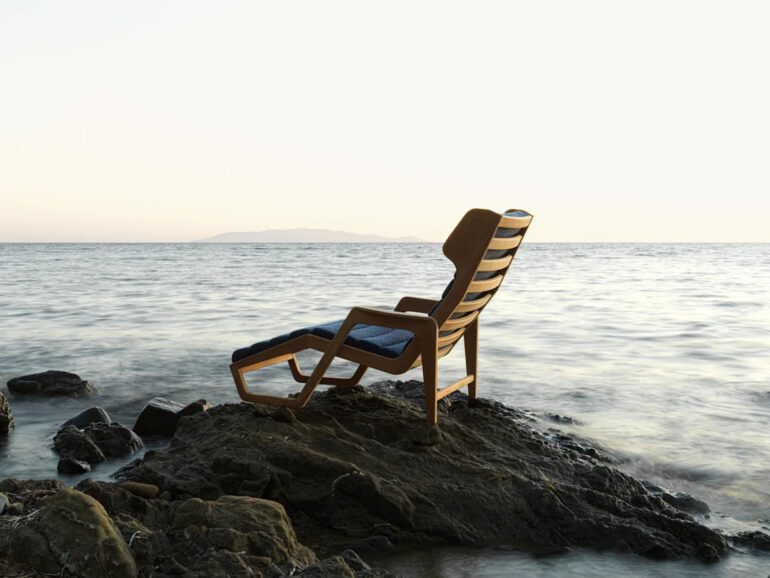
Other works read like freeze-frames of social customs. Egyptian designer Abeer Borhan created SHE, a console table whose lines evoke the tension in the nape of the neck and the balance of women carrying containers on their heads. Saudi designer Areej AlGhonaim, for her part, translates the fullness and drape of the traditional garments worn by women of the Ghamid tribe (from southern Saudi Arabia) through the volumes of the GAMID chair.

The ritual is also rooted in the cycle of the seasons and in departures. The Qatari collective composed of Amina Fakhroo, Noof Al-Naama, and Noor Al-Abdulmalik explores the local custom of Hiyya Biyya—a spring tradition involving children, temporary plantings, and the anticipation of the pilgrims’ return. Their interpretation takes the form of an outdoor chair incorporating a planter, physically linking rest and plant growth.
Taming Luminous Spectres
The final section of the exhibition curated by Etienne Bastormagi tackles the intangible. Three works explore light, a central element in the perception of space in Middle Eastern architecture. With NAFURA, Spanish artist Catalina Martínez Rojo uses the refractive properties of textured glass to mimic the trickling flow and perpetual motion of a fountain. Here, light becomes liquid.
On a more monumental scale, Ismail Hutet and Blanca Scully present *Minara: Pillars of Light*. This light fixture draws its visual rhythm from the hypostyle halls of mosques and palaces, echoing the strict alternation of light and dark stone layers to structure the beam of light. Finally, Xinyi Wang’s Dusk-Dawn Dune lamp captures the shifting geometry of deserts. It recreates the subtle variations in the shadows cast on the sand dunes during the transitional hours between day and night.
Placed in the communal spaces of Fareej Al Asmakh, these twelve objects do not arrive on neutral ground. They assert their contemporary materiality against the neighborhood’s ancient walls. The project’s success lies in this tension: the exhibition does not use Doha’s history merely as a backdrop; rather, it employs it as a sounding board to test the strength of its own creations.