Make Texture a preferred source on Google to support us
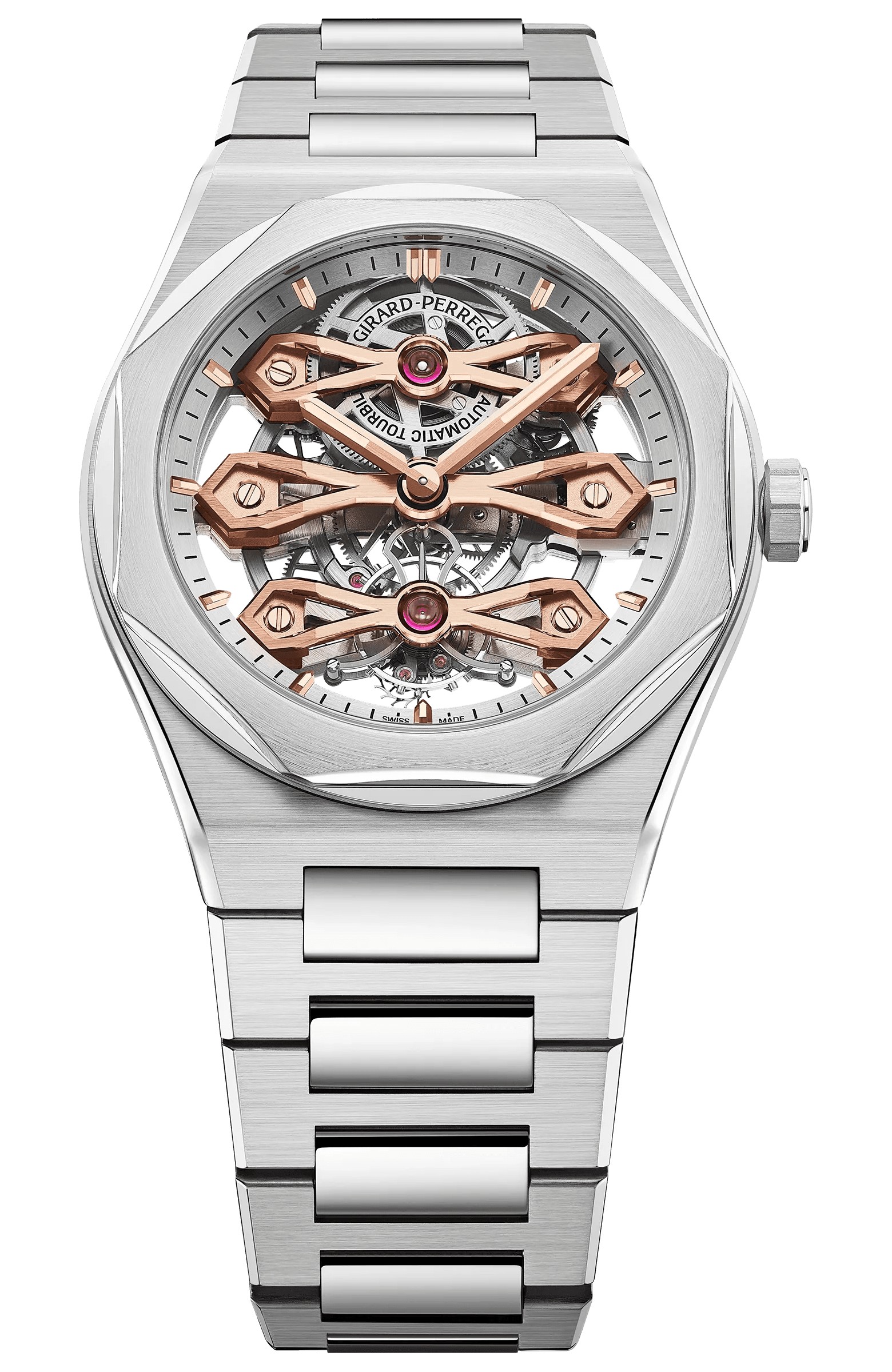
Add Texture to GoogleSome watches strive to show off everything, while others know how to be subtle. The new Laureato Fifty Three Gold Bridges from Girard-Perregaux definitely belongs to the former category. Beneath its crystal, the movement becomes a facade, a work of architecture, and a spectacle: three rose gold bridges span the space, a tourbillon animates the lower section, while a platinum micro-rotor handles the winding. The paradox is delightful: this showcase of haute horlogerie is housed within the sharply defined silhouette of a sports watch with an integrated bracelet.
This convergence of two of the manufacture’s distinct styles gives rise to a timepiece that makes no attempt at discretion. On one hand, the Laureato, introduced in 1975, with its steel case, octagonal bezel, and H-link bracelet. On the other, the tradition of the Three Gold Bridges, a mechanical signature that Girard-Perregaux presents here in a frontal composition. The Laureato Fifty Three Gold Bridges does not attempt to completely blend these two design languages; rather, it creates a tension between them, and that is precisely where its character lies.
Sporty-chic as a mechanical showcase
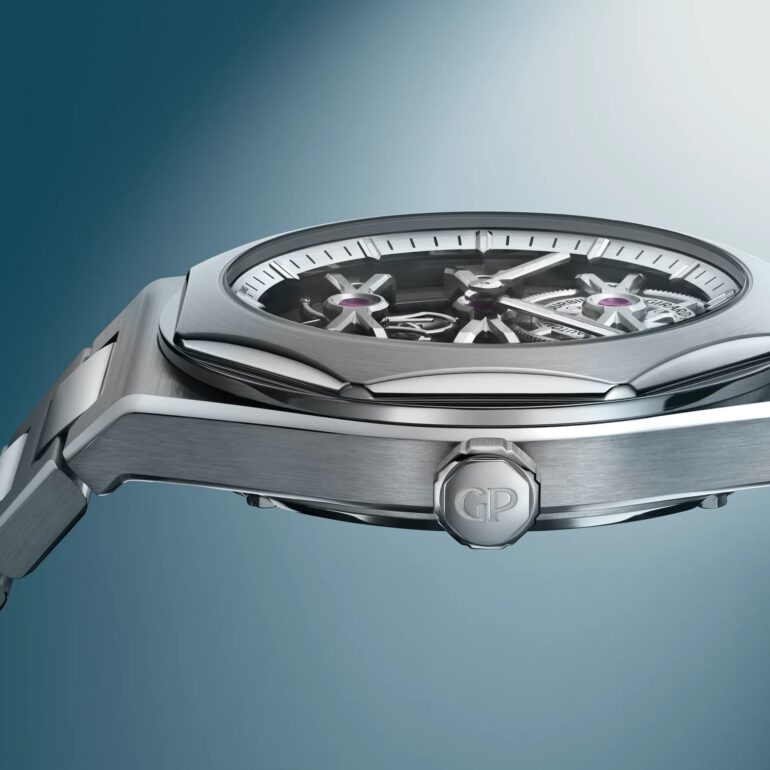
The case measures 41 mm in diameter and 10.85 mm in thickness. It thus exceeds the usual 39 mm proportions associated with the Laureato Fifty, including certain tourbillon variations. This increase is no coincidence: it provides the necessary space for the open-worked movement and gives the watch a more assertive presence on the wrist.
Girard-Perregaux, however, sticks with stainless steel for the case and bracelet, a choice that keeps the timepiece firmly within the Laureato’s historical lineage. The octagonal bezel, meanwhile, is crafted from white gold. This detail significantly alters the overall aesthetic. Stainless steel lends an almost utilitarian straightforwardness, while white gold introduces a richer luster—less ostentatious than yellow gold but distinctly more precious than an all-stainless-steel finish.
The surface finishes play a major role in this duality. Polishing, circular brushing, and straight brushing alternate on the bezel and bracelet. The H-shaped links—a defining visual element of the Laureato—are not merely supports for a spectacular movement; they extend the geometry of the case and anchor the watch in a sense of continuity. The bracelet features a triple folding clasp with fine adjustment—a practical touch that reminds us that this 41-mm timepiece is designed to be worn, not merely admired behind glass.
Water resistance is rated at 50 meters, or 5 bars. While this specification does not make the model a diving watch, it remains consistent with its DNA as a luxury sports watch. Here, the concept of “sport” does not refer to feats of endurance or raw ruggedness. Rather, it denotes a certain freedom of style—that of an integrated steel case and bracelet capable of accommodating a level of craftsmanship that belongs to an entirely different realm.
Three bridges, an open stage
The dial is reduced to a perimeter: a ring-shaped minute track and suspended hour markers structure the outer edge, while the center recedes to let the movement breathe. The rose gold hour markers are coated with luminescent material, as are the hands. This outer ring provides a few reference points, but the eye is inevitably drawn inward.
The three rose gold bridges form the true face of the watch. Their presence is not merely decorative. At 6 o’clock, the lower bridge supports the tourbillon, housed in a lyre-shaped cage. In the center, a second bridge organizes the display of the hours and minutes. At the top, the third bridge supports the mainspring barrel as well as the platinum micro-rotor. Telling the time becomes almost secondary in the face of this vertical construction, which arranges the watch’s essential components like elements of a relief.
This design calls for a bit of attention. The rose gold hands can blend in with the bridges when they align with the central structure. This is the trade-off for this chromatic coherence, where rose gold serves both mechanical functions and the display. The watch is not illegible, but it lacks the immediate clarity of a solid, high-contrast dial organized around prominent hour markers.
At night, the dynamic is partially reversed. The luminescent material applied to the hands and hour markers makes the time easier to read, while the interplay of metal and the depths of the movement fade into the background. This is a situation rare enough to be worth noting: the Laureato Fifty Three Gold Bridges can be easier to read in the dark than in bright light, when reflections compete with the contours of the hands.
The Movement as a Personal Signature
Inside, Girard-Perregaux employs a unique variation of the GP09620 caliber, designed specifically for this model. This automatic movement, designated GP09620-2856, comprises 303 components. Its construction features 418 hand-polished angles—a figure that reflects the time devoted to finishing operations, far beyond mere performance metrics.

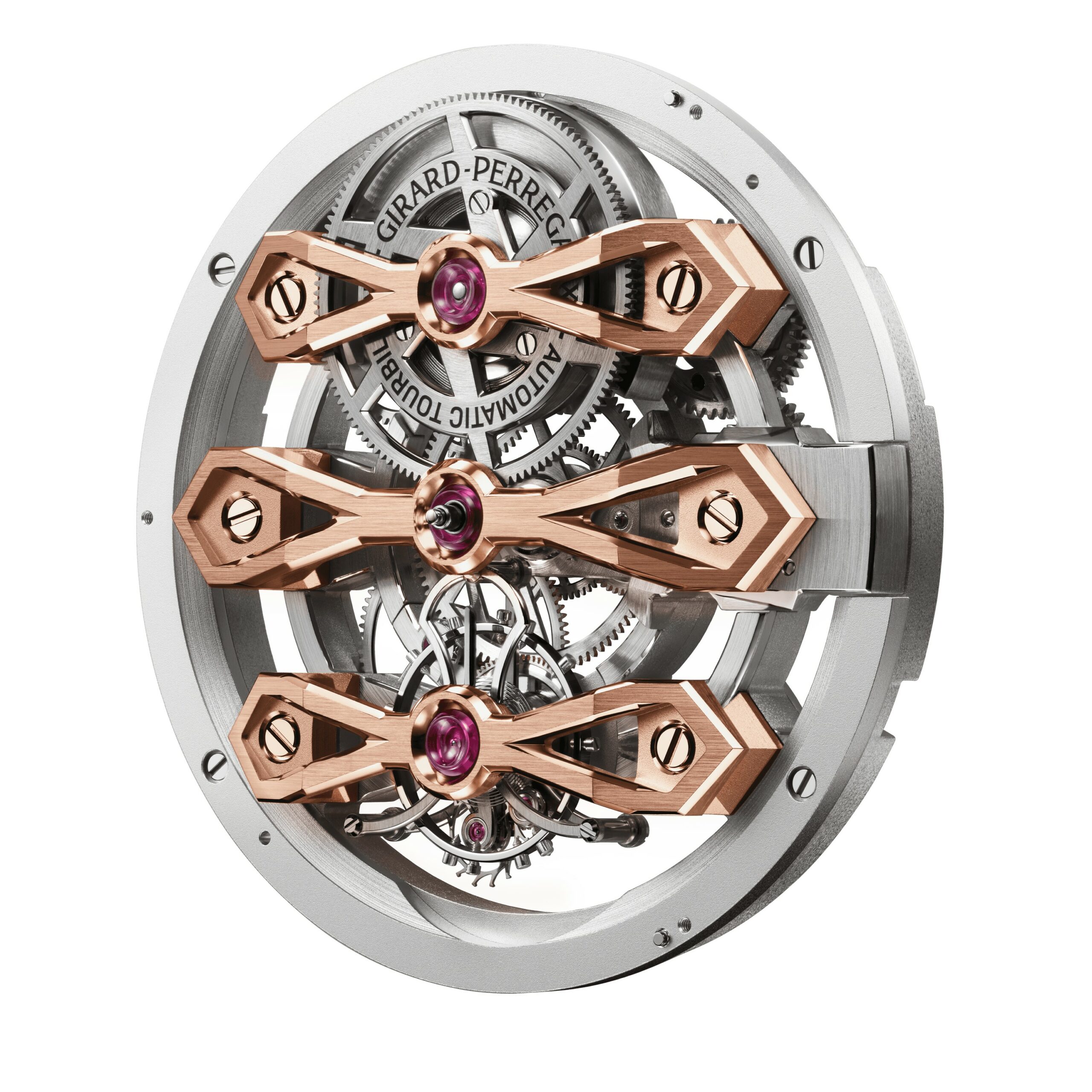
The caliber beats at 21,600 vibrations per hour, or 3 Hz, and has a power reserve of 55 hours. The functions are deliberately kept to a minimum: hours, minutes, and seconds. Nothing disrupts the arrangement of the bridges or distracts from the tourbillon. In a timepiece of this type, functional simplicity is not a shortcoming; it serves to preserve the clarity of the architecture.
Each piece is assembled entirely by a single watchmaker. His initials are engraved on the movement alongside the brand’s logo. In the highly codified world of fine watchmaking, this detail transforms the relationship with the object. It is no longer merely a caliber identified by a reference number, but a mechanism whose final assembly bears the personal mark of the person who carried out the work.
The platinum micro-rotor also deserves attention. Its integration helps preserve an unobstructed view of the bridges and movement components, where a central oscillating weight would have obscured a large part of the composition. This technical choice is therefore also a stylistic one. It allows the automatic winding mechanism to coexist with a largely openworked dial without compromising its visual impact.
A Laureato That Embraces Excess
The Laureato Fifty Three Gold Bridges occupies a unique place within the collection. It incorporates the Laureato’s most recognizable design elements but elevates them to a level that transcends the typical logic of a sport-chic watch. Its price, set at 144,000 pounds sterling, confirms this: this model does not aim for the same relationship with the object as a classic Laureato. It is intended for those who wish to see the tradition of the Three Gold Bridges expressed in a contemporary design, with all the constraints and contrasts that entails.
This combination results in a watch that is more polarizing than a conventional version. Lovers of balanced dials may regret that the hands sometimes get lost in the structure. Those seeking a showcase of visible mechanics, on the other hand, will find an almost theatrical piece, where each component is called upon to play its part. The steel case and integrated bracelet, however, prevent the result from becoming merely a showpiece: the Laureato retains a certain urban edge.
The reference 99112-58-3619-1CM therefore does not seek to replace the steel Laureato in its primary function. Instead, it offers a more radical, more sculptural interpretation, where the case becomes the frame for a movement treated like a landscape. Complete information on this Laureato Fifty Three Gold Bridges is available on the Girard-Perregaux website.