Make Texture a preferred source on Google to support us
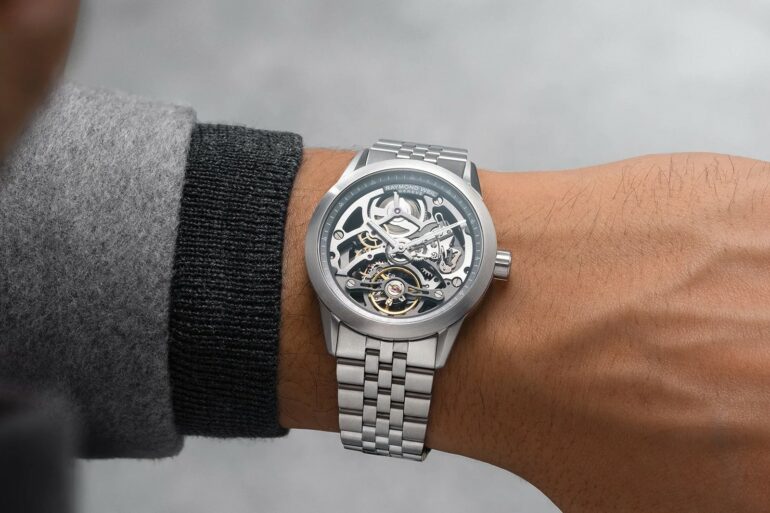
Add Texture to GoogleMechanical watchmaking often maintains a discreet relationship with its own inner workings. Traditionally, the gear train, barrel, and escapement remain hidden beneath the opaque surface of the dial, reserving the privilege of viewing them solely for the wearer who takes the trouble to turn the watch over. By choosing to display the regulating organ of its RW1212 caliber head-on, Raymond Weil takes the opposite approach. The balance wheel no longer hides in the shadow of the mainplate: it takes center stage at six o’clock, imposing its continuous oscillation as the axis around which the watch’s entire aesthetic is organized. This bold spotlight on the mechanics is not merely a stylistic whim. It marks a decisive turning point for the Geneva-based brand, which is here presenting its very first movement claimed as its own.
The transition to an in-house movement profoundly alters a brand’s identity. For a long time, the industry relied—often with great reliability—on calibers supplied by external manufacturers, which then had to be finished. While this method ensures easy maintenance and proven durability, it imposes its own structural limitations on the design. Developing one’s own technical movement offers radical freedom: the freedom to conceive the architecture of the mechanism and that of the case as a single, unified entity. It is precisely this design independence that has allowed Raymond Weil to position the beating heart of its watch on the front side, supported by a single bridge. This unique construction creates the mesmerizing illusion that the wheel is literally floating above the void.
Mechanics as a Visual Signature
In terms of horological physics, the RW1212 automatic caliber operates at a frequency of 28,800 vibrations per hour, ensuring highly precise timekeeping. Its mainspring barrel provides a power reserve of forty-one hours—a practical duration that allows you to take off the watch in the evening and find it perfectly on time the next day, without interrupting its cycle. The daily experience of automatic winding remains true to the standards of fine watchmaking: a simple movement of the wrist is all it takes to wind the mechanism.
While the front of this caliber immediately catches the eye with its view of the balance wheel, the watch’s case back has not been overlooked either. Through a sapphire crystal, the owner can observe the oscillating weight, finely decorated with a Côtes de Genève pattern and stamped with the brand’s logo, highlighting the care taken in the finishing of a movement designed to last and evolve with each recommended service.
The Freelancer Case: The Spirit of a Generation
To house this seminal caliber, the brand did not choose its case at random. It is the Freelancer line, launched in 2007, that serves as the exclusive home for the RW1212 movement. This collection holds a special place in the history of the family-owned house. Launched under the leadership of Elie Bernheim, the founder’s own grandson, it marks the very first departure from a naming convention historically rooted in the vocabulary of classical music. Gone are the references to operas or symphonies; the Freelancer boasts a resolutely modern, urban aesthetic, designed for a new generation of watch enthusiasts.
Today, this collection features the RW1212 caliber through two distinct design philosophies. The first approach, known as the openworked version, embraces restraint by retaining a solid dial surface pierced by a single aperture. The second, the skeleton version, takes this concept to its logical conclusion by removing all superfluous material to allow the eye to gaze directly into the steel innards of the timepiece.

From Openwork to Skeleton: The Nuances of a Collection
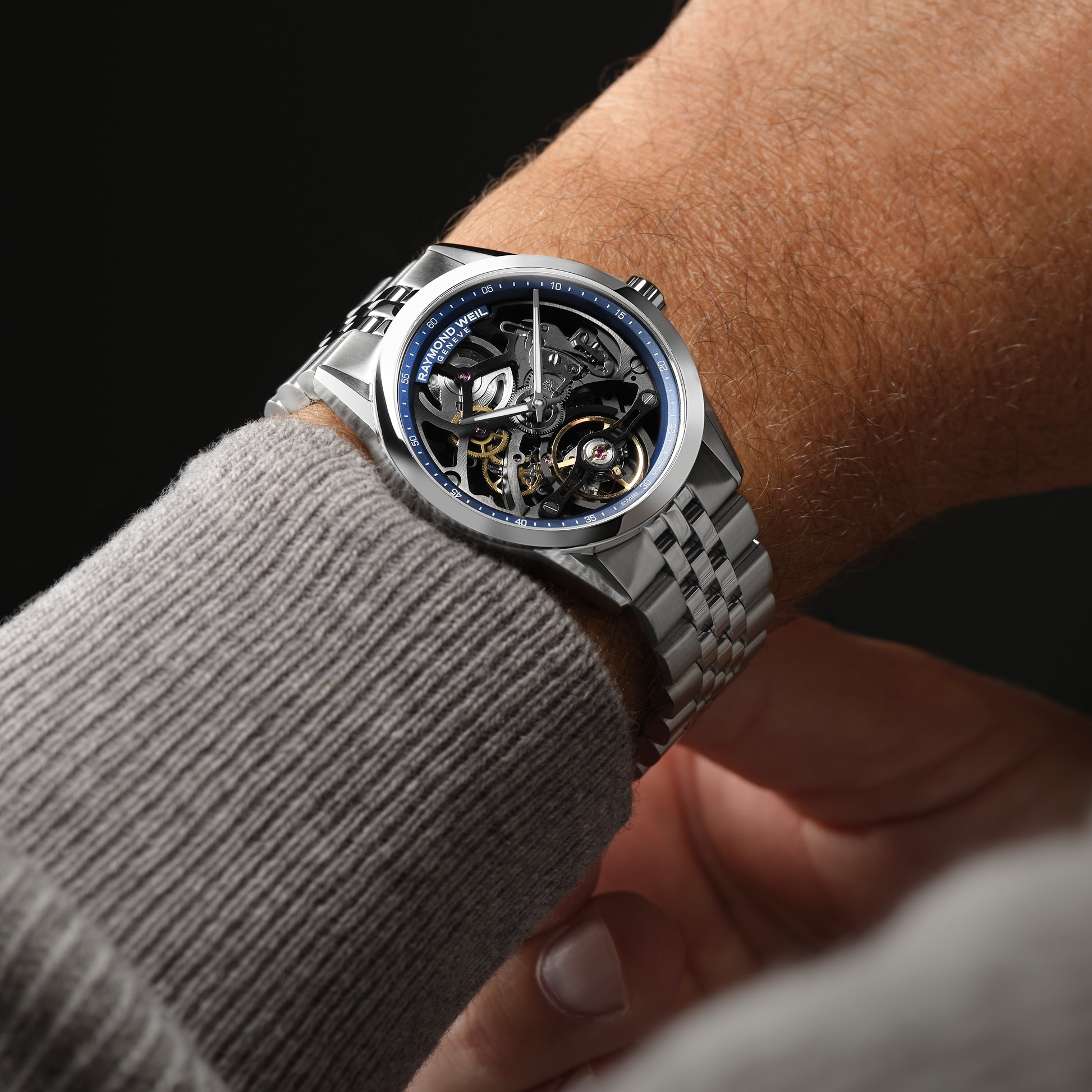
The design of the Freelancer 2781-ST-50051 perfectly illustrates the openwork approach. By retaining a deep blue dial, this model maintains classic readability while offering a spectacular view of the balance wheel at six o’clock. The choice of a minimalist display, limited to two hands for hours and minutes, reinforces this sense of understated elegance. Attention is not distracted by peripheral complications. It’s a subtle compromise for the enthusiast seeking to slip a mechanical masterpiece beneath the cuff of a dress shirt without veering into excess.
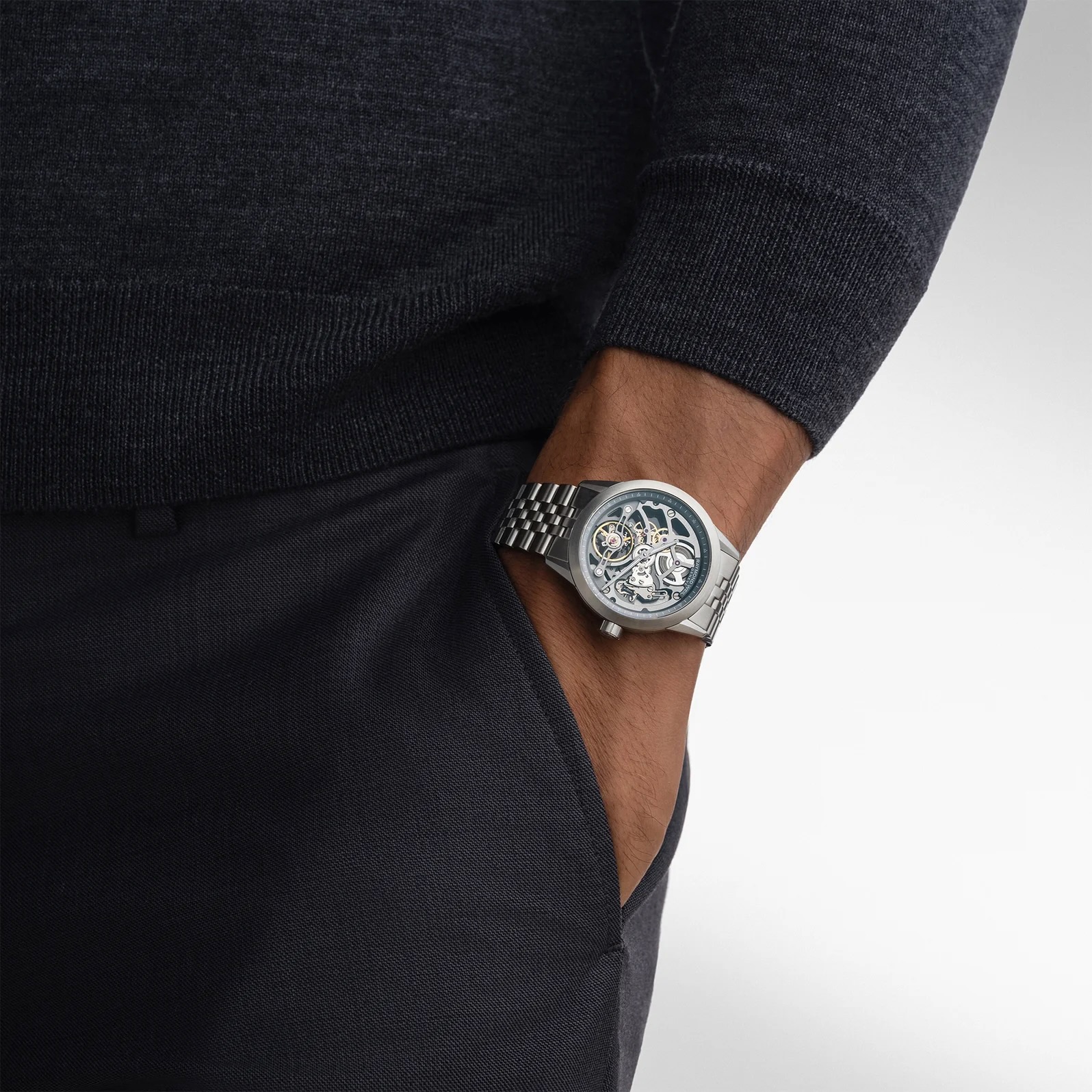
For those who prefer total immersion in the movement’s architecture, the brand offers fully skeletonized versions, available in several diameters and materials. The 2786-ST-60000 model features a 40-millimeter stainless steel case enclosing a fully skeletonized anthracite dial. Featuring an engraved tachymeter scale, luminescent hands, and water resistance tested to a depth of 100 meters, this model—mounted on a steel bracelet—stands out as the quintessential technical variant, designed for intensive daily use.
The collection then expands to a more imposing 42-millimeter diameter, venturing into more distinct stylistic territories. The 2785-BKR-20000 model embraces an unapologetically sporty aesthetic: its steel case houses the skeletonized movement within a more robust design, all securely fastened to the wrist by a black rubber strap. Immediate readability takes a back seat, supplanted by the radical nature of an open design that demands the viewer pause for a moment to decipher the time amid the tangle of bridges.
Finally, the Freelancer 2785-SBC-60000 offers a more organic way of reading the passage of time. By crowning its 42-millimeter steel case with a bezel carved from solid bronze, Raymond Weil introduces a living material into its collection. Paired with a deliberately aged brown leather strap, this bronze is destined to oxidize slowly. It will develop a patina all its own, reacting to the skin’s acidity, humidity in the air, and friction. Each piece will eventually visually reflect its owner’s habits, transforming a mass-produced timepiece into an object whose appearance becomes, over the years, truly one-of-a-kind.