
Make Texture a preferred source on Google to support us
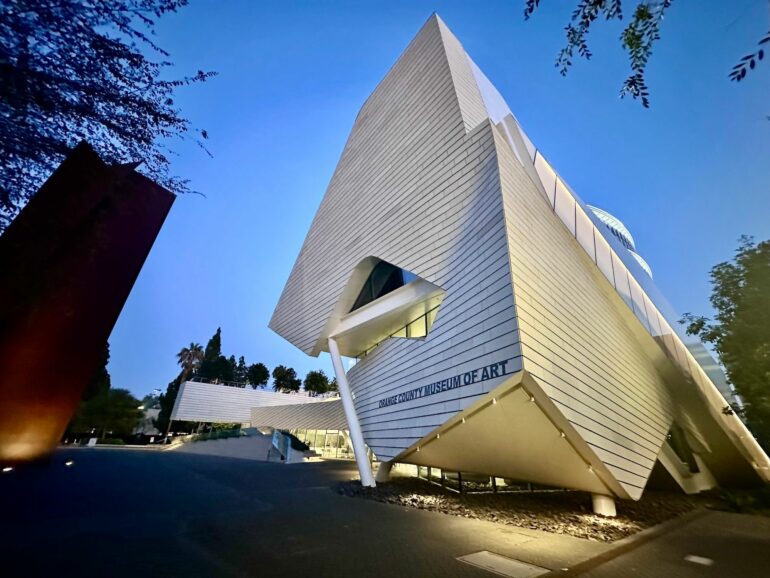
Add Texture to GoogleFollowing its recent acquisition by the University of California, Irvine, the Orange County Museum of Art is evolving to reflect a new identity, blending historical collections, visual arts, and cinema into a fresh narrative of California’s aesthetic.
An Institution in the Midst of a Transformation
The UC Irvine Langson Orange County Museum of Art, located in Costa Mesa, is undergoing a period of transition that goes beyond mere administrative changes. Since its acquisition by the University of California, Irvine—finalized on September 29, 2025—the institution has merged its collections with those of the Jack and Shanaz Langson Institute and Museum of California Art. The result is magnificent: a venue now housing more than 9,000 works of modern and contemporary art. This evolution not only expands the museum’s scope but also profoundly redefines the way it tells the story of California.
In December 2025, Kathryn Kanjo was appointed director and CEO of this reimagined museum. Having taken office in February 2026, her mission is to orchestrate the programming and operations of an institution that is still forging its shared identity. This is not the time for a grand, ostentatious opening, but rather for subtle and gradual adjustments.
Hollywood’s Golden Age Through the Lens of the Landscape
It is within this revitalized space that the exhibition “Staging California in Early Hollywood,” on view through October 4, is presented. The exhibition explores two seemingly distinct worlds that California has intimately linked: the plein air painters and the genesis of Hollywood cinema. According to the curatorial team, these artists first shared a common territory before developing a genuine shared visual language.
Michaëla Mohrmann, assistant curator, emphasizes that this exhibition highlights the decisive contribution of landscape painters to the studio system. The approach goes beyond a simple historical framework to address a form of visual invention: the art of transforming a natural landscape into a strikingly realistic cinematic setting. In Hollywood’s early days, the geography of Southern California frequently served as a backdrop for stories set on the other side of the world. Geographical accuracy mattered little; all that mattered was the quest for a perfect illusion.
The Art of Trompe-l’œil: From Reality to the Canvas
The exhibition brilliantly illustrates the influence of these locations on the film industry, demonstrating how California’s landscapes lent their features to imaginary or distant lands. Artists accustomed to painting from life mastered every nuance of the local valleys, hills, and meadows. This intimacy with nature greatly informed the design of studio sets.
Paul Grimm’s work perfectly embodies this synergy. His rock formations echo the set designed for the epic *Noah’s Ark* (1928). A vintage photograph reveals this monumental structure set up at the Iverson Movie Ranch, in the heart of an arid landscape, where the biblical ark blends in with unsettling naturalness. The shift from reality to painting occurs seamlessly; it operates insidiously, like a trompe-l’œil that whispers its lie rather than shouting it.
The exhibition then focuses on the rise of the Hollywood system and the standardization of its creative processes. As Michaëla Mohrmann points out, a few iconic studios dictated the rules of production at the time, with MGM at the forefront. Their departments dedicated to set design and special effects forged an instantly recognizable aesthetic, elevating masterpieces that have since become iconic, such as *The Wizard of Oz*.
Behind-the-Scenes Craftsmanship in the Service of Illusion
The exhibition also highlights two major figures at MGM: George Gibson, a master of painted backdrops, and Warren Newcombe, a pioneer of matte painting. This meticulous technique involves painting a portion of the image on glass or canvas and then blending it with live-action footage. This alchemy creates a seamless, utterly fluid universe, erasing all boundaries between reality and fantasy.
A landscape by Gibson, bathed in the golden hues of its hills, inevitably resonates with the legendary Yellow Brick Road. Here, painting is not merely a reproduction: it actively contributes to the mental construction of the work. The museum rightly points out that Hollywood cinema did not merely capture the essence of California; it reinvented it, endowing it with a longevity that reality itself could not guarantee.
The gallery walls are also enriched by works by Ralph Hulett, as well as Lee and Mary Blair, talents closely associated with Disney Studios. Their inclusion broadens the perspective beyond live-action footage, highlighting the interplay and flow of aesthetics between the worlds of animation, illustration, and set design.
The Unseen Masters of the Opening Credits
The exhibition design takes care to pay tribute to these creators whose expertise has all too often remained hidden in the anonymity of the opening credits. In particular, the museum brings to light the work of Arthur Beaumont, famous for his seascapes, two of whose pieces—specifically created for the big screen—have been formally identified. An anecdote that reveals the fast-paced nature of Hollywood: the creative process—rapid and fundamentally collaborative—left little room for individual recognition.
A monumental backdrop used for *The Sound of Music* illustrates this collaborative dynamic. Under the leadership of Emil J. Kosa Jr., then director of special effects for 20th Century Fox, several artists combined their brushstrokes. Yet the credits omit the diversity of these contributions. While the exhibition does not claim to correct the industry’s overall history, it nevertheless works to elegantly fill in these gaps.
Echoing this retrospective, the museum extends the discussion with “Collection Dialogues with Staging California in Early Hollywood,” a carefully curated selection of contemporary works from its own collection. For Kathryn Kanjo, this initiative demonstrates the burning relevance of the conversation between landscape, narrative, and visual creation. Mungo Thomson’s work, *The American Desert (for Chuck Jones)*, for example, attests to the power of arid imagery, which continues to haunt our contemporary visual vocabulary.
By embracing this multifaceted perspective, the merged institution asserts not so much a break as a sublimated continuity. It weaves together the threads of different histories to forge a unique entity—one that is emerging but already rich with deep cultural layers. In the heart of Orange County, a new vision of design and art is taking shape, the result of skillfully orchestrated assemblages and dialogues.