

Make Texture a preferred source on Google to support us
Add Texture to GoogleAll it takes is a dial to shift a watch’s center of gravity. With the Masterlink Atelier Edition, Gerald Charles takes its model that most closely embodies the sport-chic aesthetic with an integrated bracelet and introduces an element one would expect to find in the realm of artisanal demonstration pieces: a hand-hammered metal surface. The result is far from a mere decorative exercise tacked onto a familiar silhouette. It alters the way the watch is read, its relationship to light, and, above all, its place in the brand’s collection.
Hammered metal versus machined steel
Until now, the Masterlink was Gerald Charles’s most overtly sporty offering. Its 38-mm steel case, integrated bracelet, and taut lines tie it to a family of watches whose design language was largely defined by Gerald Genta: angular architecture, faceted surfaces, continuity between the case and the bracelet, and a bold, unapologetic use of metal. But here, the brand chooses to disrupt this industrial grammar with a dial whose every relief is created by hand.
The material used is nickel silver, also known as German silver. Before receiving its finish, it is worked by a craftsman armed with a tiny hammer. The principle seems simple; its execution is not. Each strike must maintain a constant depth and diameter, even though the distribution of the marks remains deliberately irregular to the eye. This apparent spontaneity is therefore based on extreme precision: the difference between a vibrant dial and a disordered surface is determined on a scale measured in micrometers.
Hammering is making a comeback in the world of watchmaking, but it remains less widespread than guilloché. The reason is simple: this technique tolerates neither haste nor approximation. It keeps a craftsman occupied for hours on a piece that, when worn on the wrist, does not immediately reveal the sheer amount of work hidden within its texture. It is precisely this restraint that suits the Masterlink. The decoration is not applied as a mere motif; it becomes a shifting, almost mobile element as soon as the wrist moves.
Three tones, three styles
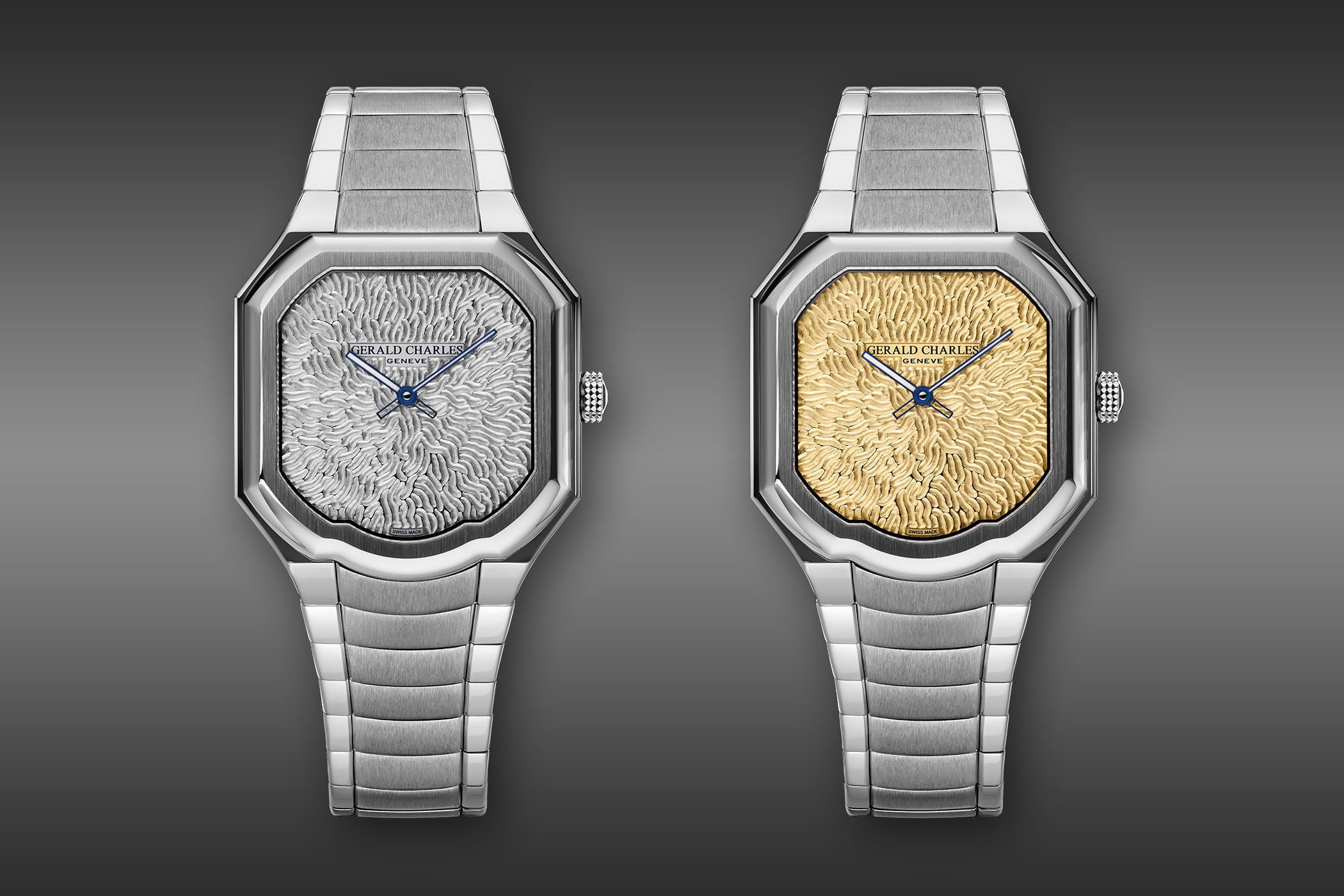
Gerald Charles offers this dial in three finishes: rose gold, yellow gold, and rhodium. The first two take advantage of the contrast with the steel. They introduce warmth into a design otherwise dominated by cool tones and the sharp brilliance of polished surfaces. In the light, the hammered texture catches the reflections, fragments them, and then renders them with an intensity that a smooth dial simply could not achieve.
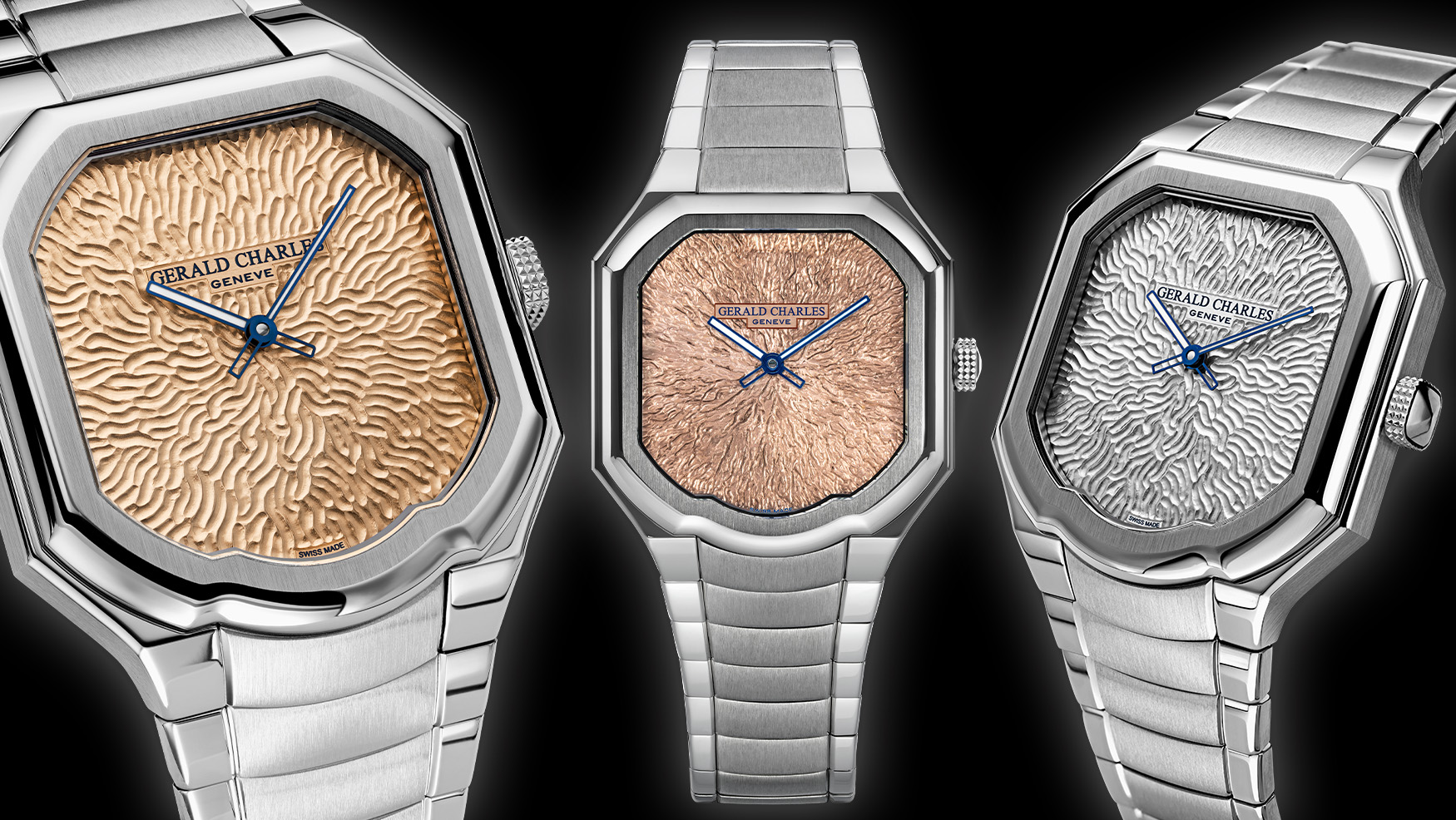
The rhodium-plated version embodies a different, more monochromatic aesthetic, where the white dial and stainless steel case create an almost tone-on-tone effect. It appears more understated, yet also less dramatic than the gold versions. Rose gold and yellow gold lend greater depth to the watch’s design, particularly because the dial remains unadorned. No hour markers punctuate the circumference; only two very sleek, openwork baton hands indicate the hours and minutes. This minimalist approach is no accident: it gives the metalwork the space it needs to shine.
This absence of hour markers also gives the model a unique presence. A sports watch often seeks to enhance its readability through abundant markers, sharp contrasts, or additional indicators. The Masterlink Atelier Edition takes the opposite approach. It reduces the information to the bare essentials and relies on the visual depth of its dial. This decision places the piece in a less obvious category: too dressy to be merely sporty, yet too metallic and robust to blend in with a classic evening watch.
A Bracelet That Rejects Interruptions
The bracelet is the other major focus of this edition. On the Masterlink, the design language specific to the Maestro collection is toned down and then elongated. The two-tiered bezel remains, as does that characteristic curve at 6 o’clock, sometimes described as a smile. But instead of ending in straight lugs, it extends into tapered elements that lead naturally to the first links.
The design becomes more fluid as it moves away from the case. The inner links feature a satin finish; the outer elements are polished. This alternation mirrors that of the case and prevents the bracelet from becoming a mere uniform block of steel. Most importantly, the screws and clasp remain invisible when the watch is worn. They are visible on the reverse side of the bracelet, allowing the visible portion to follow the contours of the wrist without any apparent break.
This mechanical detail has a clear aesthetic impact. Whereas many integrated bracelets display their joints as signs of technical sophistication, the Masterlink bracelet seeks an almost organic continuity. The contrast with the hammered dial becomes even more striking: on one hand, a deliberately irregular pattern created by repeated hammer blows; on the other, a steel construction that is masterfully crafted down to the very details it conceals.

Slimness as a Key to Comfort
This impression of lightness isn’t just due to the design. The Masterlink Atelier Edition is 7.99 mm thick, including the bezel. This is a remarkably slim profile for a watch with an integrated steel bracelet, designed to withstand a pressure of 10 bar—equivalent to 100 meters. It thus retains a sporty presence without the bulk that often accompanies this style.
This slim profile is made possible by the GCA1000 automatic caliber, which features a micro-rotor and is 2.67 mm thick. Visible through the case back, it offers a contemporary interpretation of Geneva’s traditional design codes: anthracite Côtes de Genève patterns structure the movement, while gold accents provide contrast. The rotor, recognizable by its hexagonal design, adds a more modern graphic touch than a purely traditional one.
The movement beats at 21,600 vibrations per hour—or 3 Hz—and offers a 50-hour power reserve. This reserve barely covers a weekend, without lasting much longer. This is a deliberate trade-off: it prioritizes a very slim profile over an extended power reserve. In this format, the decision makes sense. The watch slips more easily under a sleeve and avoids the bulky look that such a sculpted bracelet might otherwise create.
A watch that’s hard to categorize
Perhaps the most interesting thing about this Masterlink isn’t what it adds, but what it chooses not to include. Its steel case and water resistance place it firmly in the realm of active watches. Yet its hand-finished dial—without hour markers, featuring shades of gold or rhodium—immediately sets it apart from that category. It is not intended to be an everyday utility watch that you wear without a second thought. Nor does it adhere to the expected conventions of a dress watch designed for special occasions.
This ambiguity is its strength—provided one accepts that it is not suited for every purpose. In recent years, integrated bracelets with alternating finishes have become increasingly common, to the point where a design language born of the watchmaking avant-garde has become a widely adopted formula. Here, Gerald Charles introduces a visual fragility—not in the sense of a delicate watch, but as a human imperfection set against the precision of machined forms. The dial introduces a controlled element of chance into an architecture that, for its part, leaves nothing to chance.
The Masterlink Atelier Edition is available in a limited run of 25 pieces for each of the three versions. The model numbers are ML1.0-SSPS-SSBR-MI14HM-SBDP for rose gold, ML1.0-SSPS-SSBR-MI18HM-SBDP for rhodium, and ML1.0-SSPS-SSBR-MI22HM-SBDP for yellow gold. Pricing is available upon request. The standard Masterlink is priced at 23,160 pounds sterling, which gives an idea of its positioning—to which the cost of the handcrafted work is added. Details about the collection are available on the Gerald Charles website.