
Make Texture a preferred source on Google to support us
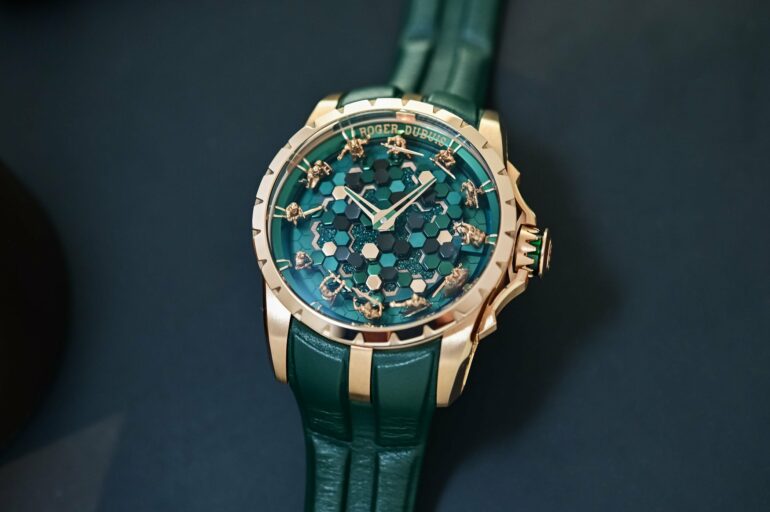
Add Texture to GoogleHow can you tell when a watch refuses to be overlooked? By its ability to draw the eye away from the hands. With the Excalibur Knights of the Round Table The Metamorph Merlin, Roger Dubuis brings a miniature medieval scene to the wrist, dominated by twelve sculpted knights and a deep green relief. The time remains there, indicated by two rose gold hands, but it seems almost secondary in the face of this legendary landscape. This piece, produced in a limited edition of 28, concludes a trilogy dedicated to Merlin and pushes the collection into a realm where watchmaking becomes decoration, narrative, and material.
When the Dial Takes on the Airs of a Set
The Knights of the Round Table collection has never sought discretion. Its concept is simple and radical: the hour markers are replaced by figures of the twelve Knights of the Round Table. Here, each stands at the edge of the dial, sculpted with particular attention to their poses. Some seem ready to strike, others are kneeling or in a defensive stance. They are not mere ornaments placed around a dial: they define how the hours are read and give the watch its narrative depth.
In this third and final interpretation dedicated to Merlin, the center of the scene consists of 57 hexagonal blocks. Their geometry is inspired by the basalt formations of the Giant’s Causeway in Northern Ireland. The idea is less to reproduce a landscape than to suggest its mineral structure: a fragmented terrain, raised in some places, hollowed out in others, whose depth varies depending on the materials and reflections.
This design makes the watch a piece to be viewed from multiple angles. The pattern is not flat, and the eye moves between the columns, the knights, and the central hands. Roger Dubuis thus adopts an almost topographical vision of the dial. The piece does not recount a specific battle or an identifiable episode from the Arthurian cycle; rather, it composes an imaginary territory, evocative enough to place Merlin at the center of the narrative without reducing him to a mere figurine.
Green: The Final Chapter of Merlin
The Metamorph Merlin follows two previous editions centered on the same character. In 2024, the Omniscient Merlin featured black columns. In 2025, the Enchanter Merlin adorned them in white. The green of the 2026 edition completes this chromatic progression with a hue that evokes the forests of ancient tales, the dwelling of the Lady of the Lake, and the secluded places where Merlin changes his appearance.
The term “Metamorph” derives precisely from this ability to transform, attributed to the enchanter. The case offers a literal interpretation of this through an engraved detail near the crown: Merlin appears there with a white stag, an animal whose form he can assume. This choice lends coherence to the design. The color is not merely a seasonal embellishment; it extends the theme of the character, his metamorphoses, and the woodland imagery associated with English and Irish legends.
However, the green does not cover the dial uniformly. The 57 hexagonal elements combine four materials: polished glass treated with a CVD coating, transparent glass, shimmering Crystalium, and rose gold. The result thus relies on differences in transparency, brilliance, and depth. Some columns capture the light, others filter it, while the rose gold elements create points of warmth within this blend of plant and mineral. The time is read from a landscape built on contrasts rather than from a conventional surface.
A Case That Continues the Story
The watch measures 45 mm in diameter and 16.87 mm in thickness. Its proportions reflect the grandeur of the scene it houses. Crafted in rose gold, the case features—for the first time in the collection’s history—engraved scenes on its middle and the sides of its lugs. The narrative thus extends beyond the dial to the very structure of the timepiece.
On the side at the 9 o’clock position, several knights are depicted in poses mirroring those seen inside the watch. The decoration serves as a sculpted echo of the central scene. At 3 o’clock, around the crown, the engraving depicts Merlin and the white stag. This treatment transforms the watch’s profile into a viewing area in its own right, whereas many cases are usually content to serve merely as a setting for the movement and the dial.
A sapphire crystal positioned above the case middle offers a view of the internal relief. It allows the volumes to be appreciated from the sides, before the rose gold bezel frames the entire design. This interplay of transparency is essential: without it, the hexagonal columns would remain merely a decorative motif. With it, they take on an almost architectural presence. The watch is viewed less as a dial and more as a composition on display in a showcase.
This desire to create multiple layers is reflected in the use of materials. The rose gold of the hour and minute hands echoes that of the case and the twelve hour markers. It serves as a connecting thread between the exterior and the interior, between the mechanism for immediate time-reading and the sculpted scene. The figures serve as hour markers, yet they also remain the guardians of a narrative that extends all the way to the lugs and the crown.
The movement: the reverse side of the scene
On the reverse side, the timepiece reveals an entirely different language. The RD821 automatic caliber powers this Excalibur at a frequency of 4 Hz—or 28,800 vibrations per hour—and offers a 48-hour power reserve. It displays the hours and minutes—functions kept deliberately simple in light of the dial’s visual exuberance. The focus here is not on the accumulation of complications, but on the design of the movement and its integration into a watch conceived as a sculptural object.
Visible through the transparent case back, the RD821 stands out for its openworked, sinuous architecture, as well as the quality of its finishes. These characteristics have earned it the Geneva Seal. Around the case back, an inscription pays homage to the duty and responsibility of the Knights of the Round Table. Following the verdant landscape of the dial and the engravings on the case, the back of the watch thus brings the narrative to a close with a more ceremonial dimension.
The juxtaposition speaks volumes: on the front, the knights create a legendary scene centered on the passage of time; on the back, the movement reveals a contemporary mechanism whose construction remains fully visible. Roger Dubuis does not seek to make us forget the watchmaking behind the myth. The brand simply places it on another level, as if the caliber were the hidden framework of this miniature kingdom.
A collector’s watch, conceived as a narrative object
With its water resistance rated at 30 meters, its calfskin strap, and its price available upon request, The Metamorph Merlin is clearly positioned as a collector’s piece. The limited run of 28 pieces reinforces this status. But its uniqueness lies above all in the way it interprets the codes of luxury watchmaking: not as a display of understated elegance, but as a tangible vehicle for storytelling.
The Merlin trilogy thus concludes with a green hue and a dial inspired by the Giant’s Causeway. This latest model favors the forest over the black mineral tones of 2024 and the white of 2025. Amid the blocks of glass, Crystalium, and rose gold, the twelve knights remain motionless while the hands continue their journey. Information about the collection is available on the Roger Dubuis website.