Make Texture a preferred source on Google to support us
Add Texture to GoogleA tiny steel cage, barely larger than the diameter of a lens, rotates on its own axis beneath the sapphire crystal. Inside, a balance wheel oscillates frantically, making its back-and-forth movements several times per second. Around this opening—usually positioned at the six o’clock mark on the dial—the gaze is transfixed. The mechanism exerts an immediate, almost animalistic pull. Watch enthusiasts pause to admire it, captivated by this visible mechanical rhythm. This device, known as a tourbillon, now epitomizes the pinnacle of watchmaking architecture—a major aesthetic selling point that justifies sky-high prices. Yet this miniature choreography, now ostentatiously displayed on collectors’ wrists, has its roots in a strict utilitarian necessity, designed to solve a problem of elementary physics.
The Invisible Enemy and Messidor’s Ingenuity
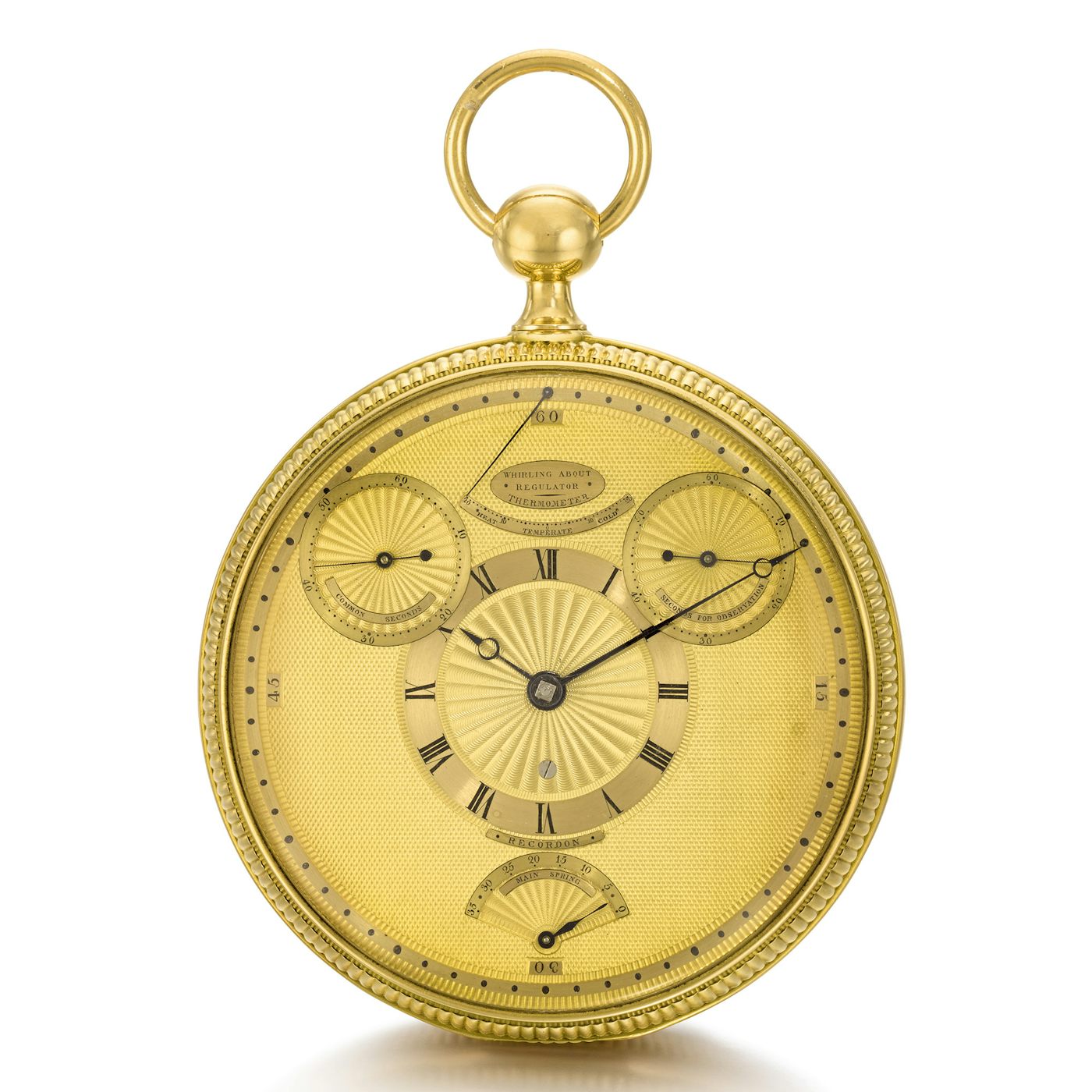
To understand the origins of this complication, we must leave behind the contemporary era of wristwatches and go back to the late 18th century. On the Quai de l’Horloge in Paris, Abraham-Louis Breguet observed the limitations of the timepieces he designed. At that time, the pocket watch reigned supreme. By its very nature, this object spent most of its life in a vertical position, tucked away in a waistcoat pocket. However, Earth’s gravity had a detrimental effect on the watch’s movement.
The regulating organ functions like the pendulum of a clock, but on a microscopic scale: it dictates the rate at which energy is released. When the watch remains upright, Earth’s gravitational pull asymmetrically distorts the fine balance spring that drives the balance wheel. The mechanism’s center of gravity shifts, creating what watchmakers call an imbalance. The direct consequence: the watch gains or loses time randomly depending on its exact orientation.
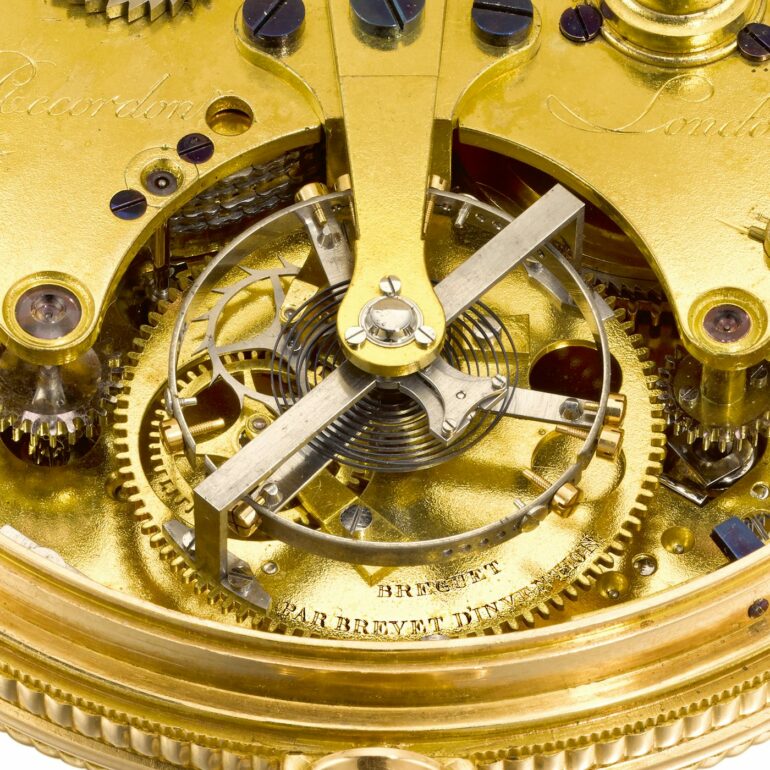
The technical context of the early 19th century underscores the difficulty of the task. In workshops lacking electricity and CNC machines, perfectly balancing each component was a daunting challenge. The solution devised by Breguet was a stroke of engineering genius. Rather than fighting gravity, he chose to outwit it. He decided to enclose the entire regulating mechanism—balance wheel, hairspring, anchor, and escape wheel—within a movable cage. By rotating this structure on its own axis at a steady rate of one revolution per minute, positional errors cancel each other out. The error accumulated during the first half of the rotation is mathematically compensated for during the second half. The invention was patented on June 26, 1801, or 7 Messidor, Year IX. The term “tourbillon” was borrowed from the vocabulary of astronomy, referring to the regular orbit of the planets—a far cry from the image of a storm it evokes today.
Planned Obsolescence on the Wrist
Logic would have dictated that the tourbillon remain confined to pocket watches, like an ingenious antiquity. The emergence—and then the rapid popularization—of the wristwatch during the 20th century radically upended the rules of chronometry. Worn on the wrist, the watch now follows constant movements. The wearer walks, gestures, and writes, causing the mechanism to pass through an infinite number of positions in space. The problem of prolonged upright positioning disappears.
From a strictly mechanical standpoint, the presence of a tourbillon in a wristwatch borders on anachronism. Not only does it no longer guarantee superior accuracy compared to a perfectly regulated conventional escapement, but the mass of its cage requires additional energy to be driven, readily drawing on the movement’s power reserve. Despite this loss of its original utility, the mechanism has not fallen into oblivion. It has undergone a spectacular transformation: from a precision instrument, it has become the gold standard of technical virtuosity.
Assembling a tourbillon requires extraordinary dexterity. The complete cage, composed of dozens of parts, often weighs less than one gram. The slightest imbalance during assembly renders the artisan’s efforts futile. Until the 1980s, the number of watchmakers capable of regulating such a mechanism from start to finish could be counted on the fingers of just a few hands. Its rarity, the high standards involved, and the failure rate have forged an aura, transforming an outdated technical solution into a pure object of desire.
The Open Stage and the Illusion of Emptiness
For over a century, the tourbillon operated in the shadows. Hidden beneath a solid dial or the case back, it worked in secret, revealing its existence only through a discreet engraving. Watch manufacturers eventually recognized the hypnotic potential of this ceaseless rotation. The architecture of watches was redesigned to pierce the dial and place the escapement in the spotlight.
This theatrical presentation reached a technical milestone in 1920, spearheaded by the German watchmaker Alfred Helwig. In his workshops in Glashütte, he designed the flying tourbillon. This daring variation simply eliminates the upper bridge that traditionally anchored the cage. Supported solely by a bearing at its base, the mechanism appears to float in mid-air, offering a completely unobstructed view of the balance spring’s oscillations. While this structure leaves the movement more vulnerable to shocks, it greatly enhances its visual impact. Contemporary watchmakers have taken this transparency to its peak, integrating the mechanism into skeletonized movements where light passes right through the watch.

Conquering the Third Dimension
With the arrival of the 21st century and the advent of ultra-high-precision CNC machines, the watchmaking industry decided to push its own boundaries. The classic tourbillon, rotating quietly on a single axis, was no longer enough to satisfy the thirst for complexity among a demanding clientele. Since the wrist moves in all directions, designers concluded that gravity compensation must adopt a spatial approach.
Manufacturers are completely rethinking the kinematics of regulating mechanisms. Jaeger-LeCoultre devised its Gyrotourbillon, a double sphere housing the balance wheel that rotates simultaneously on two axes at different speeds. Elsewhere, engineers at Greubel Forsey deliberately tilt their cages by 25 or 30 degrees, or couple multiple tourbillons within a single caliber using spherical differentials. The goal is to multiply the number of orbits to average out timing errors across all possible positions. The watch is transformed into a miniature satellite. The cases adapt, expanding with protrusions or domed sapphire crystals to accommodate the amplitude of these rotating spheres.
Time frozen in matter
Beyond the kinematic feat, the exclusivity of such a timepiece lies in the art of beveling and polishing. The tourbillon exposes the movement’s most intimate components to harsh light. Every edge of the cage undergoes manual finishing. The artisan uses tiny files and wooden dowels coated with abrasive paste to create clean bevels, eliminating any trace of industrial machining.
Black polishing, sometimes called mirror polishing, is methodically applied to the steel bridges. The technique requires rubbing the part against a zinc plate coated with diamond powder until absolute flatness is achieved. Under low-angle light, the surface appears deep black; from another angle, it reflects light like a perfect mirror. Finishing a single cage often takes several dozen hours. The buyer is paying less for the watch’s timekeeping precision than for the human time distilled into the material—that meticulous attention to millimeter-scale components.
Rationality has ultimately given way to emotion. Wearing a watch equipped with such a mechanism has little to do with the need to know the exact time. The tourbillon endures as a deliberate act of resistance in an era saturated by silent electronics. By revealing a metallic pulse beating just beneath the surface of the dial, it serves as a reminder of the fragility and ingenuity of human-crafted assemblies of springs and gears, setting a perpetual dance in opposition to the relentless laws of gravity.