
Make Texture a preferred source on Google to support us
Add Texture to GoogleThe Tel Aviv Museum of Art is presenting a groundbreaking retrospective of Tom Wesselmann, inviting viewers to critically reexamine American imagery from the 1960s and 1970s in light of current societal issues. As the United States approaches its 250th anniversary, this masterful wave of Pop Art arrives in Israel, examining the resonance of consumer culture in our contemporary political climate.
At a time when local realities seem increasingly complex, the Tel Aviv Museum of Art (TAMA) turns to Tom Wesselmann and the bold, colorful visual language of American consumer culture.
The exhibition *Tom Wesselmann: All Out*, on view through December 26, marks the first major retrospective in Israel dedicated to this late master of Pop Art (1931–2004). The exhibition brings together more than 40 historic works from the 1960s and 1970s, showcasing masterpieces from his iconic “Great American Nude,” “Still Life,” and “Bedroom Paintings” series. This exceptional collection comes entirely from the prestigious private collection of Marie and Jose Mugrabi.
“Presenting an exhibition of this magnitude in Israel at this very moment, dedicated to one of the most influential artists of the 20th century, is a major achievement for the museum,” emphasizes Tania Coen-Uzzielli, director of TAMA. “Wesselmann’s work continues to resonate today, inspiring generations of creators working within a culture saturated with images.”
“Bedroom Painting #12,” 1969, oil on canvas. (Credit: © 2026 Estate of Tom Wesselmann/Artists Rights Society, NY)
Yet transposing Wesselmann’s landscapes of abundance to the Middle East is far from a mere exercise in aesthetic escapism. For curator Shahar Molcho, the exhibition demands a direct and liberating interaction with the public, using the artist’s work as a prism through which to examine our own consumption of images.
Beyond the Contemporary Gaze
Wesselmann’s work emerged in the 1960s, at the heart of the sexual revolution and the golden age of mass advertising. His paintings isolate fragments of the body—flesh-toned lips, suggestive breasts—transforming the classical nude into a flat, hyper-pigmented pop icon.
Today, this directness inevitably clashes with our modern sensibilities. Shahar Molcho explicitly invites visitors to set aside their 21st-century perspective for the duration of the visit. “Today, there is such a critical eye when we approach an image,” she explains, referring to the influence of free speech movements and a heightened sensitivity to objectification. “I ask the public to set all that aside and step back sixty years in time. We’re used to jumping immediately to moralizing judgments that often overlook the context of the era.”
The curator highlights the radical evolution of our social norms, citing the cigarette as an example—the ultimate symbol of yesteryear’s glamour. “What, in the 1960s, embodied the pinnacle of Hollywood sex appeal is now viewed through the lens of advertising and health restrictions.”
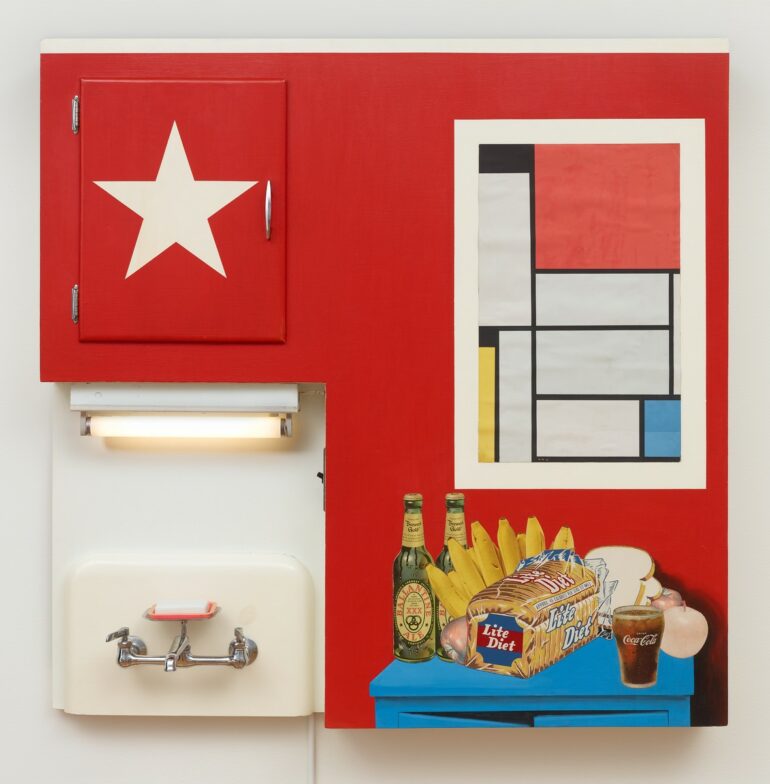
‘Still Life #34,’ 1963, paint, printed reproductions, and fabric, with a painted metal bottle. (credit: © 2026 Estate of Tom Wesselmann/Artists Rights Society, NY)

This tension is intimately linked to our relationship with the body. While our society strictly regulates physical space, digital space, on the other hand, is subject to unprecedented exposure. This contrast is fundamental to understanding the Bedroom Paintings and Great American Nude series today, in an era where intimacy has become a full-fledged platform economy, standing in stark contrast to Wesselmann’s direct and carefree celebration of sexuality six decades ago.
Aesthetic Friction and Classical Heritage
Despite his bold flat colors and an aesthetic borrowed from mass culture, Wesselmann’s engagement with art history remains profound. Beneath the pop veneer lies a scholarly dialogue with European pictorial traditions. He appropriates classical subjects, such as still life, and transposes them into the intimacy of an American bedroom saturated with everyday objects.
Pushing the boundaries of his medium, the artist uses canvases in unconventional formats, such as the famous *Mouth #14 (Marilyn)*, and incorporates manufactured objects directly into his compositions, such as the actual radiator in *Great American Nude #44*. The effect goes beyond mere ornamentation: it creates a striking tension between high culture and consumerism, between the intimacy of the bedroom and the grand spectacle of commodities. To highlight this resonance, the exhibition juxtaposes Wesselmann’s world with masterpieces by Matisse and Picasso from the TAMA’s collections, as well as with contemporary voices such as Mickalene Thomas.
But perhaps the true feat of *All Out* lies in its very existence on the museum’s walls. Shahar Molcho candidly discusses the colossal challenges involved in presenting international art in Israel in the current context, marked by complex logistical hurdles, astronomical insurance costs, and a climate of tension.
In this context, the Mugrabi family’s contribution has proven invaluable, offering a collection of impeccable museum-quality works, without the slightest compromise. Ultimately, All Out transcends a mere nostalgic retrospective to emerge as a test of perception. While Tom Wesselmann’s images retain their captivating immediacy, they now navigate a world in which our gaze—constantly shaped by criticism and memory—has never been more scrutinizing.