Make Texture a preferred source on Google to support us
Add Texture to GoogleOn November 7, the Geneva exhibition halls were buzzing with a special kind of excitement. The annual grand event of fine watchmaking, epitomized by the 26th edition of the Grand Prix d’Horlogerie de Genève (GPHG), delivered its verdict in an atmosphere where the ambitions of historic watchmakers clashed with the boldness of niche designers. Twenty trophies were awarded throughout the evening, covering a spectrum ranging from diving watches to artistic crafts. Yet the ultimate accolade, the highly coveted Aiguille d’Or, eluded the industry’s giants to crown an artisan operating far removed from the logic of mass production: Rexhep Rexhepi. By honoring his Flyback Chronograph, the Geneva-based institution did not merely reward a timepiece; it endorsed the triumph of a certain philosophy of independence, where mechanical innovation takes precedence over marketing clout.
This accolade illustrates a fascinating dynamic currently sweeping through the luxury sector. While major houses rely on sprawling research and development departments, a handful of small, discreet workshops manage to capture the attention of the most discerning collectors through an almost monastic approach to their craft. This year’s award-winning creation, in fact, embodies this duality perfectly: an outward appearance of great restraint that conceals an internal architecture of rich complexity.
A Masterclass in Classicism and Mechanical Architecture
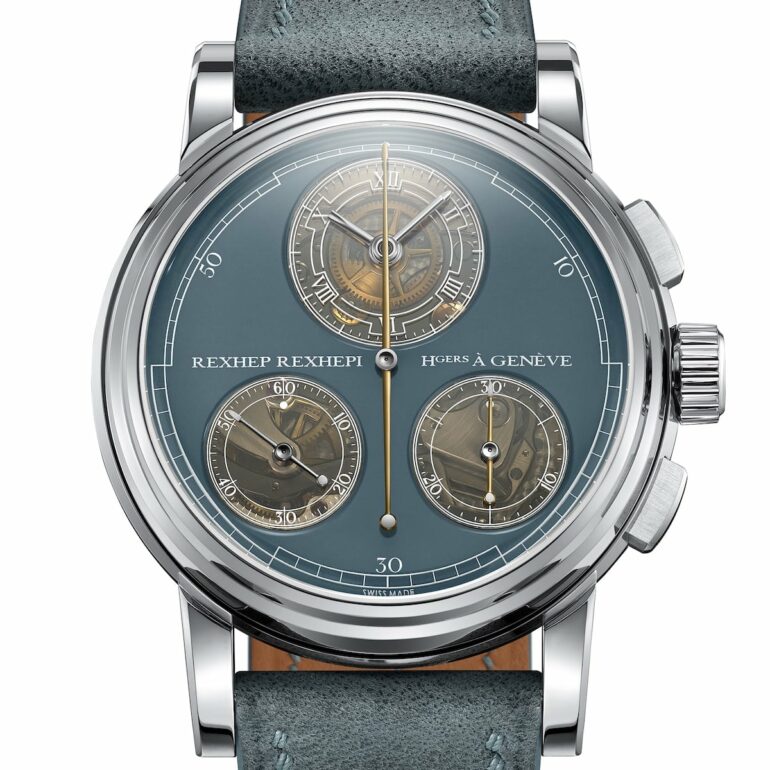
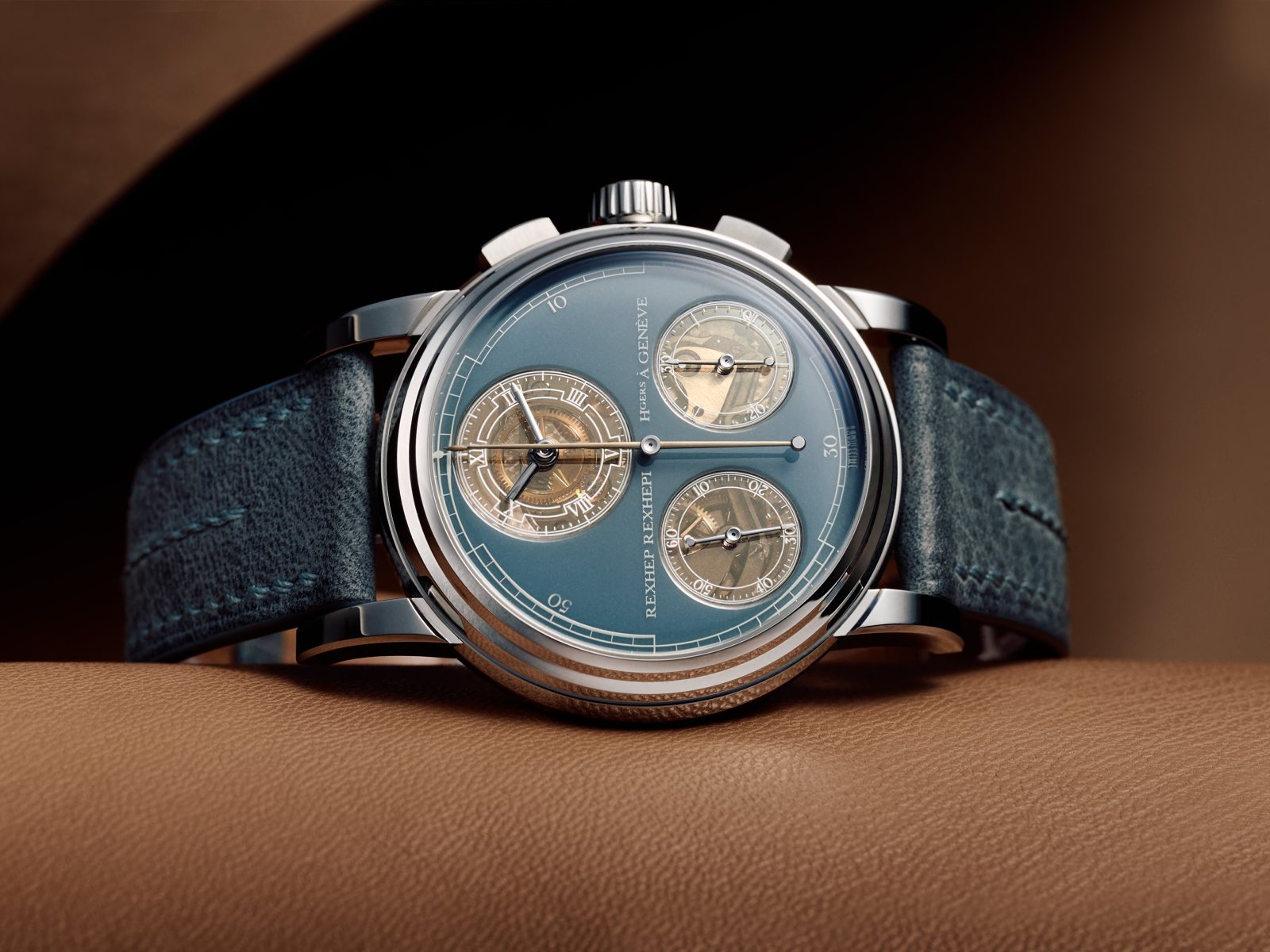
The Flyback Chronograph immediately makes its presence felt through proportions that purists would describe as just right. Defying the trend toward ostentatious cases, the timepiece is limited to a diameter of 38.8 mm and a thickness of 9.7 mm. In the platinum version that won over the competition’s judges, this strict geometry frames a grand feu enamel dial in a unique shade known as “storm blue.” This deep, melancholic dial is punctuated by three sub-dials crafted from smoked sapphire, offering a subtle contrast and optimal readability without disrupting the overall chromatic harmony.
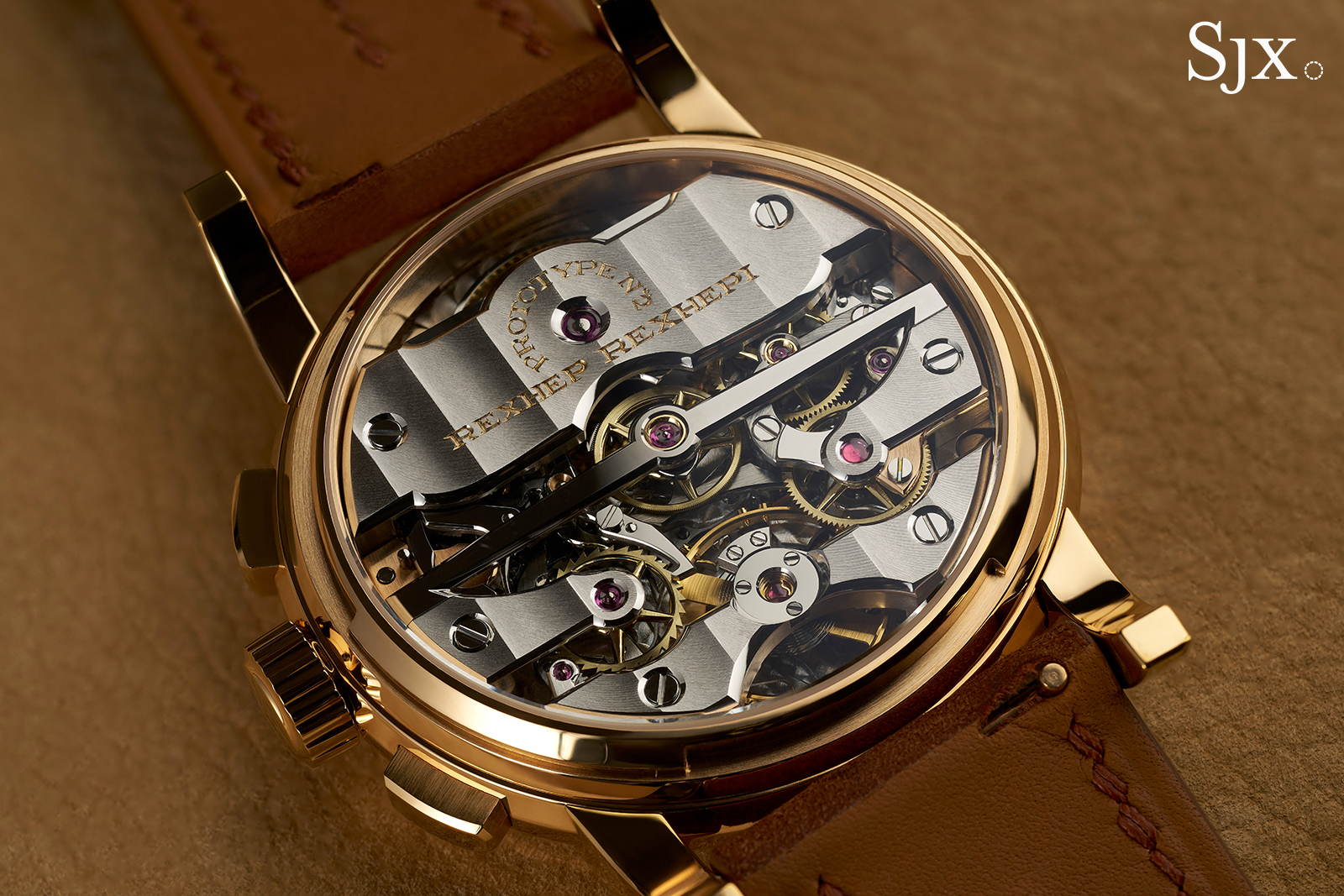
While the aesthetic borders on minimalism, the real spectacle unfolds on the back of the watch. The hand-wound caliber is not a generic movement adapted for the occasion, but a mechanism entirely conceived and structured to fit the exact dimensions of this model. Beating at 21,600 vibrations per hour and offering a 72-hour power reserve, it is built around a classic column wheel coupled with a horizontal clutch. This traditional configuration is enhanced by the flyback function. With a single press of the push-button, the mechanism freezes the current measurement, resets the hand to zero, and instantly starts a new timing session.
Viewing this movement through the sapphire crystal case back reveals a level of finish that alone justifies the Aiguille d’Or award. The bridges, machined from nickel silver, capture the light thanks to meticulous hand-finishing. Hand-finished bevels sit alongside black-polished surfaces, while traditional Côtes de Genève patterns provide structure to the space. The chronograph complication, deliberately left exposed, thus transforms into a dynamic metallic landscape.
Such high standards naturally affect the watch’s affordability. The specialized magazines *Monochrome Watches* and *Time and Watches* estimate a price point of around 150,000 Swiss francs for this platinum edition. There is also a rose gold version paired with a black dial, which is equally exclusive. Production volumes are extremely limited, making each piece a coveted item for connoisseurs of high-end horology.
The Coexistence of Opposites in the 2026 Awards
Beyond Rexhep Rexhepi’s victory, the overall picture of the 2026 awards reflects a diverse industry. The awards landscape has reserved a prominent place for long-standing players. Audemars Piguet, for example, asserts its supremacy in two very distinct categories: the Joux Valley-based manufacturer won the Iconic Watch Award for its Royal Oak RD#5, while demonstrating its mastery of classic complications with the 150 Heritage, the winner in the calendar and astronomical watches category.
Other watchmakers doubled their success at this ceremony. Ferdinand Berthoud cemented its reputation for chronometric excellence by winning the eponymous category with its Naissance d’une Montre 3, while also taking home the tourbillon award for the FB 2TV Chronometer. Chopard also distinguished itself twice, ranging from absolute minimalism with the L.U.C 1860—which won in the “Time Only” category—to the exuberance of high jewelry with the Mystery Nut.

The thematic categories helped highlight specific areas of expertise. Louis Vuitton saw its work on dials recognized with the Artistic Crafts Award for the Tambour Taiko Arty Automata, while Grand Seiko demonstrated the relevance of its hybrid technologies with the Spring Drive U.F.A. The Ushio 300 Diver was named Best Sports Watch of the Year. Notably, Patek Philippe took home the Special Jury Prize—not for a specific timepiece, but to celebrate the impact of its special exhibition, the Watch Art Grand Exhibition—proving that a brand’s cultural influence matters just as much as its manufacturing output.
The list of winners expands to include prestigious names such as Blancpain, Piaget, Parmigiani Fleurier, and Daniel Roth. Above all, it highlights unconventional mechanical creations from Otsuka Lotec, SpaceOne, and La Vallée. Although the evaluation criteria differ radically from one category to another, this interplay between the guardians of the Geneva and Jura watchmaking traditions and the free spirits of contemporary watchmaking remains the defining feature of this competition.
The Complex Mechanics of Judging
How can one objectively evaluate creations whose appeal often rests on an element of irrationality and emotion? The GPHG Foundation has gradually refined its selection process to minimize personal biases. The rules for the 2026 edition mandate a strict weighting system: the Academy—a body comprising a broad panel of industry professionals—submits the competing timepieces, and its votes account for one-third of the final score. The remaining two-thirds are in the hands of the official jury.
This voting does not take place based on a catalog. Before taking the stage in Geneva, jurors must examine the shortlisted watches in person. The timepieces are handled, examined under a magnifying glass, and their pushers are activated to assess the smoothness of the mechanisms. The deliberations remain confidential, and the integrity of the voting is guaranteed by the supervision of court officers and notaries. This “bureaucracy of beauty” does not claim to hold the absolute truth about what constitutes the world’s best watch, but it offers the strongest possible consensus at a specific moment in watchmaking history.
Once the awards are presented, these works of kinetic art embark on a brief public life before finding their way into the safes of their new owners. Curious visitors were first able to examine the shortlisted watches up close in the display cases of the Geneva Museum of Art and History through November 15. The select group of winners then traveled to the United Kingdom, where the Foundation had organized a final retrospective from November 18 to 23 at Watches of Switzerland, in the heart of London’s Knightsbridge district. It was a final opportunity to experience, firsthand, the pulse of contemporary watchmaking.