Make Texture a preferred source on Google to support us
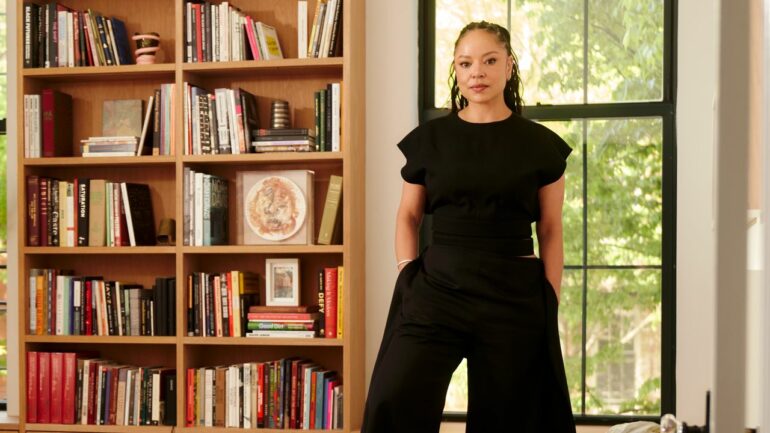
Add Texture to GoogleIn Tokyo, travel is no longer limited to the straight lines of Ginza’s avenues or the orderly flow of the circular subway lines. For its fifth annual edition, Art Week Tokyo (AWT) aims to shift the perspective of commuters. Through the AWT Video program, which kicks off its fourth edition from November 4 to 8, 2026, the event invites reflection on the paths dictated by our navigation tools. Under the title “Your Travel Guide To . . .”, this program—curated by X Zhu-Nowell, executive director and chief curator of the Rockbund Art Museum in Shanghai—seeks to deconstruct the travel guide. Far from being a simple collection of recommendations, this object is analyzed here as a political instrument capable of choreographing bodies in public space and defining—by omission—what deserves to be seen and what must remain in the shadows.
Geography as a Human Experience
X Zhu-Nowell’s curatorial project is rooted in a radical conception of space. Drawing on the theories of scholar Katherine McKittrick, for whom “geography is always human,” the program refuses to view maps as neutral representations of fixed borders. Geography is conceived here as a shifting subject, shaped by migration, data flows, collective memory, and labor. The traditional travel guide thus becomes a normative framework that must be dismantled to reveal the blind spots of cartography.
Ten artists—five based in Japan and four from abroad—explore these interstices. The collection brings together historical figures from experimental video and contemporary creators, illustrating how personal and political narratives are woven into the landscape. The selection of single-channel works, drawn from the catalogs of galleries participating in Art Week Tokyo, allows for an immersion in these narratives that lie outside the radar of mass tourism.
Kandis Williams: Between Segregation and Cinematic Horror
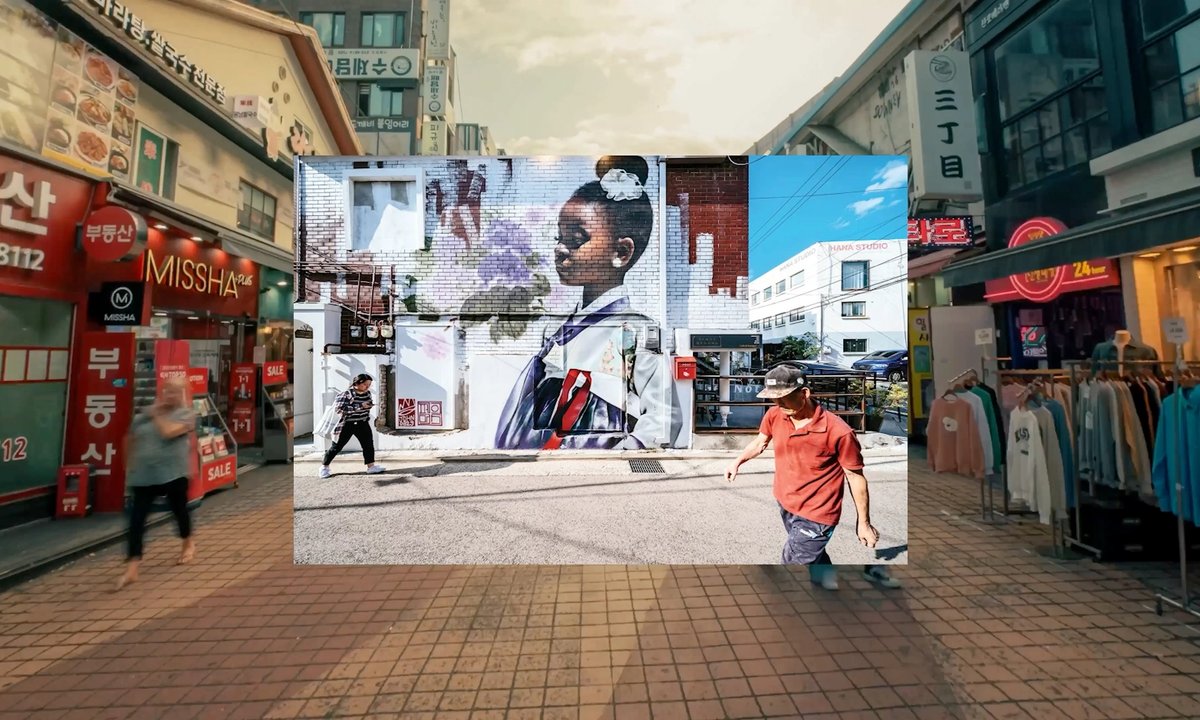
Among the highlights of this edition, Berlin-based American artist Kandis Williams presents her first exhibition in Japan. Her work, titled *A Travel Guide: Black Gothic in South Korean Horror* (2025), is a video collage approximately 50 minutes long. In it, Williams weaves complex connections between the history of racial segregation in the United States and the conventions of South Korean horror cinema.
The work takes *The Negro Motorist Green Book*—the historic guide essential to Black mobility during the Jim Crow era—as its starting point, linking it to a reflection on state-inflicted trauma and gender narratives. By situating these issues of mobility and safety within the realm of Gothic aesthetics and Asian cinema, Williams examines how marginalized bodies are perceived when they attempt to traverse spaces not intended for them.
Intimate Narratives and Urban Memories
The program also highlights the Japanese art scene, exploring timeframes often absent from official guides. Hiroyuki Oki’s (1964–2025) work, *Buddy Matsumae’s Picture Diary* (1988), offers a deep dive into an aesthetic of the ephemeral. Originally filmed on 8 mm film, this work—less than six minutes long—captures a fragmented everyday life, far removed from static monuments.
In a more contemporary vein, Linda Iha, represented by the Misa Shin Gallery, presents *Modern Contradiction* (2026). This short video explores the tensions inherent in Japanese urban modernity. It is shown alongside the work of Ken Okiishi, a Japanese diaspora artist based in the United States, whose work *Brian at Home* (2020–2025) spans 86 minutes, offering an observation of domestic space and intimacy that contrasts with the hustle and bustle of the metropolis outside.
The selection is rounded out by contributions from major figures such as Keiichi Tanaami (1936–2024), a pioneer of experimental animation, and He Xiangyu, whose work oscillates between Berlin and Beijing. Fuyuhiko Takata, Atsushi Yamamoto, Cici Wu, and Shubigi Rao enrich this constellation of artists who, each in their own way, map what official maps overlook.
A Pavilion in the Heart of the Marunouchi District
The AWT Video program takes place in a unique architectural setting. The screening pavilion is located in the Earth Garden atrium, on the ground floor of the SMBC East Tower in the prestigious Marunouchi district. This choice of location—in the heart of a hub of finance and institutional power—reinforces the exhibition’s purpose: to introduce stories of crossing and human geographies into the very spaces where the environment is most strictly regulated.
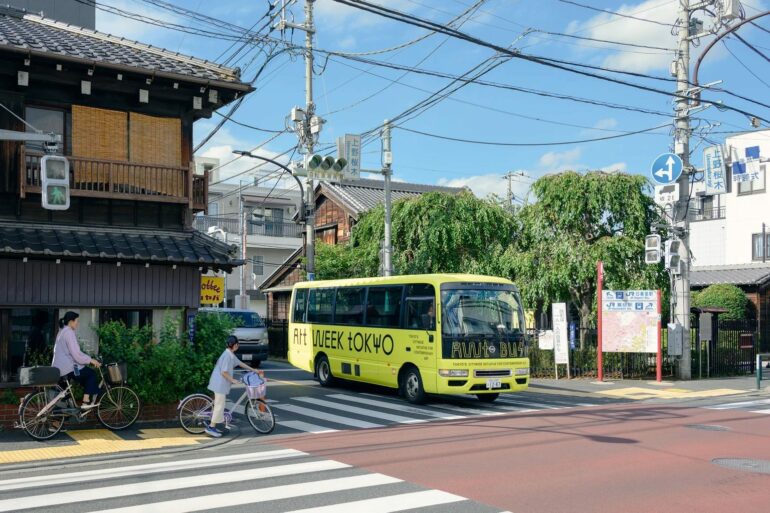
Admission to the program is completely free, reflecting a commitment to openness toward the urban public. To facilitate movement between the various key venues of Art Week Tokyo, a network of free shuttle buses—the AWT Bus—connects galleries and museums via six loops crisscrossing the city. These buses run approximately every 15 minutes, transforming the journey itself into part of the artistic experience. Between screenings, visitors can also attend the symposia and debates of the AWT Talks, which are free with advance registration.
Taking over the SMBC East Tower from November 4 to 8, 2026, from 10:00 a.m. to 6:00 p.m., “Your Travel Guide To . . .” does more than just show videos. The program invites visitors on a critical stroll through Tokyo, where the viewer becomes a traveler aware of the limits of their own itinerary, attentive to the whispers of stories that appear on no official map.