Make Texture a preferred source on Google to support us
Add Texture to GoogleThe Memory of Stones and the Thrill of Carats
Certain objects span decades while retaining the silent imprint of those who once owned them. The history of fine jewelry is not written solely in the secrecy of workshops or under the magnifying glasses of gemologists; it can also be traced through the genealogy of the pieces. It is precisely this dimension of memory that Phillips intends to place at the center of its upcoming Geneva auction, scheduled for November 9, 2026. For the second edition of its thematic section, simply titled “Collections & Provenance,” the catalog highlights the history of signed pieces and antique gems. Before the hammer seals the fate of these lots, a vast international tour is set in motion. In the weeks leading up to the auction, a carefully curated selection will leave the vaults to embark on a global tour, meeting collectors in New York, Singapore, Paris, London, and Taipei.
The culmination of this tour will take place on the shores of Lake Geneva. The Hôtel President in Geneva will host the complete exhibition from November 4 to 9, 2026, offering a brief window of opportunity to examine these secular relics—hailing from European courts and the art world alike—before they are dispersed.
Shadows of the Victorian Era
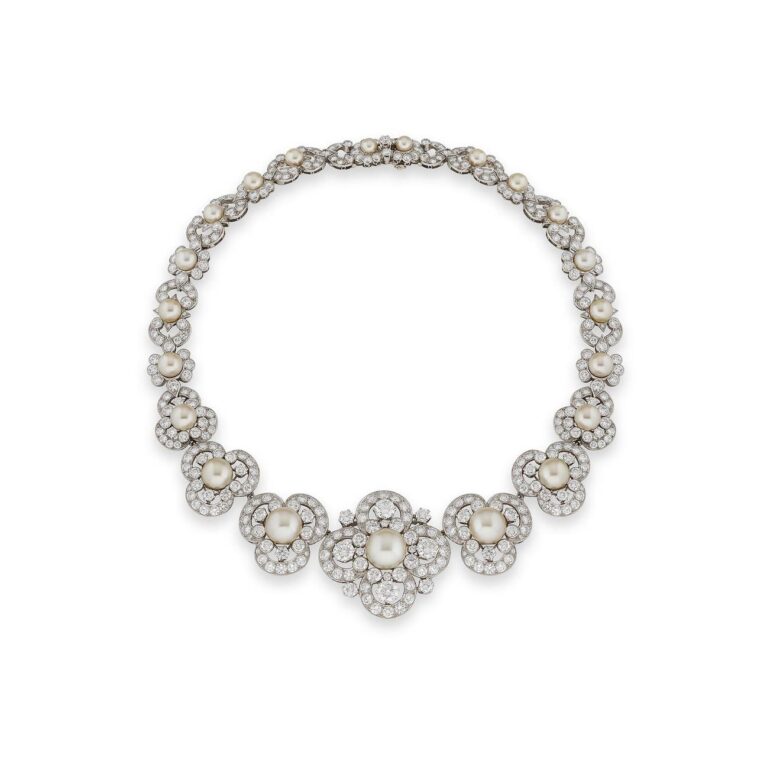
The appeal of an auction of this caliber often lies in the public reappearance of pieces whose provenance is linked to major historical events. Attention here centers on a necklace combining cultured pearls and diamonds, crafted in London during the interwar period. Created in 1928 by the Hennell workshops, this piece was made to a specific commission from Queen Mary. It was not a creation from scratch, but a faithful reproduction of a piece of jewelry of major symbolic significance: the famous “Golden Jubilee Necklace,” presented to Queen Victoria forty years earlier, in 1888.
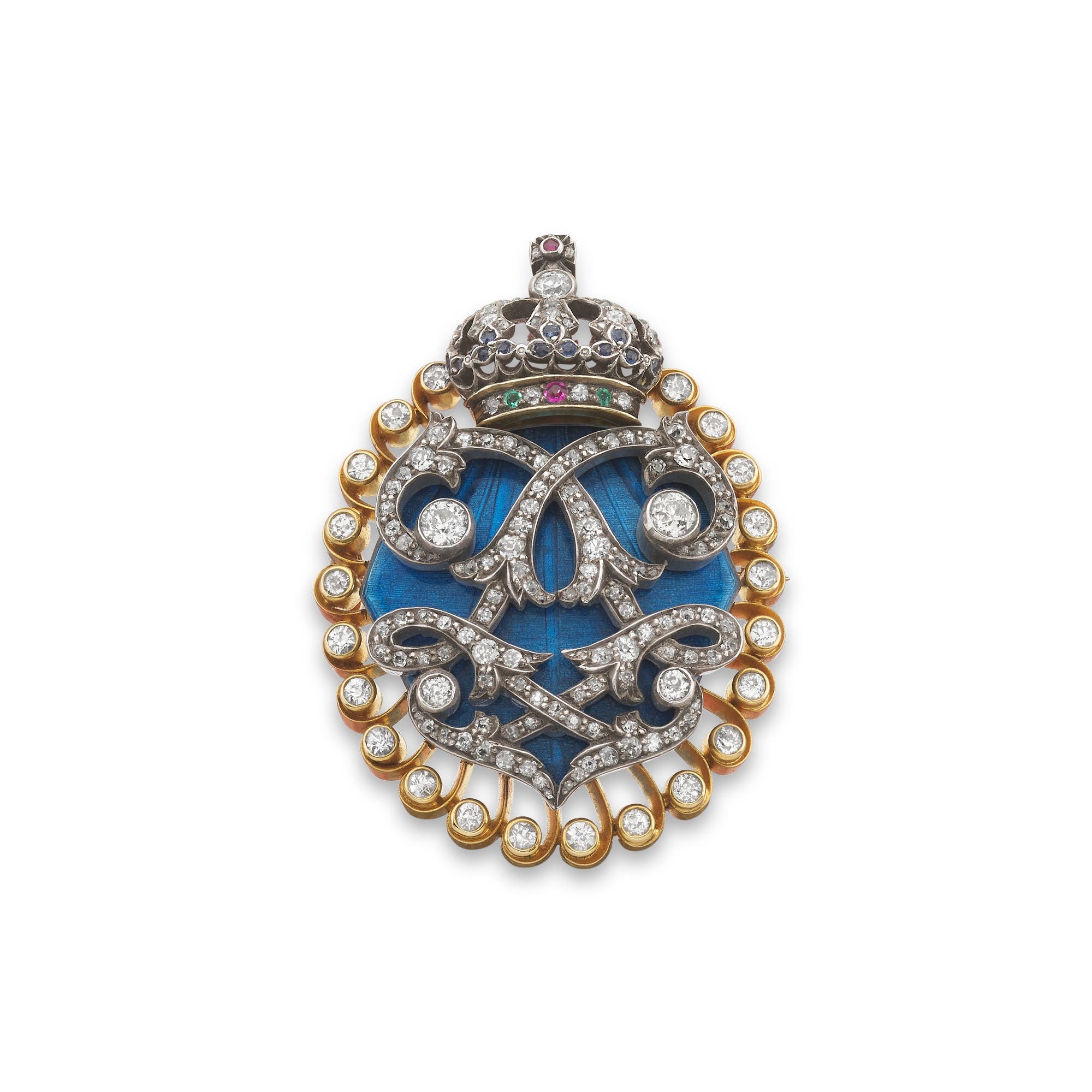
The history of this design speaks volumes about the patterns of inheritance within the British aristocracy. Queen Victoria herself had kept the original necklace until the end of her reign, after which it passed into the hands of her niece, Mary Somerset, Duchess of Beaufort. The design of this seminal piece has continued to shape royal protocol long after its creation, as Queen Elizabeth II made it one of her favorite pieces of jewelry, choosing to wear it during a pivotal moment of her own reign: her very first official opening of Parliament in 1952. The 1928 necklace, designed by Hennell, which Phillips will unveil in Geneva, directly echoes this dynastic legacy.
Intimacy and Style: From Rudolf Nureyev to the 1960s
Alongside royal commissions, the curation of this fall session explores another form of connection, this time linked to the world of the arts and Parisian elegance. The catalog features a gold cross, richly set with gemstones. The uniqueness of this devotional object lies in its former owner: the prima ballerina Rudolf Nureyev. The appearance of such a piece on the market offers a glimpse into the private life of a major figure in twentieth-century ballet.
The tone shifts dramatically with the introduction of creations that shaped the evolution of jewelry design during the Trente Glorieuses. The house of Van Cleef & Arpels is particularly well-represented through two lots that epitomize the boldness of the era. First among these is the “Liz” long necklace, a cascade of amethysts that illustrates a taste for color and fluid forms. In a more playful vein, the auction will also feature a “Puppy” brooch. This animal motif comes directly from the “La Boutique” line, an initiative launched by the Place Vendôme house in the 1960s to offer day jewelry that was more accessible, playful, and in tune with the changing lifestyles of a new clientele.
The color spectrum taken to its extreme
While provenance imbues jewelry with a soul, geological rarity dictates the laws of the market. Collectors converging on Geneva on November 9, 2026, will have their eyes fixed on a series of diamonds whose color defies mining statistics. The centerpiece of this session is a 1.35-carat diamond. Its weight, relatively modest on paper, pales in comparison to its certification: it is graded Fancy Vivid Blue. This grade—the highest on the colored diamond grading scale—guarantees extreme blue saturation, a natural phenomenon caused by the presence of minute traces of boron during the crystallization of carbon.
The fascination with chromatic anomalies continues with a particularly unusual collection, comprising nine colored diamonds all on its own. This collection serves as a veritable handbook of applied gemology, covering shades of absolute rarity. The collection includes two Fancy Purplish Red diamonds, a purplish-red hue that ranks among the most elusive in the world. Alongside them, the expert eye will be able to discern a Fancy Dark Gray-Violet, a Fancy Intense Green-Blue, and a Fancy Deep Purplish Pink. The spectrum broadens further to include solar and botanical hues with a Fancy Intense Yellow-Orange, a Fancy Yellow-Green, a Fancy Vivid Yellow, and, finally, a Fancy White diamond.
The Ultimate Quest for Optical Purity
As a counterpoint to this display of intense colors, Phillips will offer white diamonds at auction whose technical characteristics border on theoretical perfection. Attention is focused on a ring set with a 10.09-carat diamond. The laboratory report for this stone reads like a flawless record: its color is graded D—indicating a total absence of tint on the reference scale—and its clarity is certified as Flawless, signifying the absence of internal inclusions or surface blemishes, even under tenfold magnification with a loupe.
Even rarer, this diamond weighing over ten carats belongs to the Type IIa category. This scientific classification, which applies to only a tiny fraction of the diamonds mined worldwide, signifies a chemically pure structure, free of nitrogen, which gives the stone exceptional transparency, often compared to the clarity of water. Its physical proportions are further highlighted by a grade of “excellent” awarded jointly for its cut, polish, and symmetry, ensuring optimal light return.
Finally, for enthusiasts of vintage cuts—whose charm lies in less standardized facets and a warmer light than that of modern brilliant cuts—the auction includes a 9.77-carat diamond. The juxtaposition of this gem, cut according to the standards of a bygone era, with the geometric perfection of the 10.09-carat Flawless diamond epitomizes the philosophy of this sale. Through the display cases of the Hôtel President, two visions of jewelry will coexist for a few days: one that prioritizes the scientific precision of the raw material, and one that celebrates the patina of time, the artisan’s craftsmanship, and the enduring nature of memory.