Make Texture a preferred source on Google to support us
Add Texture to GoogleIn Tirana, the fall of 2026 has a taste of sulfur and fresh concrete. While the echoes of turbulent nighttime protests still reverberate off the facades of the Albanian capital, a strange calm reigns behind the walls of a reception villa made of raw concrete, tinged with a vibrant red. It is here, in this residence designed by Catalan architect Pablo Bofill, that the heart of an urban project unlike any other in Europe beats. Edi Rama, sixty-two, a painter and visual artist who became prime minister after serving as the city’s mayor, welcomes his guests here with the ease of a gallery curator. For him, architecture is not merely a matter of urban planning, but a diplomatic and cultural tool intended to permanently shatter the image of an Albania frozen in the austerity of the Enver Hoxha era.
The Face of the City: Living in a Nose
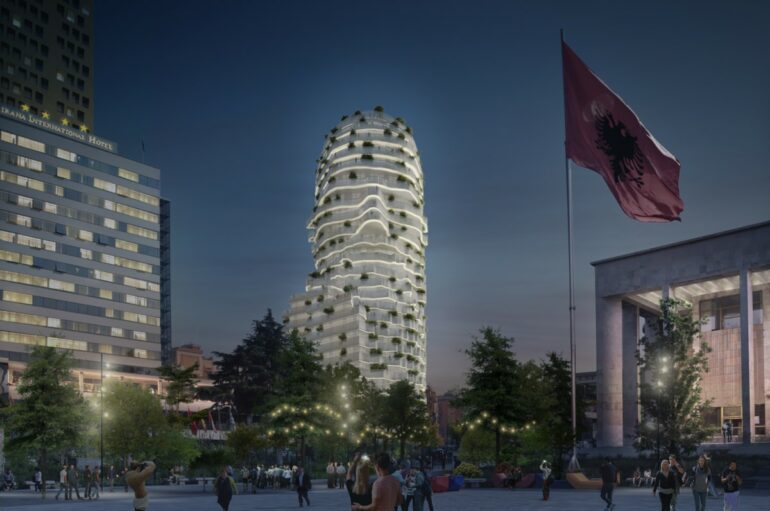
Amid this profusion of cranes, one building captures everyone’s curiosity: the Skanderbeg Building, also known as Tirana’s Rock. This project, whose construction began in 2021, pushes the concept of figurative architecture to its most radical extremes. Designed by the Dutch firm MVRDV in collaboration with Sfera Studio for the developers ANA sh.p.k. and VI&VI sh.p.k., the building takes the form of a giant bust. It is none other than Gjergj Kastrioti, known as Skanderbeg, the 15th-century national hero, who towers over the streets.
The technical feat relies on a series of undulating, continuous balconies, adorned with planters, whose projections and recesses literally sculpt the warrior’s features: his ears, beard, and nose. The structure also houses living spaces, raising an almost surreal question about the local real estate market: who would choose to buy a luxury apartment located precisely inside the nose of a national monument? The structure, with a height ranging between 85 and 89.5 meters according to technical specifications, offers a mix of uses. The first four levels, forming the hero’s shoulders, house offices and retail spaces, while the twenty upper floors, located in the head, are dedicated to residential use.
The Doctrine of Renaissance Through Design
This construction frenzy is no accident. Under the leadership of Edi Rama, Tirana has become the favorite playground of “starchitects.” The stated goal is to accelerate the country’s integration into the European Union by radically transforming its visual landscape. The MVRDV firm is omnipresent, not only with the Skanderbeg Tower but also with the transformation of the Tirana Pyramid—a former museum glorifying the dictatorship, now converted into a digital center for youth—and Downtown One. The latter, rising 40 stories high, is the first building in Albania to earn LEED Gold certification; its cantilevered sections cleverly form a map of Albania on its facade.
The city’s master plan, dubbed Tirana 2030 (TR030), was entrusted to the Italian architect Stefano Boeri. His vision is based on strict vertical densification, surrounded by a forest belt—the “Bosco Orbitale”—designed to curb urban sprawl. A few blocks away, the Danish firm BIG (Bjarke Ingels Group) is working on the new National Theater, a project that sparked intense controversy following the demolition of the historic building. The list of international firms involved reads like the table of contents of an encyclopedia of contemporary architecture: Zaha Hadid Architects with the residential complex The Nest and Cascades, the Portuguese firm OODA with the Hora Vertikale tower—a stack of thirteen cubes—and the Belgian firm 51N4E, responsible for the redevelopment of Skanderbeg Square and The Book Building. The list also includes the names of Álvaro Siza, Kengo Kuma, Snøhetta, and OMA, turning this small Adriatic capital into an open-air laboratory.
The Albanian ArchArmy and the Gray Areas
However, this spectacular architectural boom is raising growing questions about governance methods. In July 2026, the publication of a massive, nearly 800-page book titled *The Albanian Files: Freedom and Architecture* (Lars Müller Publishers, approximately €69) caused quite a stir. This book, which catalogs 60 international firms and 500 projects, offers a behind-the-scenes look at a public procurement system that is, to say the least, informal.

The book documents the existence of a private WhatsApp group called “Albanian ArchArmy.” This direct communication channel connects Edi Rama and his senior administration to the world’s leading architects, bypassing traditional procurement procedures. Testimonies from architects included in the book recount late-night contacts, impromptu meetings organized by intermediaries such as Pablo Bofill, and encounters with private developers driving around in SUVs, far removed from the usual administrative frameworks. One of them recounts being asked on May 1 to design 45,000 m² in Tirana without any prior call for bids, following a simple message from Adelajda Roka, director of the Territorial Development Agency.
A Legal Turning Point for the Urban Laboratory
While the “architectural renaissance” is an attractive showcase for foreign investors, it is now being caught up in legal realities. In July 2026, the opposition Democratic Party and several citizen groups filed criminal complaints with SPAK, Albania’s special agency for combating corruption and organized crime. The accounts contained in *The Albanian Files* are now being used as evidence to support charges of abuse of power, passive corruption, and money laundering directly targeting the Prime Minister.
For Edi Rama, who organizes an annual informal summit bringing architects from around the world to Tirana, this criticism is merely the inevitable turbulence of forced modernization. But between the formal audacity of a beard-shaped balcony and the opacity of mobile discussion groups, the line becomes blurred. Tirana continues to rise, but the shadow cast by its towers over Albanian democracy fuels a debate that now extends far beyond the realm of aesthetics and design. The capital has become the stage for a fundamental question: at what cost can a nation afford a new visual identity?