Make Texture a preferred source on Google to support us
Add Texture to GoogleSome watches seek to captivate through a proliferation of complications, power reserves, and historical references. The Monolith by Svea Atelier takes the opposite approach: it distills the design down to a single silhouette. Square without being quite square, cut at an angle, almost architectural, this first collection born in Sweden makes the case its manifesto. A risky approach for a young brand, but one that stands out clearly in a market where the round shape remains the norm.
A watch conceived as a design object
Svea Atelier arrives with a clear vision: the watch can be approached as a piece of furniture or an architectural detail worn on the wrist. Its very name draws on the Swedish imagination. Svea is an ancient poetic name for Sweden, and the company claims this heritage from Landskrona, where the watches are assembled. The components come from external partners, but final assembly is carried out by the brand in this southern Swedish city.
At the helm is Francis Jacquerye, former head of design at Longines. His career path mirrors that of several designers who, after shaping the identity of major houses, choose to leave established structures to bring a more personal vision to life. Max Büsser followed this path after leaving Harry Winston Rare Timepieces before launching MB&F; Sylvain Berneron had stepped down from his role as creative director at Breitling. At Svea Atelier, the break from Longines’ highly codified world is evident. The Monolith is neither a heritage watch nor a reissue of a “sport-chic” model.
Each project begins with a hand-drawn sketch. The process continues with 3D-printed prototypes, followed by the production of the final pieces. The design language evokes mid-20th-century Scandinavian modernism, certain objects from that period, and an almost constructive relationship with metal. The inspiration is not decorative: it shapes the proportions and the watch’s presence on the wrist.
The Case: A Statement of Character
The Monolith abandons the traditional circular watch case in favor of an asymmetrical shape. Its design evokes less a conventional case than a machined block, whose edges and offsets have been carefully composed. The comparison with the Rolex King Midas, created by Gérald Genta in the 1960s, naturally comes to mind: the same taste for a dense, angular shape, deliberately distinct from the classic watch. But Svea Atelier does not replicate the spectacular gold finish of that model. Instead, it draws inspiration from its geometric confidence.
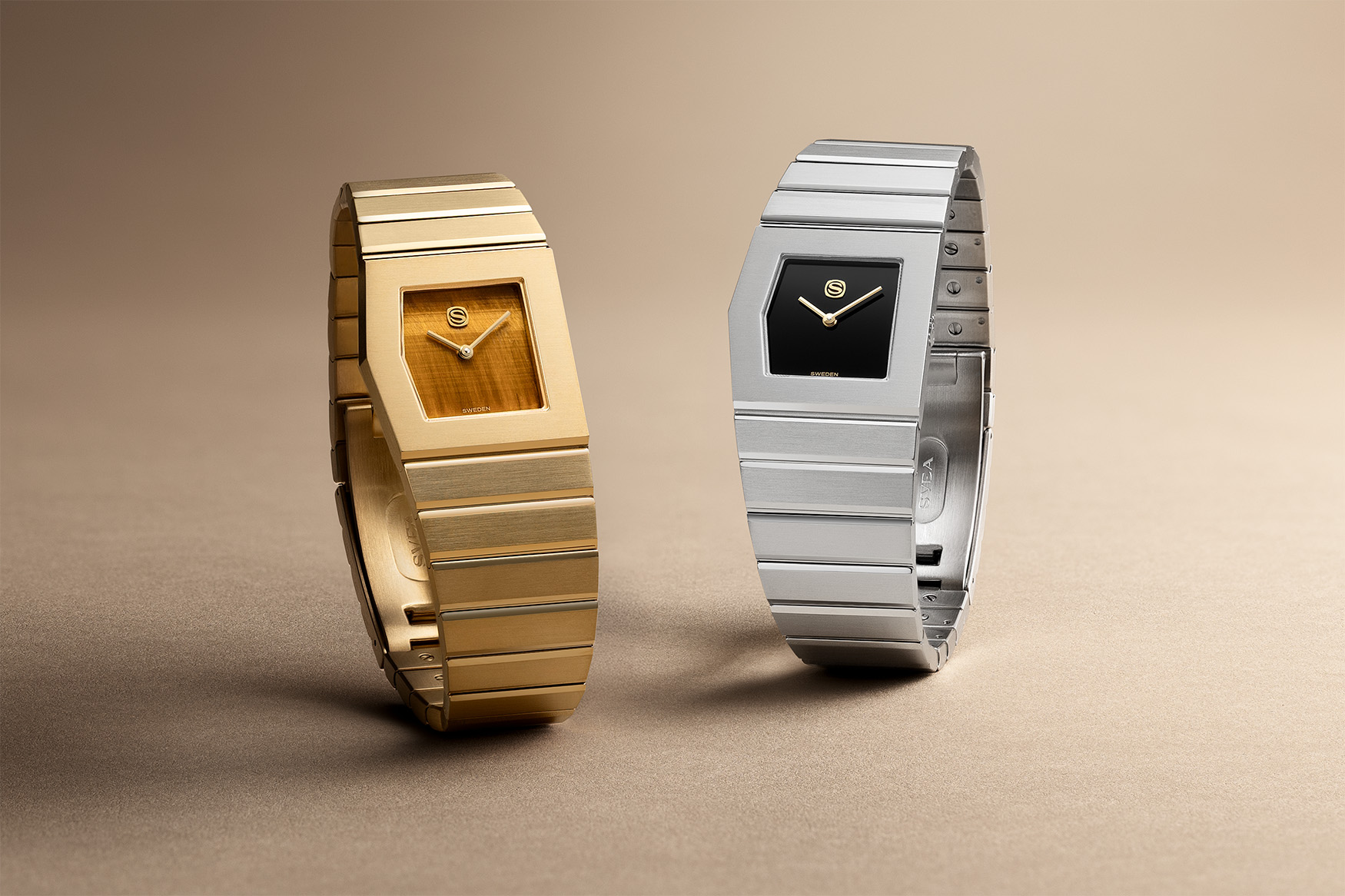
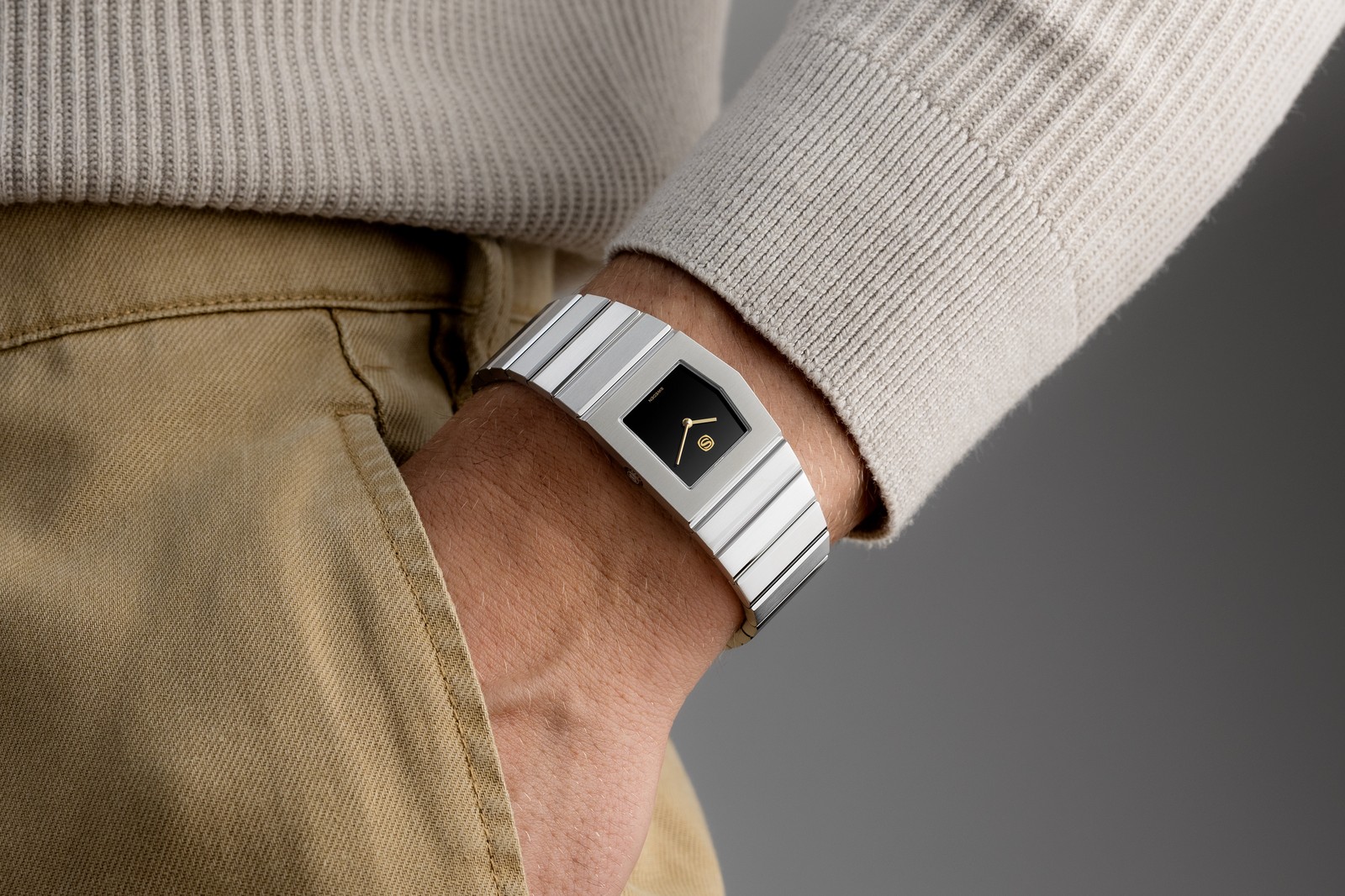
The five launch models share the same architecture: 27.5 mm wide, 27 mm long, and just 5.5 mm thick. These compact dimensions significantly alter how the watch is perceived. Despite its name, the Monolith does not come across as a massive watch; it is designed to be low-profile, to blend into the sleeve, and to make an impression through its design rather than its size. The case is crafted from 316L stainless steel.
The Lattice and Fjord variants feature a brushed finish that enhances the watch’s industrial minimalism. The Oxblood and Tiger Eye versions are finished with a gold PVD coating, introducing a warmer tone to this austere design. The Onyx, meanwhile, retains the uncoated stainless steel. This interplay of surfaces allows the character of the same watch to vary without altering its structure, as if each dial offered a different interpretation of a single original design.
Five Faces, One Architecture
The collection is divided into two families. The first, called Core, includes Lattice, Oxblood, and Fjord. These are the versions that most closely embody a graphic vision of the watch, where color and material set the tone without disrupting the case’s design.
Lattice is the most understated of the three. Its silver dial features a textile pattern reminiscent of linen, with a texture that almost blends into the brushed steel. The watch emphasizes shades with an immediate impact, and it is undoubtedly the one that most directly expresses the collection’s Nordic inspiration. In contrast, Oxblood features a glossy mirror dial in a deep burgundy, paired with a PVD-gold-plated case and bracelet. The color gives this version a more formal, almost nocturnal presence.
Fjord follows the same theme in a deep blue hue. Its deep, glossy blue dial catches the light more effectively and contrasts sharply with the brushed finish of its metal surroundings. These three models share the common approach of using the dial’s surface to enhance the watch’s overall volume: the goal is not to add decoration, but to alter the way the metal block is perceived.
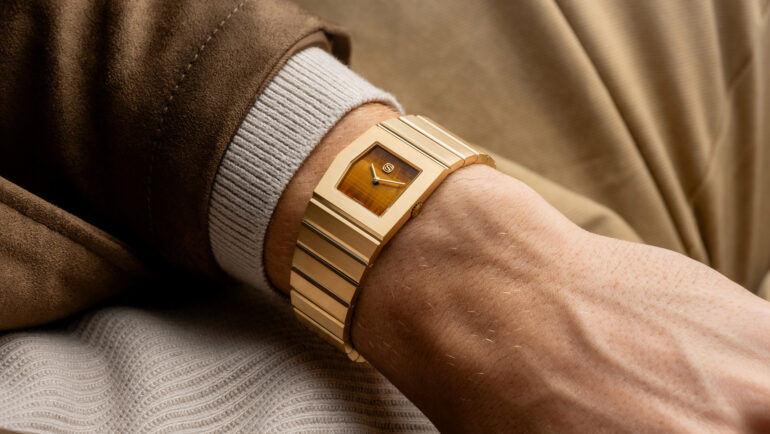
The two Monolith Atelier models take a different approach. Here, the dial ceases to be a mere colored surface and becomes a natural material. Tiger Eye features a polished tiger’s-eye dial; Onyx is set with a black onyx stone, also polished. The concept is simple, yet it gives each piece its own unique identity: natural stone never reproduces exactly the same patterns, veins, or variations in tone. Svea Atelier has announced these two variations as limited editions, without specifying the planned number of pieces.

Quartz as a Choice of Consistency
In an industry where the mechanical movement often serves as the primary justification for the price, Svea Atelier takes a more straightforward approach. The five Monolith models are powered by the Swiss Ronda 1062 quartz movement. It displays the hours and minutes, with no date or additional functions. This choice may frustrate enthusiasts who judge a watch by its mechanical complexity, but it aligns with the brand’s vision: here, the value lies in the design, the refinement, and the visible materials.
The watch is protected by a sapphire crystal with six layers of anti-reflective coating. It is water-resistant to 50 meters, or 5 bars—a specification suited for everyday use, without attempting to turn this design piece into a utility watch. The metal bracelet features the same finish as the case—steel or gold PVD—and can be adjusted using removable links. It fastens with a single-fold deployant clasp.
This bracelet contributes to the Monolith’s overall balance. With such a compact design, the continuity between the case and the metal on the wrist is essential. A leather strap would likely have shifted the watch into the realm of jewelry; steel, on the other hand, preserves the impression of a monolithic object—a small, portable creation. Each piece comes in a burl wood box, a detail that contrasts with the industrial restraint of the overall design without detracting from it.
A price based on design, not on technical specifications
The Core, Lattice, Oxblood, and Fjord models are priced at 680 euros before tax, or approximately 572 British pounds or 760 dollars. The Atelier versions with stone dials—Tiger Eye and Onyx—are priced at 780 euros before tax, approximately 656 pounds or 870 dollars. The price difference remains reasonable given the use of tiger’s eye and onyx—two materials whose natural variations make each dial unique.
The positioning will require a less conventional view of watchmaking. A buyer focused solely on the movement might compare the Ronda quartz movement to mechanical alternatives offered in the same price range. But the Monolith isn’t playing that game. It’s aimed at those who choose a watch the same way they would choose a pair of glasses, an armchair, or a ring: for the precision of its lines, its relationship to materials, and the way it enhances one’s silhouette.
Pre-orders will open on October 21, with deliveries scheduled to begin in early January 2027. Discover the Monolith collection on the Svea Atelier website. For its debut, the brand stays true to its vision: five dials, a single case design, and a take on the Swedish watch that favors clean lines over nostalgia.