Make Texture a preferred source on Google to support us
Add Texture to GoogleThe casual shopper no longer really fits into the picture. For a long time, the luxury industry gauged its desirability by the length of the lines that stretched along the sidewalks of major shopping streets. Those days seem to be over. Third-quarter figures paint an unprecedented picture of high-end consumption: window shoppers are disappearing, but buyers remain. Faced with a sluggish macroeconomic climate, the challenge for major players is no longer to attract crowds, but to capture the attention of a highly targeted clientele. A paradigm shift in which spontaneous browsing gives way to private appointments, and where prestige is now measured by the ability to sell more to a handful of insiders rather than to a multitude of casual visitors.
The Strategy of Emptiness: Reducing Footprint to Amplify Desire
The most dramatic manifestation of this shift is evident in commercial real estate. Gone is the era of unbridled territorial expansion; the time has come for surgical retrenchment. At Kering, the streamlining of its store portfolio is taking on the appearance of a strategic purge. In the first nine months of the year, the group closed 128 locations, while opening only 23. With a net total of 105 closures, the initial annual target was shattered even before winter began. Management has also had to revise its forecasts upward, anticipating at least 125 permanent closures for the current fiscal year—a striking jump from the 75 closures recorded the previous year.
This trend toward contraction is also evident at Ermenegildo Zegna. With organic growth of 8.2% and revenue rising to 433.8 million euros for the quarter, the Italian group demonstrates that it is possible to boost revenue by scaling back operations. As of the end of September, its network of single-brand stores stood at 650 locations, down by 20 stores in one year. Four stores closed in the third quarter alone. Yet the Zegna brand posted organic growth of 12.7%, driven by a 16.4% surge in its company-operated network. The strategy of its executive chairman, Ermenegildo Zegna, is based on a clear premise: hyper-control. Direct-to-consumer sales now account for 84% of the brand’s revenue, up from 82% twelve months earlier. Exclusivity is maintained by limiting the number of physical stores and deepening customer relationships, built on a century-old legacy.
The anatomy of a slowdown: when foot traffic declines, average transaction value holds steady
Behind the doors of these increasingly scarce boutiques, foot traffic is dwindling. Kering’s direct sales slipped by 3% in the third quarter, bringing the group’s revenue to 3.345 billion euros. The performance of Gucci, the conglomerate’s financial lifeline, illustrates this sluggishness. The Italian brand saw a 6% overall decline (to 1.29 billion euros) and a 9% drop in its own store network. A regional breakdown reveals a clear slowdown in the Asia-Pacific region, weighed down by declining foot traffic at stores in Japan and mainland China.
However, the weak sales figures do not reflect a collapse in demand. While store doors are opening less frequently, payment terminals are running at full capacity. Kering maintains solid levels across its most critical metrics: the conversion rate remains steady, while the selling price and average ticket hold firm. Luca de Meo, the group’s CEO, views this quarter as a step in line with the roadmap, reaffirming that Gucci’s revival through product development and the renewal of its appeal dictates the immediate agenda.
The Unwavering Consistency of the Artisanal Model
In this rapidly evolving landscape, Hermès continues to chart its own distinct course. The Faubourg Saint-Honoré seems impervious to the turbulence shaking its competitors, validating the relevance of a model based on the very highest level of craftsmanship. Its historic division—leather goods and saddlery—now accounts for 46% of revenue for the first nine months of the year. In the third quarter, this segment even enjoyed a slight acceleration, posting growth of 10.8% (compared to 10.2% over the first nine months), driven jointly by new designs and the enduring appeal of the house’s classics.
The behavior of its local customer base has proven to be a formidable shield against the volatility of tourism. In Japan, the brand’s loyal customers drove local sales up 10.5% over the first nine months and 9.6% in the last quarter. The French market is following a similar trend. The only clouds on the horizon stem from currency dynamics: the yen’s plunge automatically eroded Japanese growth once consolidated, resulting in a 0.3% decline in reported revenue to 1.2 billion euros for the period. Axel Dumas, Hermès’s executive chairman, defends this profitability strategy designed to withstand short-term cycles. However, a slowdown is evident in growth rates at constant exchange rates: the company’s growth rate fell from 6.1% in the first half of the year to 4.3% in the third quarter. Elsewhere in Asia, outside of Japan, business has stagnated. The South Korean market has emerged as the regional anchor, offsetting a mainland China stuck in a complex economic climate.
Resilience and Turbulence Within Broad-Based Portfolios
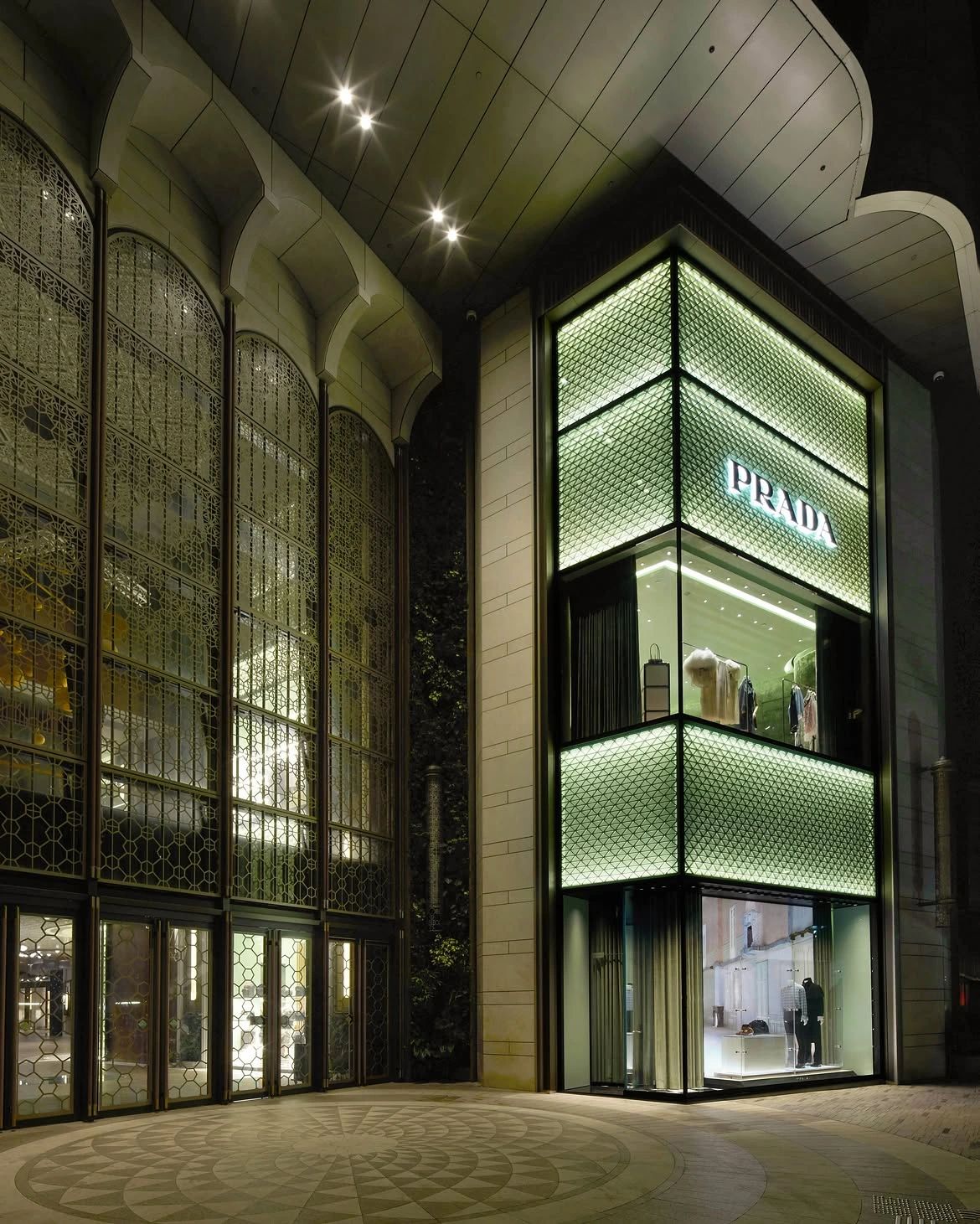
Performance analysis becomes more complex when examining conglomerates with shifting structures. At the Prada Group, net revenue for the first nine months surpassed the 4.5 billion euro mark, marking a 15% increase at constant exchange rates. This apparent vitality, however, masks deep internal disparities and the mechanical effect of Versace’s integration. Consolidated for the first time this fiscal year, the Medusa-branded fashion house contributed 441 million euros to the group’s coffers, accounting for nearly 10% of the company’s total revenue.
In terms of organic retail sales, the Italian group has stalled, showing complete stability in the third quarter—a sharp contrast to the 8% growth posted the previous year. The Prada brand is just barely staying afloat with a modest 1% increase for the quarter and 2% for the first nine months. The shock comes from Miu Miu. The brand, typically prized for its niche positioning, suffered a sharp 41% year-over-year drop in retail sales over the first three quarters, and a 3% decline in the most recent quarter alone. Andrea Guerra, CEO of the Prada Group, downplays this upheaval by highlighting Miu Miu’s stability outside the Middle Eastern market. He defends the overall effectiveness of the distribution network and sets the stage for Versace’s next creative phase.
The Winter of Creative Upheaval
The fourth quarter will serve as the ultimate arbiter. The end-of-year festivities are approaching, but they will face historically high comparison bases. To rekindle the enthusiasm of a clientele that has become increasingly discerning in its choices, management teams are betting heavily on aesthetic shock value and the rotation of designers.
The January schedule is already crystallizing the industry’s expectations. Hermès will play two major cards with the introduction of the men’s collection designed by Grace Wales Bonner, as well as the highly anticipated launch of the couture line conceived by Nadège Vanhée. For its part, Versace will unveil its first collections under the Prada Group’s umbrella. Meanwhile, the fashion landscape remains incomplete, with the market still awaiting the appointment of future creative directors at Saint Laurent and Alexander McQueen.
The era of euphoria, when simply having a storefront was enough to reap financial rewards, is over. Today, the act of purchasing is no longer simply the culmination of a stroll through the city. In this streamlined and fiercely selective ecosystem, the decisive advantage belongs to brands capable of maintaining a direct, exclusive, and uninterrupted dialogue with their core clientele.