
Make Texture a preferred source on Google to support us
Add Texture to GoogleIndian fabrics brought by Florentine merchants, followed by a designer from New Delhi invited to present his work in Florence: Kartik Kumra sees this connection as more than just a coincidence of timing. For his appearance at Pitti Uomo in January 2027, the founder of Kartik Research intends to revisit this historic flow of textiles—but to reverse its direction. This time, the designer who works with them will also offer his own interpretation. The shift is subtle, almost literal. Yet it gives this invitation its significance: viewing Indian design through its own lens, rather than as a reservoir of materials for the European imagination.
Florence: Destination and Subject of Research
The project conceived for Florence will take as its starting point a historical connection that Kumra wishes to explore: the role of Florentine merchants in the journey of Indian textiles and the way these fabrics contributed to the visual universe associated with the city. The designer is also interested in what these fabrics may have represented in terms of desire and distinction. His focus, therefore, is as much on the circulation of goods as on that of tastes.
This approach avoids treating Florence as merely a prestigious backdrop. The city itself becomes the subject of the work being presented. From this perspective, the invitation from Pitti offers an opportunity to revive a long-standing exchange from across the river: a fashion house based in New Delhi revisits a history in which its country’s textiles were one of the key elements. Kumra sees this as an opportunity to continue his research, allowing encounters and places to shape its direction.
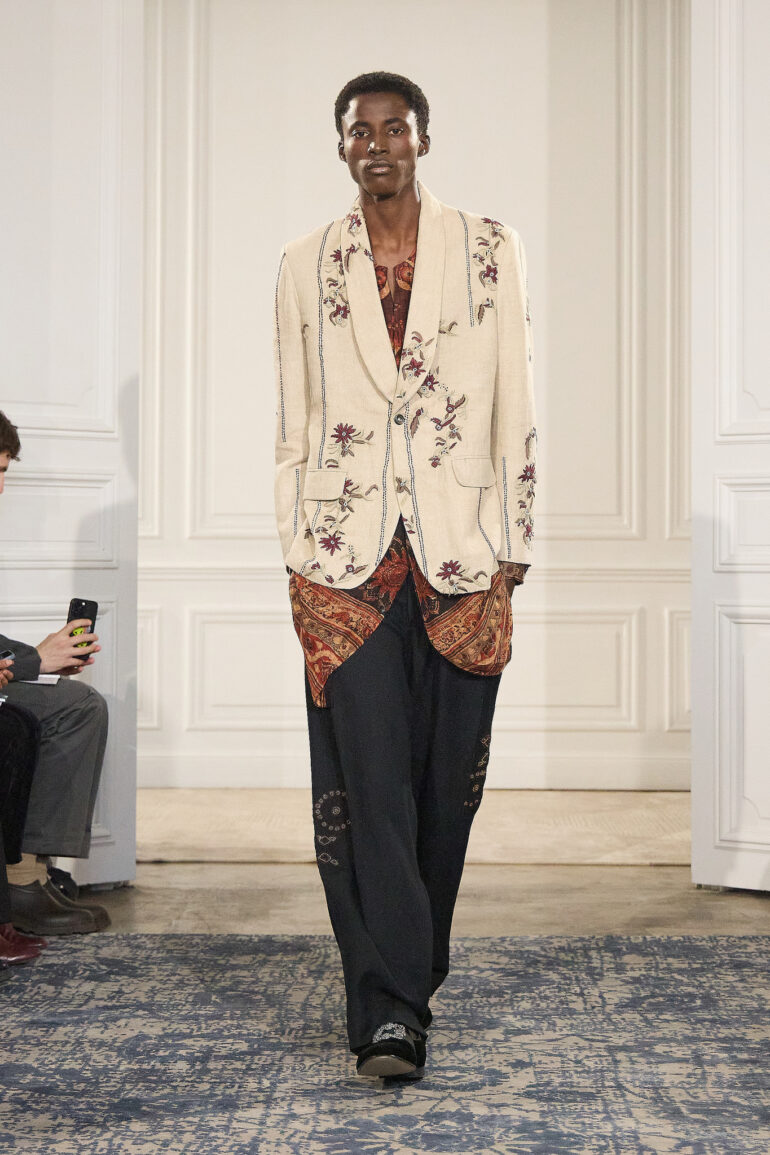
We’ll have to wait for the presentation to discover how this concept translates into clothing. The information released so far does not yet allow for a description of the pieces or the precise format of the event. This discretion is significant: the appeal of the event currently lies in an intention—that of connecting a textile history with the contemporary vision of an independent designer.
A young fashion house already reaching far beyond Delhi
Founded in 2021, Kartik Research now operates two flagship stores, in Delhi and New York. This dual presence makes its ambition quite clear. The creative center of gravity remains in India, while the brand caters to an international clientele. Its commercial development gives this dialogue a tangible dimension: the garments are not merely discussed in the context of craftsmanship; they have found a place in retail spaces with distinct identities.
Mr Porter, Selfridges, and Harrods carry the collections, as do Lane Crawford, Biotop, and Mohawk General Store. Added to this is Dover Street Market, with locations in London, New York, Los Angeles, Ginza, Paris, and Beijing. The scope of this network matters less as a list of achievements than as an indicator of acceptance. A collection rooted in Indian techniques can now be viewed and purchased in several capital cities without losing its local identity.
Kumra’s personal recognition has come at a steady pace. In 2025, he was named to the BoF 500 and Time magazine’s list of the 100 most influential people, while also receiving the FTA 2025 Guest Country Award—India. In 2026, he was among the semifinalists for the LVMH Prize. These accolades alone do not define the value of the garments. They do, however, serve as a measure of the attention a still-young brand has garnered in just a few years.
Handcrafting as a Starting Point
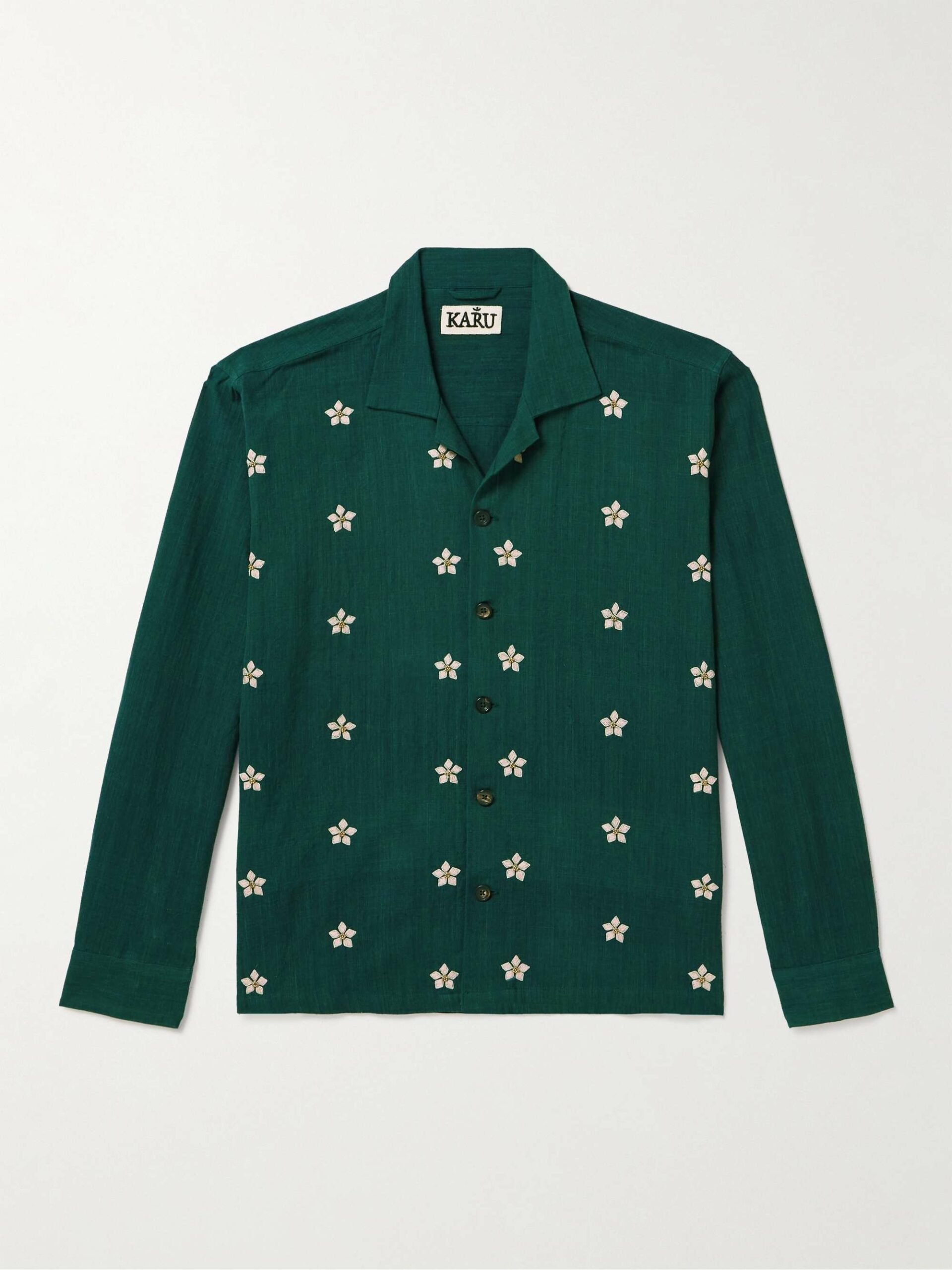
To understand what lies behind this visibility, we must look at the manufacturing process. At Kartik Research, fabrics are woven on manual looms and embroidery is done by hand. The brand collaborates with master artisans who are working to revive forgotten Indian crafts. The human touch, therefore, does not merely serve to embellish a surface; it plays a role in the garment’s construction right from the fabric stage.
Kumra thus champions a way of dressing that makes the presence of those who produce the garments tangible. This is a specific ambition, one that goes beyond merely using a few decorative symbols of authenticity. It forges a relationship with the custodians of this knowledge and raises the question of their place in contemporary design. Bringing these practices to the attention of a global audience means giving them a presence in the present, not merely highlighting their historical significance.
Distinction is essential in the luxury sector. A technique can be presented as a precious relic, or it can become the instrument of a new vision. Kartik Research’s work prioritizes this second possibility. The irregularities inherent in handcrafted work find their value here without the need to turn the garment into an object of nostalgia. What matters is not so much the promise of an unspoiled past as the ability of craftsmanship to produce contemporary forms.

From Psychedelic Rock to Indo-Modernist Art
Kumra’s references shed light on this perspective. His collections draw notably from 1960s psychedelic rock and 1980s Indo-Modernist art. Between these two sources of inspiration, there is no narrative of a static India. On the contrary, we encounter cultural expressions rooted in different eras, each with its own aspirations and ways of subverting conventions.
This appreciation for Indian subcultures lends depth to the project. Here, heritage does not refer solely to a set of passed-down techniques; it also encompasses images, sensibilities, and artistic movements. Kumra explores how artisanal practices can bear the mark of these transformations. The past to which he refers is therefore not homogeneous; it already contains ruptures.
This is where the project gains its uniqueness. Combining hand weaving with musical or artistic references allows us to move beyond a overly simplistic opposition between tradition and modernity. The question becomes more intriguing: what can an ancient technique reveal when it encounters a culture that has itself sought to transform forms? At Kartik Research, this inquiry serves as a creative foundation rather than merely a sales pitch.
What Pitti Chooses to Highlight
Francesca Tacconi, head of special events at Pitti Immagine, pinpointed the significance of this invitation precisely in the brand’s line of thinking. She emphasized the contemporary nature of the silhouettes and an approach to craftsmanship free from nostalgic celebration. In her view, Indian techniques should be recognized for their creative and intellectual merit, rather than being confined to an “exotic” category.
Pitti’s choice thus embodies a certain definition of luxury: value also lies in the knowledge embodied in the gesture, in the variations of manual labor, and in the ability to distill from it a contemporary language. This perspective aligns with Kumra’s project without reducing it to a preservation mission. Preserving a craft and opening up a creative future for it are two interconnected yet distinct ambitions.
Kartik Research will be the second guest designer at the 111th edition of Pitti Immagine Uomo, scheduled to take place in Florence from January 12 to 15, 2027, following Dunhill. Kumra understands what it means for his independent house to join a program in which many designers before him have participated. His event is scheduled for Wednesday, January 13, the day before Dunhill’s presentation. On that date, his exploration of the journey of Indian fabrics will move beyond the realm of intention to take on a tangible form in Florence.