

Make Texture a preferred source on Google to support us
Add Texture to GoogleThe craftsman’s chisel glides across the metal surface with extreme slowness, dictated by the precision required by this age-old craft. Under the binocular lens, microscopic scrolls take shape on a component barely larger than a match head. This part—the balance bridge—will become the invisible signature of a timepiece assembled thousands of kilometers away, in the silence of the Saxon valleys. Placing this microcosm of absolute precision in the midst of Singapore’s ceaseless flow of people and commercial frenzy is the result of a carefully orchestrated setup. It is this contrast that A. Lange & Söhne is currently capitalizing on by physically relocating its master craftsmen from Glashütte to the air-conditioned corridors of the ION Orchard complex.
The mechanics of fluids and those of time
The pop-up installation, aptly named “Challenging Chronographs,” revolves around a shared obsession between two worlds that constantly intersect: fine watchmaking and classic cars. Enthusiasts of complex movements share the same vocabulary as lovers of historic automobiles. On both sides, discussions revolve around energy transmission, hand-finished details, polished gears, and friction. The German manufacturer does not cultivate this connection out of mere aesthetic opportunism; it has firmly established itself within the world’s most exclusive concours d’élégance circuits.
The Saxon brand establishes its institutional presence on the manicured lawns where vintage bodywork is judged, scrutinizing the condition of the chassis with the same uncompromising standards it applies to its own exhaust systems. The Singapore exhibition traces this connection to the Concorso d’Eleganza Villa d’Este, where the streamlined silhouettes are reflected in the waters of Lake Como, as well as in the royal avenues of Hampton Court Palace in England, not to mention the gatherings overlooking the ocean at the Audrain Newport. These events do more than simply showcase rare vehicles; they celebrate the obsessive preservation of mechanical heritage by awarding the industry’s most coveted prizes. A philosophy of preservation and technical perfection that directly echoes the maintenance of the manual craftsmanship of haute horlogerie championed by the manufacture.
The Genealogy of a Technical Breakthrough
To understand the fascination with short-term timekeeping, the space at ION Orchard breaks down a very specific lineage within the brand’s catalog. It all begins with a key date: 1999. That year, the industry discovered the Datograph. The introduction of this model marked a clear break from the traditional approach to the chronograph. By unveiling a movement with a groundbreaking architecture, featuring a large date display, the watchmaker challenged the technical conventions of the time and established a new visual and mechanical standard.
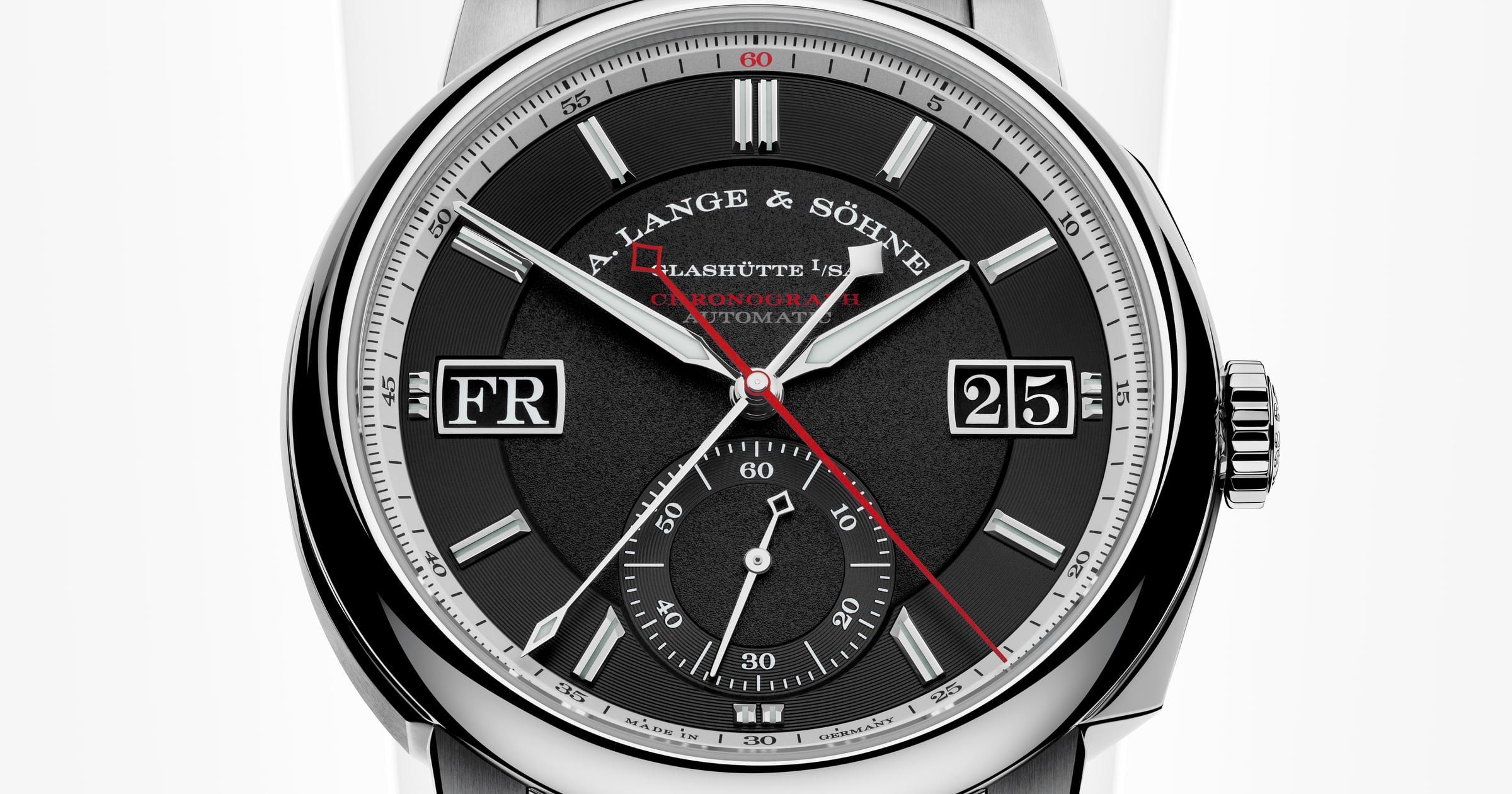
The exhibition demonstrates how Saxon engineering refused to let this breakthrough become stagnant. The display cases showcase the variations of this seminal collection to illustrate a bold technical escalation. The evolution begins with the Double Split—a timepiece capable of timing two simultaneous events with a set of split-seconds hands—and reaches its climax with the Triple Split. The latter pushes the logic of time division to a structural scale that defies conventional watchmaking understanding. The story told through these cases is not merely a juxtaposition of components, but rather a quest for mastery over fractions of a second—an ambition that resonates with the demands for precision faced by drivers competing in historic rallies.

The Workbench Facing the Public
Observing gear trains behind glass quickly reaches its limits for anyone seeking to grasp the reality of the manufacturing process. The watchmaker therefore chose to physically embody his vision. Two key figures from the workshop traveled from Germany to perform their tasks live: a master watchmaker and a master engraver. Their presence radically alters the atmosphere of the atrium, transforming a theoretical exhibition into a direct encounter with the material.
Assembling a chronograph requires a choreographed sequence of adjustments to levers and cams that machines cannot fully automate. The master watchmaker explains these critical steps, making the intricate web of components that characterizes the back of a Datograph easy to understand. Just a few centimeters away, the engraver works freehand. The balance bridge—that small metal bar responsible for holding the watch’s regulating organ in place—is carved without any stencil. Every notch, every variation in depth and angle forms a fingerprint unique to the artisan, making it theoretically impossible for two calibers to be strictly identical. Visitors can watch this steel tip bite into the brass—a gesture that requires total relaxation of muscle tension and absolute stillness of the wrist.
A Chronology of Access Down to the Millimeter
The logistics of this off-site workshop require a great deal of planning. The first level of the atrium, although located at the heart of one of the city-state’s busiest commercial hubs at 2 Orchard Turn, has been redesigned to draw attention to the workbenches. This Saxon enclave will remain open through October 30.
Demonstrations of freehand engraving and watch assembly take place daily, from 10 a.m. to 9 p.m. However, the close quarters required to observe the infinitely small dictate their own rules. The number of visitors is intentionally limited to ensure close proximity to the Glashütte artisans and preserve their level of concentration. To participate in guided tours and benefit from detailed technical explanations, advance reservation via the dedicated platform Events.alange-soehne.com is required. This access restriction filters the flow of passersby, retaining only those willing to pause long enough to observe the crisp engagement of a column wheel or the emergence of a floral motif in the metal.