
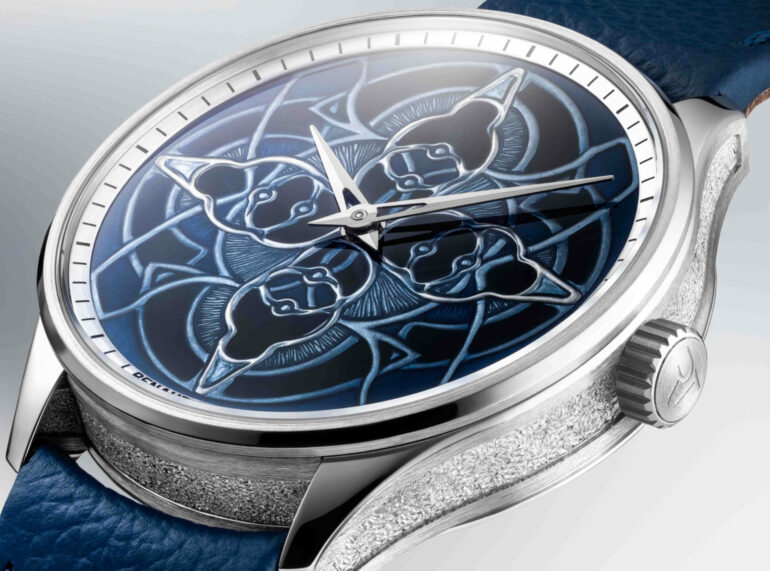
At 18,000 vibrations per hour, the Monday Organica goes against the grain of the standard frequency now common in contemporary watchmaking. Its movement beats at 2.5 Hz, whereas 4 Hz has become the norm. This choice, made by Renaud Tixier, is not driven by mechanical nostalgia: at this slower frequency, the movement of the balance wheel and hairspring becomes more visible. The watch thus seems to devote as much time to what it displays as to what it measures.
This approach sums up the conclusion of the Organica cycle quite well. Following a first blue version unveiled a year earlier, the brand is completing its Monday series with two new interpretations: Black and Bordeaux. Each is produced in a limited edition of seven pieces, exactly like the original model. Thus, only twenty-one watches make up this triptych, before Renaud Tixier opens the chapter announced under the name Tuesday.
A movement that doesn’t try to hide
The in-house movement is called the RVI2023. It is an automatic movement with a micro-rotor—an architecture that typically offers a clearer view of the movement’s components than a central rotor. Here, this micro-rotor is assisted by a flying weight designed to improve winding efficiency. The movement offers a 60-hour power reserve.
The relative slowness of its oscillator gives the movement a distinctive character. High frequencies are often associated with the idea of modern precision, but haute horlogerie retains a certain preference for more measured beats. These make the regulator’s movement less abstract and more visible to the eye. In this Monday Organica, the movement echoes the dial’s design: both invite the viewer to observe elements that are usually hidden behind the watch’s facade.
Water resistance is rated at 30 meters, or 3 bar. This specification is consistent with a timepiece whose focus is neither sport nor functionality, but rather the expression of craftsmanship in materials and engraving.
The Plant Kingdom as a Watchmaking Vocabulary
The name “Organica” is based on a carefully exploited ambiguity. It evokes the natural world, plant forms, and floral motifs, while also referring to the watch’s regulating organ. This dual meaning structures the dials of the Black and Bordeaux editions, crafted in grand feu enamel by the Ateliers Olivier Vaucher.
The engraved design does not seek to depict a recognizable flower. Rather, it operates through hybridization. The small circles recall the rubies used in the movements; the large circular shapes bring to mind balance wheels. Straddling the line between imaginary botany and mechanical schematics, the dial creates a surface that does not reveal itself at first glance. One might see a floral design, only to later discern the silhouettes of components essential to the caliber’s function.
The grand feu enamel lends these compositions a depth that goes beyond a simple play of color. The black of the Black version lends the motif an almost mineral-like quality—dense and reserved. The burgundy of the other model lends the watch a more sensual warmth, without obscuring the engraved design. In both cases, color is not merely an interchangeable finish: it plays an integral part in the story the series aims to tell.
Roots, Flowers, and Fruit
The trilogy is not based solely on three color variations. Renaud Tixier attributes a botanical trajectory to it. Black embodies the buried part of the plant—the roots and the earth. The blue of the first model corresponds to flowering. Finally, burgundy suggests the fruit that emerges after pollination.
This structure gives each piece a distinct role, rather than reducing the new releases to merely two additional colors. The Black remains in the shadows, at the starting point of the cycle; the Blue, already introduced, represents its visible and expansive moment; the Bordeaux conveys a sense of fulfillment. The collection as a whole may bring to mind certain plants with blue flowers and red fruits, such as the bittersweet nightshade, known for its toxicity. This botanical reference is less decorative than it appears, and it introduces a touch of strangeness into a deliberately organic design.
This offers a rather unique way of viewing the watch collection: not as a succession of variations, but as the interconnected stages of a single organism. The extremely limited production run reinforces this impression. With only seven pieces per color, the goal is not to replicate a catalog success but to bring a specific sequence to a close.

The weight of platinum, the warmth of gold
The two watches share the same proportions, but not the same presence on the wrist. The case measures 40.8 mm in diameter and 10.5 mm in thickness, not including the crystal. These dimensions give the Monday Organica a commanding presence. Their density contributes just as much: the Black model is crafted from platinum, while the Bordeaux model is made of 5N rose gold.
Both metals are heavy, with platinum being even heavier. The Black version thus pairs its dark dial with a case whose white sheen retains a very cool luminosity. The Bordeaux takes the opposite approach: the rosy hue of the gold creates a warmer contrast with its enamel. The materials, therefore, do more than simply frame two different dials; they alter the way colors are perceived and the watch’s physical presence on the wrist.
The case’s finish avoids uniformity. The tops of the lugs are polished, their sides feature a brushed finish, and the middle section is hand-engraved with a frosted texture. These contrasts are particularly striking on a case of this size. They catch the light without making the watch appear overly flashy, and they extend the sense of a dynamic surface already established by the dial.
The Black model is mounted on a black Monroe calfskin strap, fastened with a white gold pin buckle. The Bordeaux, meanwhile, features a beige Island calfskin strap and a rose gold pin buckle. The choice of beige for the strap provides visual breathing room: it prevents the burgundy and rose gold from forming an overly compact ensemble, while maintaining a chromatic connection to the concept of fruit and plant matter.
A collection completed before the next day
Pricing for the Monday Organica Black and Bordeaux is available upon request. The previous Blue model, also crafted in platinum, was priced at 125,000 Swiss francs, or approximately 113,000 British pounds. This benchmark naturally places the two new creations in a similar price range, though no specific price has been announced.
Rarity, in this case, is not an afterthought: it is inherent in the very structure of the project. Seven blue pieces, seven black, and seven burgundy. Once this cycle is complete, the brand does not plan to extend the motif indefinitely. It is now turning its attention to “Tuesday,” its next major project. In the meantime, the three Organica watches are united by a single concept: creating a dialogue between plants, metal, enamel, and the slow beat of a movement that reveals its very rhythm.
Information about the brand’s creations is available on Renaud Tixier’s website.