Make Texture a preferred source on Google to support us
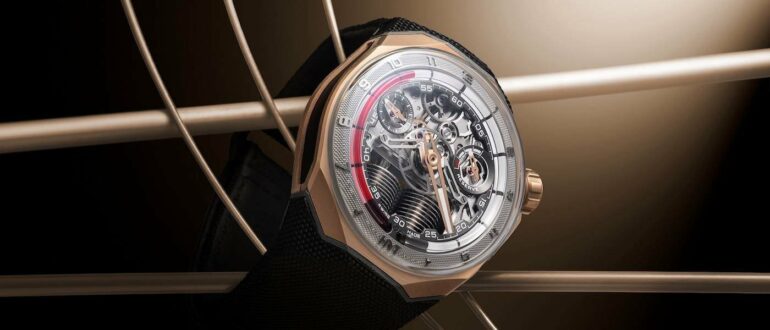
Add Texture to GoogleA 45-mm watch whose time advances inside a glass tube, worn as a design piece rather than consulted as an instrument: the HYT paradox is encapsulated in this miniature spectacle. The Swiss brand has taken the least conventional approach in contemporary watchmaking. While the industry has spent centuries perfecting hands, wheels, and escapements, HYT has chosen to circulate two liquids through a capillary tube. At the heart of this adventure, having long remained behind the scenes, Lucien Vouillamoz reemerges today with the determination to speak out once more on behalf of a brand whose history has been anything but straightforward.
A Watch Born of Doubt
The starting point is not a nostalgic fascination with old measuring techniques. Rather, it is a rather blunt question: what do we really expect from a high-end watch, when a cell phone provides a free, accurate, and satellite-corrected time? For Lucien Vouillamoz, the independent timepiece does not, therefore, justify itself through its practical efficiency. It is a matter of emotion, technical prowess, and a certain taste for unreasonable ideas.
The idea of using liquid as a time indicator stems from a discussion among friends during Expo.02, the Swiss national exhibition held across three lakes. This quickly led to a predecessor far older than mechanical watchmaking: the clepsydra, a water clock used some 3,500 years ago. HYT was thus able to pay homage to the watchmakers who proudly claim several centuries of history: its inspiration, however, dates back to around 1500 BCE.
For a long time, however, the project remained merely an intuition. It was in 2008 that Naomi, Lucien Vouillamoz’s eldest daughter, urged her father to make a decision: either turn this idea into a business or stop talking about it. This family push served as a catalyst. Vouillamoz then partnered with Patrick Berdoz, a former business partner who had become president of HYT and Preciflex. One provided the funding, the other the technology, with the initial understanding that the venture might fail quickly. Their agreement at the time consisted of a single sheet of paper and a few lines.
The Liquid Race Against Time
Designing a fluid watch wasn’t simply a matter of substituting one material for another. They had to invent an entirely new system, with no existing industrial precedent and no supplier willing to solve the problems for them. At Preciflex, Lucien Vouillamoz developed a very fine glass capillary tube in which the position of a colored liquid indicates the time. Opposite it, a transparent liquid ensures the fluid’s return to the circuit. The idea seems simple at first glance. It is anything but simple to manufacture.
The main obstacle stemmed from the very nature of the material itself. During the return movement, the colored liquid did not detach sufficiently from the inner wall of the tube. It adhered to the glass, much like oil that clings to certain containers after washing. This invisible resistance rendered the device unusable: the indication had to remain clear and the movement, smooth.
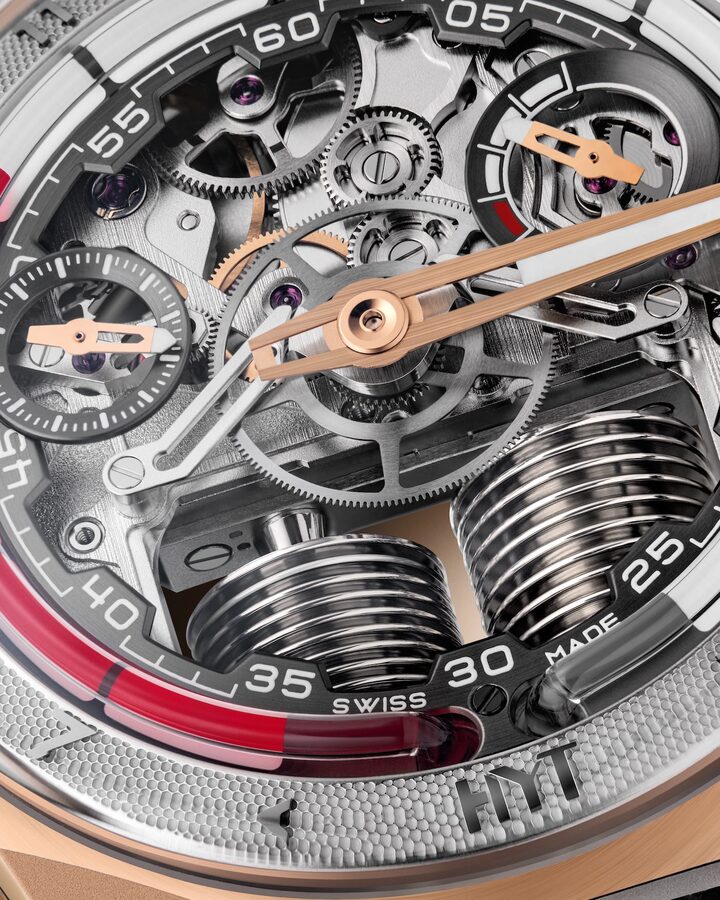
The solution involved a special coating on the inner surface of the capillary tube, developed in collaboration with a scientist affiliated with Stanford University who is based in San Diego. Although initially expensive, this treatment was later produced in Switzerland by Preciflex, which brought down its cost. It’s a component that the average watch enthusiast never sees, but on which the watch’s operation entirely depends.
This difficulty gave rise to a series of manufacturing challenges: shaping the glass to tolerances compatible with watchmaking, designing tools capable of filling a sealed tube with two liquids, preventing air bubbles, and ensuring the system’s stability. HYT and Preciflex thus had to develop several hundred processes. The result is therefore not merely an unconventional way of telling time. It is the culmination of an engineering feat that had to create its own conditions for existence.
The Founder’s Return
For much of HYT’s history, this story unfolded without its inventor. Lucien Vouillamoz had chosen not to publicly represent the brand, largely because he was running other companies. The company was thus represented by external executives, starting with Vincent, while the creator of the technology remained in the workshop and behind the scenes, where the fluid, glass, and mechanisms demanded his attention.
This structure changed following the company’s recapitalization, in which Vouillamoz participated by reinvesting. In recent months, he has resumed an operational role within a streamlined organization and now agrees to be directly associated with the public face of HYT. This shift is less trivial than it seems. In the world of independent watchmakers, a watch’s story often matters as much as its technical specifications. Yet HYT possesses precisely what many brands seek to build: a recognizable invention, a living founder, and a journey fraught with real challenges.
Vouillamoz does not sugarcoat the journey. He acknowledges a turbulent journey and now places trust among the brand’s top priorities, alongside reliability, a personal connection with collectors, and respect for those who have followed the brand. This commitment to transparency contrasts with a segment of the industry, which he views with a certain detachment.
Beyond Speculation: Proof Through the Object
His assessment is blunt. The watch industry has long been fueled by a private banking clientele accustomed to viewing timepieces as just another asset, alongside contemporary art or classic cars. Auction houses have set the tone for certain price surges, while the gray market has at times revealed a reality harsher than the official narrative.

Lucien Vouillamoz, however, perceives a shift: buyers are reportedly seeking more substance—a credible technical history and an identity that isn’t based solely on staged rarity. This trend could benefit HYT, provided the brand knows how to transform its uniqueness into a lasting relationship with its customers. Because in watchmaking, uniqueness alone is not enough. It must be paired with a timepiece that is wearable, reliable, and desirable outside the display case.
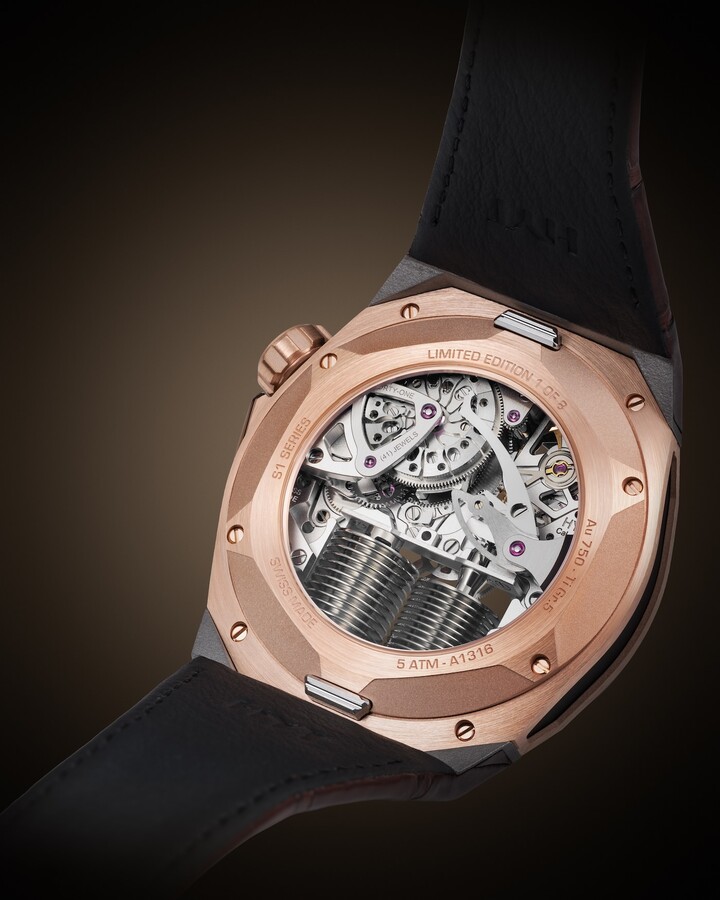
On this point, Vouillamoz highlights the current models, which he considers much easier to wear than their diameter might suggest. The 45-mm cases sit comfortably on the wrist without feeling overly imposing. The S1 Titanium DLC Red, with its red fluidic display, and the S1 Titanium Orange Millésime Edition embody this pursuit of a sportier, more direct aesthetic. On the back of the S1 Titanium Orange, the bellows of the fluidic module serve as a reminder that time here is not a graphic abstraction: it is physically propelled, displaced, and returned to its circuit.
Mechanics Have Not Disappeared
The use of liquid has never meant abandoning fine mechanical watchmaking. HYT has surrounded itself with specialists to create a dialogue between these two worlds. Eric Coudray designed the multi-cam system that powers the T1 and S1 models and contributed to the development of the brand’s conical tourbillon. The Conical Tourbillon Midnight Blue embodies this ambition: to integrate a haute horlogerie complication into an aesthetic where the fluid remains the protagonist.
Renaud & Papi also contributed to the H2. These collaborations highlight an essential aspect of the HYT project: the liquid is not a decorative effect added to an existing watch, but a constraint that forces a rethinking of the mechanics themselves. The workshop teams contribute a decisive amount of manual labor to this process. Each module demands a level of precision that relies as much on assembly as on materials science.
Nevertheless, Lucien Vouillamoz refuses to present HYT as a complete success. His initial ambition was broader: to see the emergence of a true category of liquid-based complications within the industry. That has not happened. HYT remains a standalone concept, and perhaps that is both its strength and its limitation.
Time as a Material to Be Shaped
The announced roadmap begins with concrete priorities: delivering the current collection on schedule and developing the bespoke tourbillon program. Looking further ahead, the horizon stretches over approximately ten years. The focus is on other ways of representing time that predate mechanical timekeeping—such as the hourglass or the sundial—through a concept that combines time, casting, material, and light.
There is no guarantee that these concepts will become watches, nor in what form. But they consistently build upon HYT’s founding principle: viewing time not as information to be displayed, but as a phenomenon to be made visible. Inside the capillary tube of an S1, the liquid already moves with an almost theatrical slowness. It is a technical feat, to be sure, but also a very concrete answer to the fundamental question: since a phone tells the time better than a watch, we might as well make the watch into something a phone will never be able to become.