Make Texture a preferred source on Google to support us
Add Texture to GoogleCan a craftsman be recognized as the creator of a fabric, rather than merely its maker? The question goes beyond mere terminology. It touches on the place accorded to manual labor in an industry that readily celebrates creativity, but less consistently honors those who provide the raw materials for it. By dedicating a section of its “Territories of Savoir-Faire” program to India, Première Vision highlights professionals there who are recognized as co-creators—and sometimes as creators in their own right. This shift in perspective sheds light on the transformation of fashion trade shows: to prepare collections, one must also understand the conditions under which they take shape.
India: More Than Just a Repository of Patterns
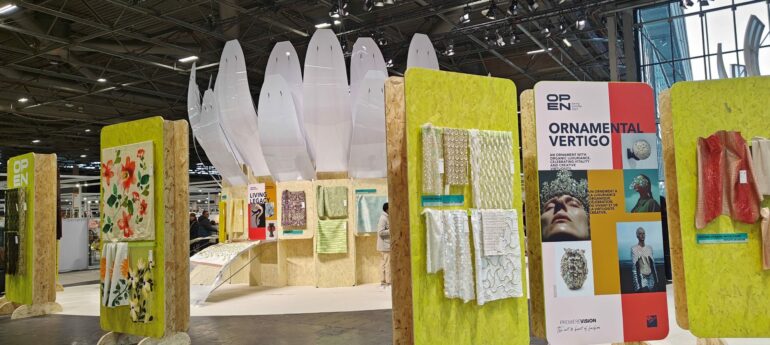
Reducing India’s textile heritage to a mere source of decorative inspiration would miss the point entirely. Dyeing, printing, embroidery, and weaving there reveal relationships with materials, local structures, and skills passed down through generations. The Indian pavilion announced at Première Vision Paris aims to showcase this technical depth through a selection of artisanal creations. The goal is to make the processes understandable, not merely to display the results.
This choice is rooted in a turbulent history. Textiles play a central role in the country’s economic, social, and cultural life. Regional styles have evolved over the centuries; the colonial period profoundly transformed production. Since independence—and more markedly since the 1990s—the modernization of methods has continued without erasing the diversity of traditions. It is this coexistence, rather than a static image of craftsmanship, that the trade show aims to explore.
Florence Rousson, Chair of the Executive Board of Première Vision, also highlights the contemporary relevance of these practices: strong regional roots and, often, a more measured use of resources. This is not about attributing environmental virtue to all manual traditions as a matter of principle. The curation and presentation process is specifically designed to examine the stages of transformation, the techniques, and the innovations. India thus joins a dialogue among regions, without displacing the European or Mediterranean expertise already represented.
The hand is not the enemy of the machine
In Paris, Blossom Première Vision approaches the same question from a different angle: “artisanal intelligence.” The similarity to the acronym for artificial intelligence is intentional. But the subject deserves better than a duel between the hand and the algorithm. According to Florence Rousson’s perspective, technological tools expand creative possibilities; they do not render intuition and a sensory understanding of a material superfluous.
An irregularity, a trace of the manufacturing process, or a finish that reveals the work involved thus become indicators of value. What matters is not an imperfection celebrated for its own sake, but what it reveals: human intervention, time invested, a decision made in direct contact with the material. This perspective shifts the criteria for desirability. It invites us to seek uniqueness in the process as much as in the final appearance.
Behind an embroidered sample or a textile innovation lie skills acquired over many years. Première Vision highlights these skills, particularly through its “Maisons d’Exception” offering. With Blossom, this focus becomes an explicit theme for reflection. The challenge posed to brands is demanding: how can they integrate this expertise into contemporary design without treating it as a mere decorative addition? Technology can enhance it; its transmission remains a human endeavor.
The trade show also becomes a matter of industrial policy
This defense of craftsmanship might seem far removed from discussions about competitiveness. Yet it is closely linked to them. Preserving a craft requires companies capable of keeping it alive, market opportunities, and stakeholders who engage with one another. It is in this context that GL events’ Fashion division has been redefining its events for nearly two years. Business transactions remain essential, but they are no longer enough to address the industry’s shared challenges.
The events hosted reflect this evolution. The annual plenary sessions of the Fashion and Luxury Industry Strategic Committee have brought together French stakeholders to address the sector’s development challenges. On a different scale, the European Federations Meetings brought together European textile and apparel federations for the first time to foster coordination in the face of ultra-fast fashion. The trade show thus becomes a venue where industry issues can be discussed collectively.
To this end, GL events has a network spanning everything from raw materials to finished products, from Première Vision to Tranoï. Its relationships extend from professional federations to educational institutions—such as the IFM and La Cambre—as well as the Comité Colbert, Galeries Lafayette, and ANDAM. This diversity of partners makes it possible to bring together concerns that are usually addressed separately: design, production, and distribution. The challenge now is to turn this proximity into something more than just a sum of individual presences.


Milan and Tokyo: Proximity on an International Scale
The geography of trade shows follows a similar logic. Denim Première Vision is returning to Milan for its sixth consecutive edition because the city combines nearby historic production hubs with a strong creative and sourcing scene. Brands, buyers, and manufacturers are accustomed to doing business there. The choice of location is therefore based on professional realities, not solely on the prestige of a fashion capital.
The event held in Tokyo in September addressed another need: maintaining ties with the Japanese market, which is strategic for the textile and denim industries. According to Florence Rousson, travel habits have changed in recent years, particularly in the Asia-Pacific region. Events must now be adapted to these new habits rather than assuming that all professionals will continue to travel in the same way.
With 18 annual B2B events, nine offices in France and abroad, and more than 440,000 professionals united across its various communities, the Fashion division is able to observe these trends across multiple markets. Other destinations are not ruled out for the denim sector, provided they meet the needs of its stakeholders. The challenge is less about adding more locations to a map than about choosing places where exchanges serve a real purpose.
From Inspiration to Meaningful Engagement
For visitors, this ambition must be reflected in day-to-day work. Each season, the Fashion teams develop analyses of colors, trends, and emerging signals. The Innovation & Technology program showcases processes, services, and materials designed to support companies’ competitiveness and their transition. These offerings complement the exploration of expertise: some examine the tools available, while others highlight what deserves to be preserved and developed.
Content production now extends beyond in-person events. Conferences, market analyses, and forward-looking forums address traceability, shifts in consumer behavior, and the effects of geopolitical changes. For Première Vision, supporting the industry also means providing guidance between trade shows, in a context where economic uncertainty complicates decision-making and creative cycles are accelerating.
Ultimately, the challenge boils down to a very practical constraint: the time available to find the right partner. Tools for connecting with and identifying potential partners must make meetings more targeted. After discovering a technique or identifying a material, one must still meet the person capable of explaining its possibilities and initiating a collaboration. It is at this stage—the transition from examining a sample to establishing a working relationship—that the trade show’s success will be measured.