
Make Texture a preferred source on Google to support us
Add Texture to GoogleThe window does not merely separate the heated cabin from the thin air of the mountain peaks. It functions as an optical lens, an oversized, shifting frame that fundamentally alters our perception of the high mountains. Taking a seat aboard this unique conveyance means accepting a temporal contract that our era—obsessed with compressing time—has almost entirely revoked: one in which the journey itself is the sole purpose. Commercial aviation and European high-speed rail lines have transformed travel into a utilitarian interlude, a mere fade to black between a point of departure and a destination. On these Alpine rails, that logic is reversed with majestic brutality. The landscape imposes its ruggedness, dictating a pace of travel where impatience loses all hold. The Bernina Express carves its path through the Alps, not with the arrogance of seeking to shorten them, but with the determination to reveal every nook and cranny.
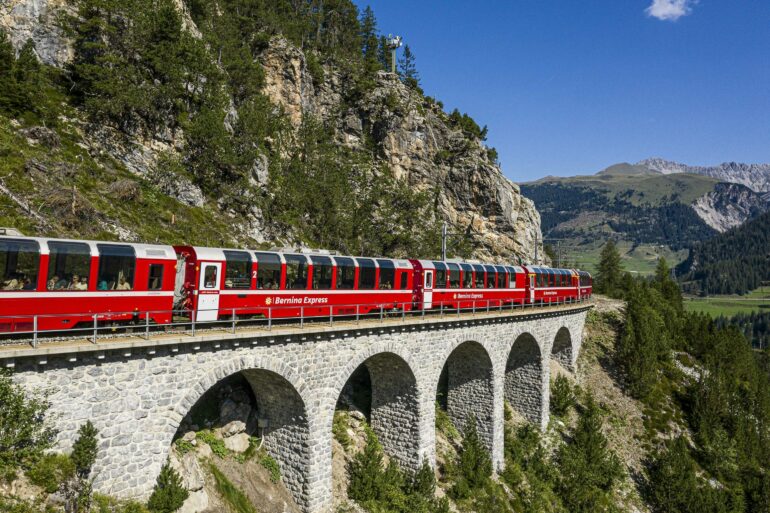
A vivid red line suddenly cuts across the mineral horizon. This choice of color is by no means trivial. In an environment overwhelmed by the monochrome of winter or the muted hues of summer rock, the scarlet cars assert a confident human presence in the midst of the inhospitable landscape. It is an unmistakable visual landmark, a moving beacon that winds its way through steep-walled valleys before tackling the bare slopes. From the outside, the contrast fascinates hikers and photographers stationed along the tracks. From the inside, this red shell houses a silent observatory, gliding along the edge of the precipice on a ribbon of steel shaped to embrace the extreme.
The Architecture of the Gaze
The very term “panoramic train” is often overused in tourist brochures, reduced to a mere sales pitch to justify barely enlarged windows. Swiss engineering has taken the concept literally, pushing architectural boundaries to the point of redefining the very structure of the railcars. Here, the metal deliberately takes a back seat to colossal glass surfaces. These do not stop at the base of the roof; they curve upward, extending into the ceiling to offer an unprecedented view of the sky.
This design physically alters the traveler’s perspective. In a conventional train, the gaze drifts sideways, sweeping across the ground and the horizon. Beneath these curved glass panels, the eye is drawn upward. You tilt your head back to search for the summit of an overhanging glacier, the crest of a jagged ridge, or the tops of the conifers that almost brush against the train’s body. The passenger compartment becomes a high-altitude greenhouse, flooded with harsh light, filtered by UV-blocking treatments that give the sky a distinctive photographic density. This completely alters the sense of scale: the passenger feels physically overwhelmed by the verticality of the surrounding landscape.
The Clash of Extremes
The aesthetic power of this route lies in the constant friction between two worlds that are polar opposites. On one hand, the brutality of an extreme environment. The Alps make no concessions. Winds sweep across the mountain passes, snow freezes the high-altitude lakes, and the rock threatens to crumble. Survival in these places demands effort, equipment, and sometimes suffering. On the other side of the glass wall, a moving lounge offers absolute climate-controlled comfort. The air is climate-controlled, ergonomic armchairs invite you to relax your muscles, and conversations are held in hushed tones, muffled by thick carpeting and state-of-the-art soundproofing.
Observing the icy harshness of a snowstorm or the deadly slope of a ravine from a cozy space induces a kind of soothing vertigo. Nature’s hostility is kept at a distance, framed, and tamed by the technical prowess that keeps the train on its tracks. We brush against the void without ever falling into it. The metallic screeching of the axles—which sometimes echoes through the cabin during the most winding stretches—is the only reminder of the physical reality of the friction between the steel of the wheels and that of the track. A gentle reminder, suggesting that this delicate balance between human luxury and geological wildness depends on rigorous mathematical precision.
The Geometry of the Curves
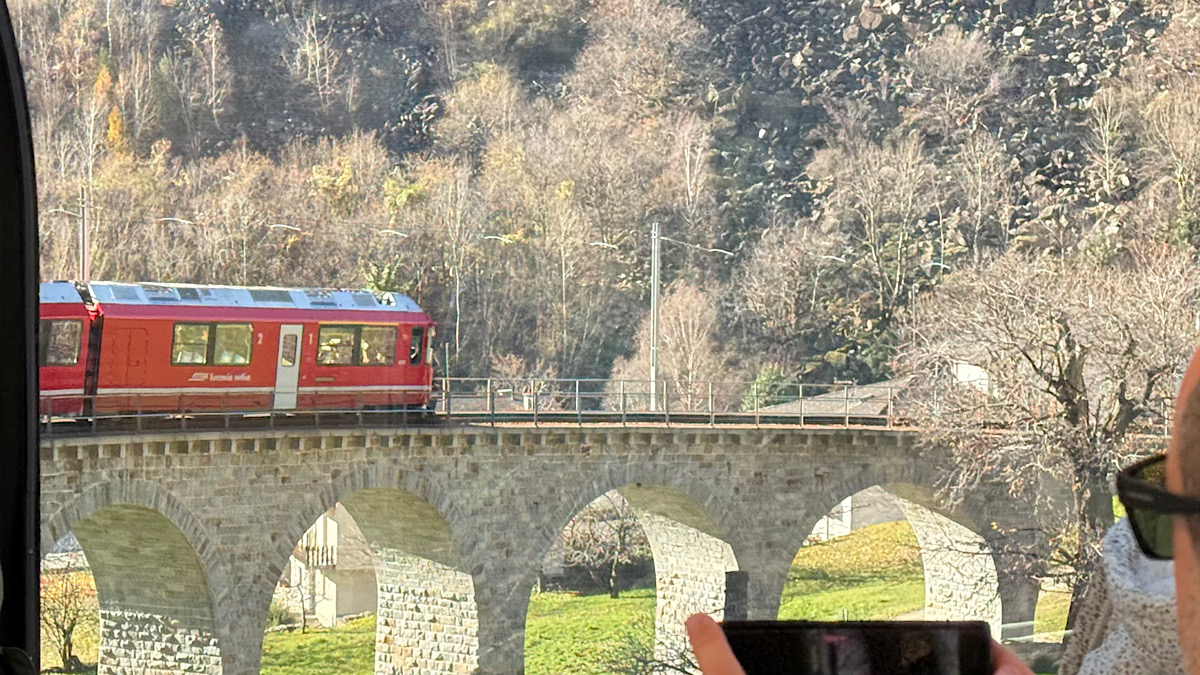
Climbing the Alpine slopes without a rack-and-pinion system requires a fascinating railway choreography. To conquer elevation changes that defy common sense, the track winds around itself, traces helical loops, crosses stone viaducts suspended over the void, and plunges into tunnels carved directly into the dark rock. This complex route offers a dynamic and fragmented visual experience.

As it approaches a particularly sharp curve, the train bends. Passengers seated in the front cars can see the long red tail of their own train stretching out across the viaduct they’ve just left, while those in the rear catch a glimpse of the locomotive already plunging into the black mouth of the next tunnel. The train seems to be searching for its way, winding through a labyrinth of stone. Light and shadow alternate abruptly as it passes through the avalanche-protection tunnels. One moment, the cab is plunged into the cool darkness of a granite tunnel; the next, it is violently bathed in light as the sun glints off a pristine snowfield, causing an immediate, collective glare.
The luxury of stillness in motion
Crossing a mountain range at this pace challenges our contemporary need for spatial efficiency. The time spent on board becomes a dense, almost palpable substance. Without a constant internet connection or personal screens to capture our attention, the human mind recalibrates itself to the passing landscape. The first few minutes of the journey are often marked by excitement: we search for the right angle, pull out our cameras, and comment on every bridge or stream. Then, as the ascent continues, an organic silence settles in. The hypnotic repetition of snow-capped peaks and deep forests induces a form of involuntary meditation.
This silence is broken only by the muffled murmur of the engine’s rumble. The gaze gets lost in the textures of the blue ice that surfaces on the shaded slopes, or in the sharp gray of the slate and schist. The slow pace of travel allows the eye to catch the detail of an isolated snowfield or to follow the course of a waterfall frozen solid by the frost. It is precisely in this deliberate slowness that the true value of the journey lies. It is no longer a matter of consuming a landscape by traversing it blindly, but of absorbing it through continuous observation.
When the terrain finally begins to level out, marking the start of the long descent toward milder latitudes, the atmosphere in the cabin subtly relaxes. The light changes in texture, losing the sharp harshness of the high plateaus to take on softer, more earthy hues. Bare rock gives way to denser vegetation. The red steel ribbon continues its gliding course, unperturbed. Getting out of one’s seat upon arrival requires a brief moment to readjust. We return to our usual gravity, the noise of the city, the wind blowing directly in our faces. But the retina retains a lasting imprint of this uninterrupted tracking shot, confirming that the appeal of this journey lies less in the geographical points it connects than in the dizzying mechanical poetry of its execution.