
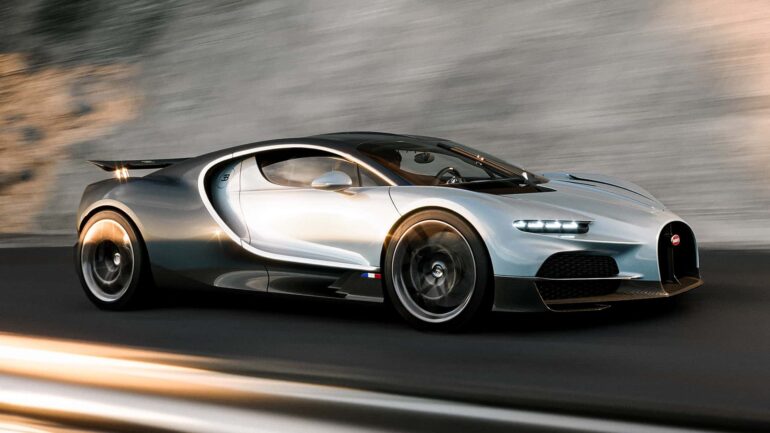
Pixels now come before asphalt. Even before the sheet metal is stamped, the carbon fiber is cured, or the engine lets out its first roar on a test bench, visual buzz has already taken hold of the hypercars of tomorrow. The case of the future Bugatti Tourbillon perfectly illustrates this dynamic of anticipation. The model isn’t yet on our roads, its order book points to distant delivery dates, and yet its virtual twin already exists. Led by designer David Baylis—who works online under the pseudonym davidbaylisdesign—a radical variation dubbed the Tourbillon Pur Sport has taken shape as a 3D model. While this concept has not received any official endorsement from the manufacturer, it captures the essence of a market where anticipation fuels desire, and where aesthetic speculation plays a key role in building the legend.
The project sketched out by Baylis is not merely a flight of fancy. It is rooted in a philosophy unique to the Molsheim-based company: optimization through subtraction and aggressive aerodynamics. On screen, this digital rendering features forged magnesium wheels, chosen to eliminate even the slightest amount of unsprung mass. The front bumper has been completely redesigned to flood the radiators with fresh air and press the car’s nose to the ground. At the rear, the imposing spoiler gives way to a more discreet appendage, blending into the flowing lines of the body, while the exhaust system reveals a clear connection to previous Super Sport models. This pursuit of lightness and aerodynamic purity reflects the thirst of a clientele and a community that demand ever-sharper versions, refusing to wait for the production schedule to fantasize about the car’s physical limits.
Farewell to the W16 and the promise of hybrid excess
If the internet is abuzz with virtual renderings, it’s because the foundation provided by Bugatti justifies every bit of excess. The Tourbillon faces the daunting task of succeeding the Chiron, a model that set the standards for automotive excess for nearly a decade. To mark this break with the past, the manufacturer is abandoning the traditional internal combustion engine in favor of a plug-in hybrid architecture. The centerpiece of this system remains an internal combustion engine, but its specifications defy reason: an 8.4-liter naturally aspirated V16, designed in close collaboration with British engineering master Cosworth.
This monumental engine doesn’t work alone. It’s paired with three electric motors, propelling the combined power to a dizzying 1,775 chevaux. The figures claimed by the brand immediately place the car in a stratosphere out of reach for the rest of the world’s automotive production. The speedometer needle is expected to hit 445 km/h—the symbolic 277 mph mark. With a name borrowed directly from the lexicon of fine watchmaking—evoking mechanical complexity and perpetual motion—this new flagship viscerally links raw performance to the idea of surgical precision.
Rarity as an Engineering Constraint
The transition to industrial production imposes a pace that the digital age’s impatience sometimes struggles to comprehend. Bugatti has set an extremely limited production run, capped at 250 units worldwide. The first customers will not receive their keys until the end of 2026. This timeline and limited production run go beyond a mere sales pitch designed to flatter collectors’ egos.
In the Alsatian workshops, this restriction dictates the assembly method. Assembling a hybrid V16 and meeting the tolerances required for top speeds approaching 450 km/h precludes any mass-production approach, even on a small-scale, artisanal level. Rarity becomes an engineering necessity—the only guarantee of delivering a finished product where the line between visual spectacle and mechanical dominance no longer exists.
A Strategic Leap Without a Safety Net
To understand the origins of this extraordinary project, one must look beyond the technical specifications and examine the brand’s financial behind-the-scenes. The Tourbillon is the first offspring of a new era of capitalism. The year 2021 marked a tectonic shift in Bugatti’s modern history. The German Volkswagen Group, which had revived the name and shouldered astronomical development costs in the early 2000s, chose to step back. The French brand was integrated into an unprecedented joint venture, named Bugatti Rimac.
The balance of power within this structure paints a picture of a completely transformed industrial landscape: the young Croatian automaker Rimac, a rising star in the hyper-electric sector, holds a 55% stake, while Porsche retains the remaining 45%. Molsheim’s legacy and its regional roots remain, but the management philosophy has taken a sharp turn. The days when the Wolfsburg-based parent company could absorb the colossal deficits associated with developing a single model are over. The company now operates within a structure that is certainly more agile, but infinitely more exposed.
The equation now requires combining absolute prestige with relentless profitability, all within a niche market where even the slightest technological misstep comes at a steep price. Rimac and Porsche must prove that the hybridized V16 can command the same respect—and the same aura of invincibility—as the iconic W16 that preceded it. Virtual renderings of a “Pur Sport” model keep the flame of desire alive, but it is on the asphalt—far from modeling software—that the Tourbillon will have to establish its legitimacy in the eyes of buyers who tolerate no compromises.