Make Texture a preferred source on Google to support us
Add Texture to GoogleA Portuguese diving watch is not something one would immediately expect. Although the country has built part of its identity around the ocean, maritime routes, and the Age of Discovery, it is not among the major watchmaking nations. This is precisely the space where Meia Lua intends to make its mark. Based in Lisbon, the young brand is making the Meridian a turning point: its first diver’s watch, its first model powered by a Swiss movement, and the first manifestation of a completely revamped visual identity.
The Meridian arrives after several years of silence. Meia Lua’s previous creation dates back to 2021, with the Callisto Halfmoon chronograph. The shift in style is clear. Whereas a chronograph often features a degree of mechanical showmanship, a dive watch demands a more austere consistency: a construction capable of withstanding pressure, immediate readability, and components chosen to last. Meia Lua is thus venturing into a crowded but straightforward category, where every detail is immediately scrutinized.
Portugal as the Horizon
The choice of a marine theme is not merely a decorative overlay on the dial. Portugal’s relationship with the Atlantic provides this watch with a natural cultural foundation. Meia Lua does not seek to replicate the codes of a historic Swiss watchmaker nor to use Lisbon as a mere graphic pretext; rather, the Meridian draws from the maritime world its need for ruggedness and its direct language.
This positioning supports a broader ambition. With this launch, the brand aims to raise its standards of finish and specifications, targeting collectors who value both mechanical engineering and the quality of craftsmanship. Water resistance to 300 meters—or 30 bars—forms the technical foundation of the project. This requirement necessitates a case designed to prevent water ingress and explains the adoption of a screw-down crown, a first for Meia Lua.
The Meridian, therefore, does not present itself as a dress watch disguised as a diving watch. Its purpose is evident in its construction, right down to the design choices for the dial and bezel. However, it chooses not to mimic the most literal dive watches on the market. This nuance is likely its strongest selling point: retaining the genre’s hallmarks without turning the model into a catalog of expected features.

A 39.5 mm case that balances precision and restraint
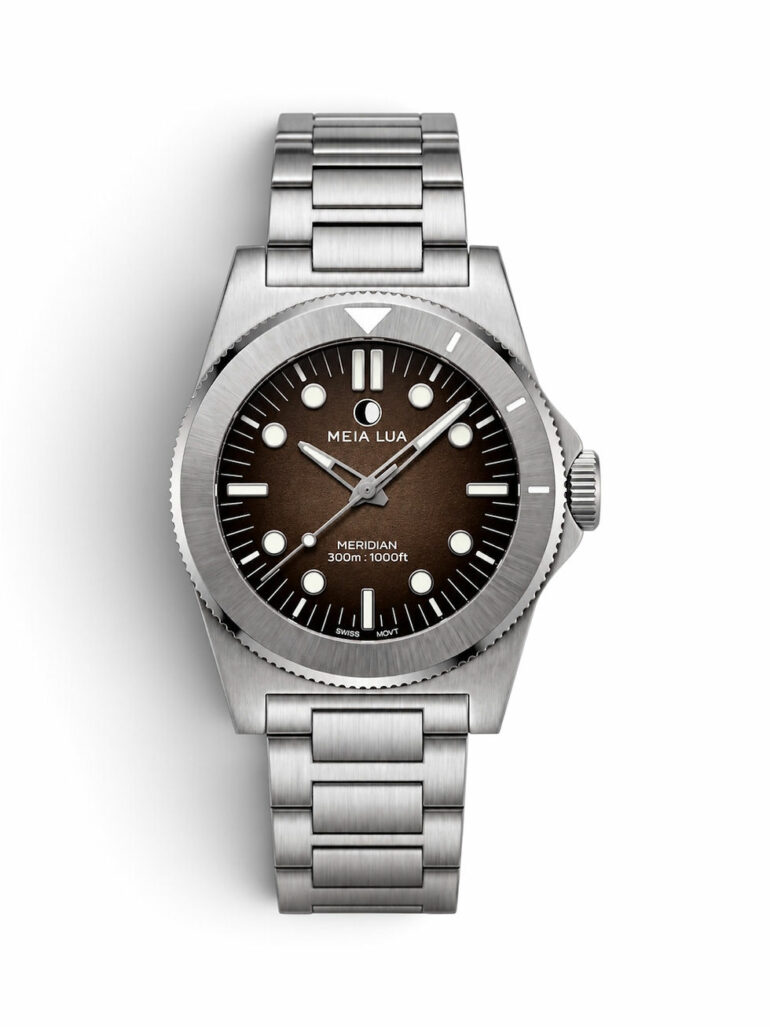
The 39.5 mm diameter places the Meridian within a moderate range for a contemporary dive watch. Its stainless steel case plays on the alternation of satin-finished and polished surfaces—a contrast that prevents the watch from coming across as strictly utilitarian. The bracelet is also made of steel, in keeping with a design intended for everyday use as well as the demands of the water.
The unidirectional rotating bezel is a key element of its character. Its sunburst finish lends a luminous quality rarely seen on this component, which is typically finished in a more straightforward manner. The first fifteen minutes are marked on it, allowing for the timing of the most immediate dive durations. This design choice deliberately omits a full sixty-minute scale. Purists will see this as a concession to minimalism; others will appreciate a less cluttered bezel, almost industrial in its focus on the essentials.
In a watch of this type, orientation markers are never superfluous. The applied hour markers alternate between rectangles and circles, while the 12 o’clock position features a double marker. Underwater, when the watch is viewed at an angle or in low light, this geometry allows the top of the dial to be identified at a glance. The hour markers are coated with luminescent material to ensure readability even outside ideal conditions.
The dial is protected by a highly domed “top-hat” sapphire crystal with an anti-reflective coating. This element alters the watch’s silhouette just as much as it contributes to its function: the Meridian does not have a flat, strictly technical face, but rather a depth that complements the interplay of colors.
Smoked Glass as a Material, Not Just an Effect
The dial is undoubtedly where Meia Lua most clearly departs from the usual design conventions of a diver’s watch. Rather than a solid color, the brand employs a smoky gradient on a textured surface. This texture does more than simply decorate the dial: it adds dimension to the transition between light and dark areas, avoiding the overly smooth appearance that a gradient can take on when it is purely printed.
Four variations are planned. Ocean Blue naturally evokes a maritime theme, while Tropical Brown introduces a warmer tone, which is rare in this segment. Black Sea offers a darker option, and Polar White lends the design a brighter look. These names do not alter the dial’s architecture or the watch’s purpose, but they allow for significant variation in its character without resorting to an abundance of complications or decorative elements.

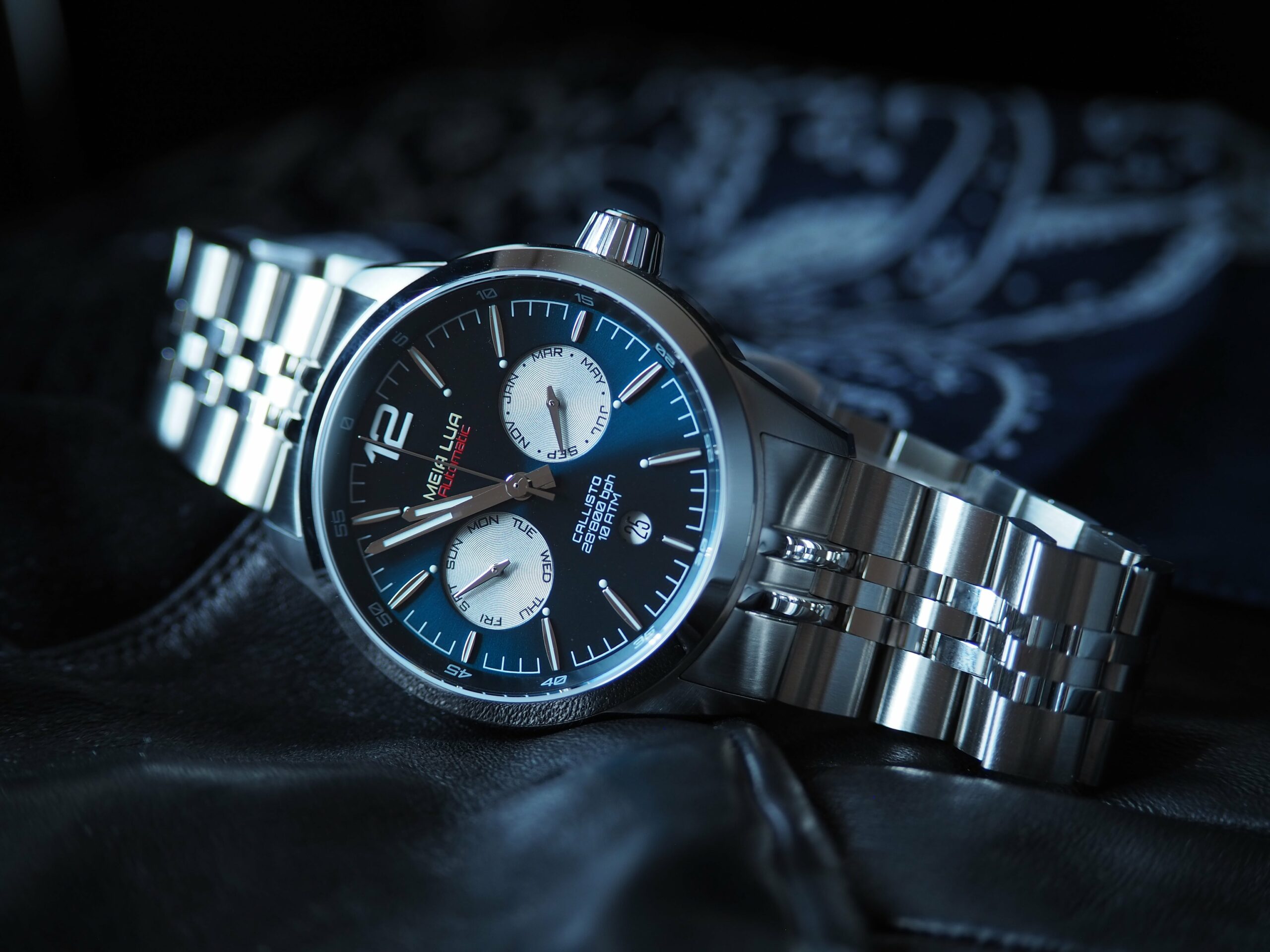
The launch also serves as a graphic manifesto. The Meia Lua logo has been redesigned and now features a half-moon symbol. The evolution is logical: “meia lua” literally means “half-moon” in Portuguese. The simplified typography takes up less visual space, allowing the dial to retain its central role. On a dive watch, where information must remain immediately distinguishable, this minimalist approach is welcome.
The Switch to a Swiss Movement
Inside, the Meridian features the brand’s first Swiss movement: the Sellita SW200-1. This automatic caliber operates at 28,800 vibrations per hour—or 4 Hz—and offers a 38-hour power reserve. It displays hours, minutes, and seconds, with no additional complications.
This choice is by no means spectacular in the showy sense of the word, but it is particularly logical. The SW200-1 is widely known in contemporary watchmaking, particularly among independent watchmakers and micro-brands that are switching from Japanese movements to a Swiss caliber. Its widespread use offers a practical advantage for a watch designed as an instrument: service centers know how to maintain it, repair procedures are familiar, and the movement is suited to life on the wrist—with its everyday bumps, travel, and, occasionally, immersion.
Meia Lua thus positions the Meridian within a pragmatic relationship with mechanical watchmaking. No exclusive caliber designed to artificially inflate the narrative, no added complication to justify a move upmarket. The movement is well-known, firmly established in the market, and well-suited to a case rated for 300 meters of water resistance.
A price that redefines the brand
The Meridian will be available for pre-order on Kickstarter in the first quarter of 2027, priced at 1,190 euros, or approximately 1,000 pounds sterling. This price places it at the top of the Meia Lua lineup. It also reflects the nature of the project: a Swiss movement, a new case design, a screw-down crown, and 300-meter water resistance mark a substantial evolution compared to the brand’s previous launches.
In this price range, the Meridian will need to win over buyers less through a promise of radical innovation than through the precision of its craftsmanship. Its appeal lies in the balance between an accessible 39.5-mm case, a dial with more depth than average, and a movement designed to stand the test of time. Information about the campaign and the brand can be found on the Meia Lua website.