Make Texture a preferred source on Google to support us
Add Texture to GoogleOn November 15, 2026, the Hollywood industry gathered in the hushed salons of the Ray Dolby Ballroom, in the heart of the Ovation Hollywood complex. Far from the hustle and bustle of television and speeches timed down to the second, the Academy of Motion Picture Arts and Sciences was hosting the 17th edition of its Governors Awards. This event occupies a unique position in the awards season calendar: it serves as a decompression chamber. Free from the pressure of a live global broadcast, directors, screen stars, and studio executives mingle there among industry insiders. While the awards honor the enduring legacy of cinema, the event’s red carpet has, over the years, become one of the most insightful observation grounds for the luxury industry. The fashion photography from this evening doesn’t set any absolute rules, but it does provide an initial map of the strategies linking campaign stars and design studios.
It is precisely in this arena that the complex art of image placement is practiced today. The specialized press scrutinizes every arrival because the choice of an outfit serves as a statement of intent. The red carpet at this awards ceremony has broken free from the traditional mermaid-style gown to become a space for high-level experimentation, centered around heritage pieces, custom-made designs, and cutting-edge ready-to-wear.
The Archive: The New Nobility of Ceremonial Dress
The quest for exclusivity has found its most radical expression in the reappropriation of archives. Zendaya’s appearance particularly crystallized this dynamic. The actress stepped onto the stage in a golden gown with a sculptural silhouette, taken directly from the legacy of British designer Giles Deacon. By eschewing the ease of a recent collection in favor of unearthing a piece from the past, the historic garment acquires an unprecedented allure. This approach underscores that a design can transcend the era in which it was created to assert immediate visual authority, while still adhering to the formal requirements of the moment.
The validity of these choices rests on a precision-driven mechanism in which accessories serve as an anchor. According to analyses published by ELLE magazine, this textile architecture was structured by pieces of Chopard fine jewelry and a Rolex watch. The details of this outfit were carefully cross-referenced by other publications such as RUSSH and TheWrap, confirming that deciphering a red-carpet look has now become a matter of factual and documented investigation. Wearing a vintage piece demonstrates a refined sense of fashion, far removed from the mere fleeting consumption of trends.
The Rise of Bespoke and the Louis Vuitton Chessboard
Given the scarcity of archival pieces, bespoke design has emerged as the diplomatic weapon of choice for major fashion houses. Louis Vuitton has dominated a large portion of media coverage by dressing a squad of high-profile personalities. Emma Stone and Léa Seydoux walked through the doors of the Ray Dolby Ballroom in designs created exclusively for them by the brand’s Parisian ateliers. This strategic move didn’t stop there; the luxury brand also outfitted HoYeon and Skyler Gisondo.
The French brand’s influence extended to men’s fashion, a sector undergoing a major image transformation. Tom Holland wore a Louis Vuitton ensemble customized from head to toe. RUSSH notes that the attention to detail extended even to the shoes, designed by Christian Louboutin, while a Cartier watch peeked out from his sleeve. This convergence of prestigious names on a single look reveals a new approach to men’s gala attire. Actors are no longer content to blend into the background behind the neutrality of a black tuxedo; they curate their look with the same level of sophistication as their female counterparts.
A Deliberate Fragmentation of Silhouettes
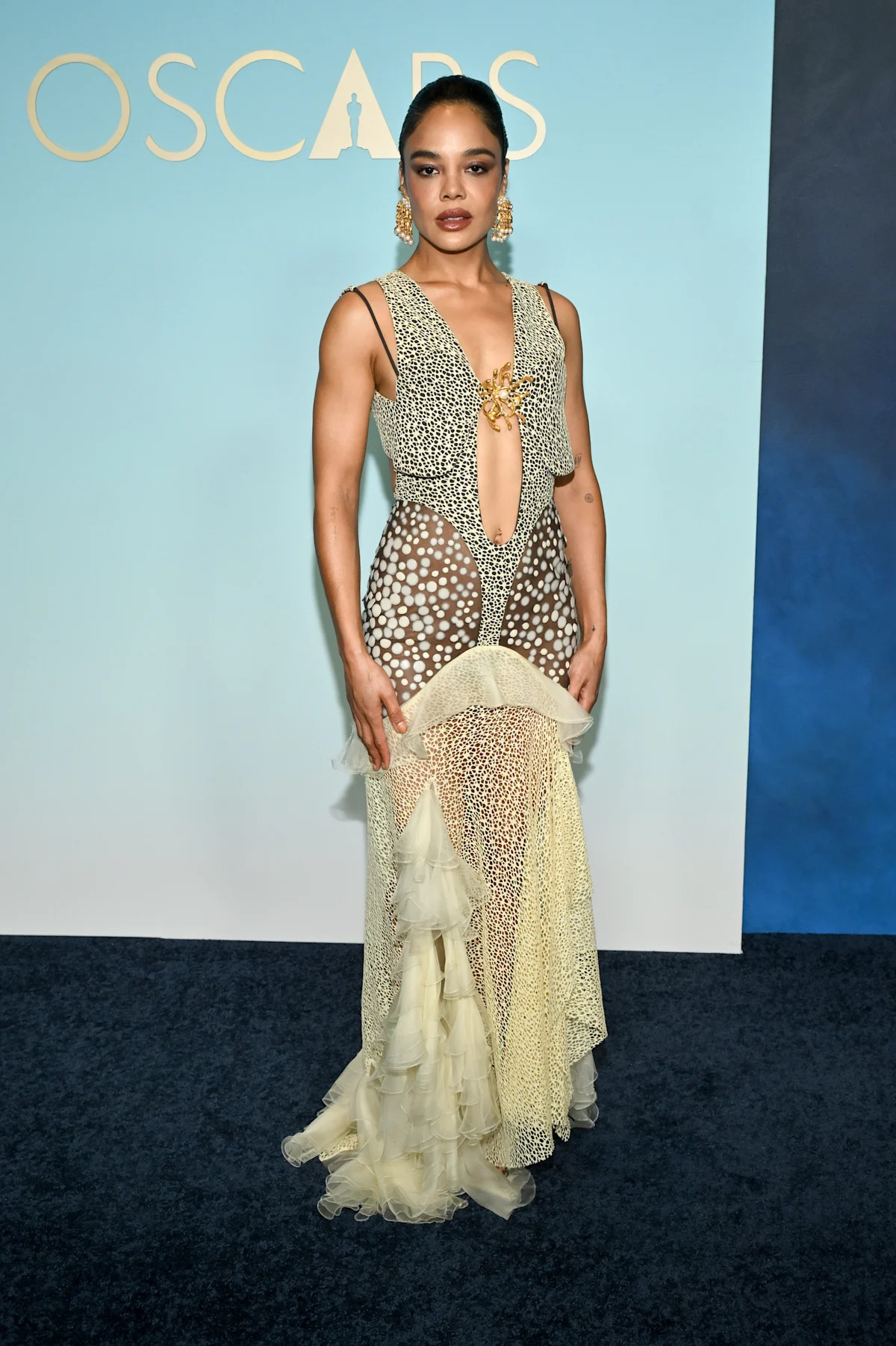
A look at the rest of the guests confirms the breakdown of formal dress norms. The haute couture aesthetic, with its majestic volumes, was brilliantly showcased by Sandra Hüller in Chanel and Tessa Thompson, who looked statuesque in Schiaparelli. In a more intimate vein, Eva Victor opted for the clean lines of a Loewe creation designed specifically for her, while Julianne Moore paired the minimalist elegance of Bottega Veneta with the sparkle of Messika diamonds—a combination highlighted by TheWrap.

The spectrum of looks ranged from unmistakable signature styles to total surprises. Elizabeth Debicki broke with convention by wearing Ferrari Style, marking a unique foray of automotive design into the world of the gala. Penélope Cruz maintained her historic connection with Chanel, and Carrie Coon opted for Balenciaga’s architectural designs. The actresses’ wardrobes were further enriched by Valentino creations worn by Olivia Wilde, Tom Ford for Charlize Theron, and Dior for Inde Navarrette. With the presence of figures such as Glenn Close, Monica Barbaro, Lily James, and Emmy Rossum—navigating between custom-made pieces and cutting-edge formal wear—the evening categorically rejected monotony.
This breaking of the rules was also evident among the men, who have become true trendsetters. Pedro Pascal exuded controlled nonchalance in Chanel, Timothée Chalamet honed his silhouette in Giorgio Armani, Alexander Skarsgård relied on Tom Ford’s razor-sharp tailoring, and Sebastian Stan turned to Prada’s Milanese minimalism.
The Enduring Power of Cinematic Memory
While the display of aesthetic power set the tone for the arrivals, the substance of the 17th edition lay beyond the reach of the cameras. Holding this separate evening event rectifies a historical shortcoming. The archives of Harper’s Bazaar remind us that these honors were once hastily handed out during the tedious Oscars ceremony. Since 2009, the Academy has chosen to remove these awards from the televised broadcast to give them a dedicated evening. The aim is to provide a platform for the industry’s founding figures to speak without time constraints.
In 2026, the honorary Oscar honored three monumental careers: British filmmaker Ridley Scott, whose visual language has redefined contemporary cinema; actress Glenn Close, whose dramatic intensity is undisputed; and Floyd Norman, a legendary animator whose influence was felt behind the scenes at the studios, each received an honorary Oscar for their lifetime achievements.
The organization also shone a spotlight on the economic and creative structure of filmmaking by honoring producers Christine Vachon and Pamela Koffler. By receiving the Irving G. Thalberg Memorial Award, they are recognized for their rigorous production standards, which are essential to the creation of great works. As the dinner draws to a close, the clash of time periods strikes the observer: the Governors Awards bring together, in a single breath, the dazzling brilliance of a fashion trend—analyzed the very next day on screens around the world—and the solemn celebration of a life dedicated to cinema.