Make Texture a preferred source on Google to support us
Add Texture to GoogleFor a long time, it remained confined to the lapels of tweed jackets, pinned with mathematical precision to the formal blouses worn at family gatherings. The ornament seemed doomed to gather dust in safes, relegated to the status of a relic of a bourgeoisie from another century. It was imagined as heavy, stiffening one’s demeanor, inevitably evoking the specter of the prim and proper great-aunt or the rigid protocol of diplomatic visits. Yet the object has broken free from its velvet prison. On the thick carpets of high-society events, on the runways, and even on the street, the brooch is making a comeback, redefining the very architecture of the contemporary silhouette. This piece of precious metal, which we thought had been permanently buried under the weight of its classicism, now dictates the trend. It is no longer worn out of convention, but out of defiance, disrupting fabrics we thought were untouchable.
Breaking Free from the Burden of Protocol
The history of the brooch is inextricably linked to power and pragmatism. Before becoming a ceremonial piece, it held together the heavy drapery of antiquity. Its strictly utilitarian aspect gradually faded, replaced by the display of social status, becoming the exclusive playground of European courts. There, it transformed into a silent tool, a coded language in which the arrangement of a sapphire, the cut of a diamond, or the choice of enamel signaled political allegiance, mourning, or provocation. The crowned heads mastered this rhetoric with polite cynicism, wearing pieces chosen to subtly signal their intentions under the gaze of cameras and dignitaries.
This institutional weight eventually suffocated jewelry. The 1990s, fascinated by raw minimalism and deconstructed cuts, violently rejected this accessory, deemed too talkative. The following decade buried it in favor of the casual long necklace, oversized hoop earrings, and skin jewelry—the kind that wraps around and fuses directly with the body. The brooch, however, requires a surface—a garment, a barrier of fabric. It was thus seen as the antithesis of an era that celebrated the liberated body. Having become a financial legacy treasured for its carats, people no longer dared to display it for fear of instantly making their demeanor appear aged.
The shockwave from men’s fashion
The rescue did not come from women’s jewelry, where the plastron necklace had long reigned supreme. The shake-up struck the men’s wardrobe. For decades, a man attending an official event was allowed to shine only through the dial of a complicated watch, the understated elegance of cufflinks, or, at a pinch, the cold metal of a signet ring bearing a coat of arms. The dark suit served as a restrictive uniform. The shift began slowly, driven by a new generation in Hollywood and the music industry who rejected this monastic sobriety.
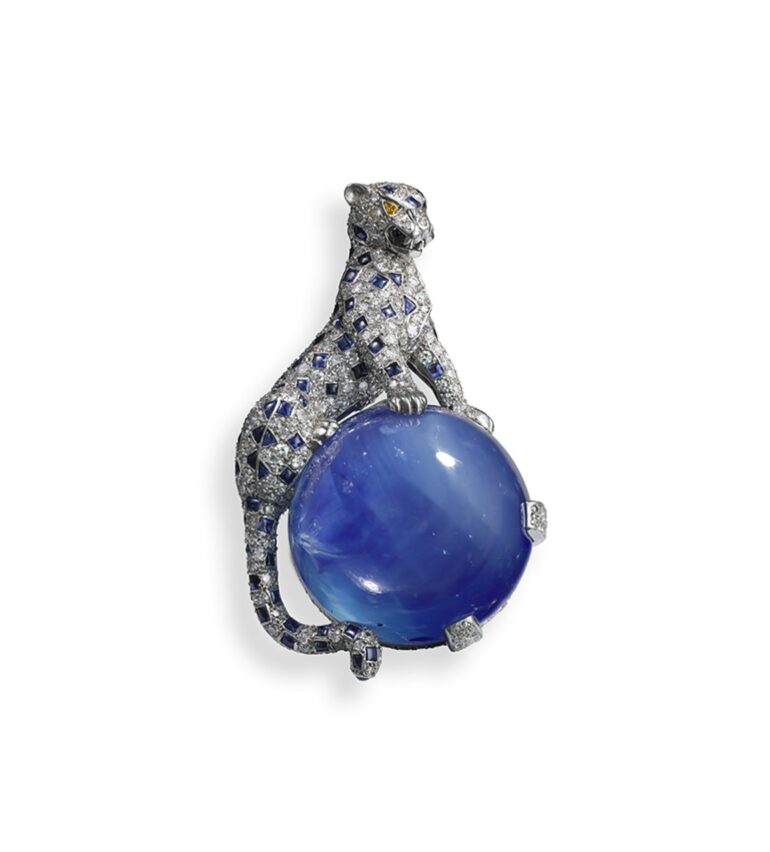
The lapel of the black jacket suddenly transformed into a canvas for self-expression. Rising actors, athletes, and leading figures in the music scene began pinning exceptional vintage pieces to their double-breasted jackets. The jacket breaks up the formality of a tuxedo, accentuates the contours of the torso, sits close to the neck over an unbuttoned shirt, or is worn directly over a ribbed cotton tank top. Historic houses like Cartier are seeing their legendary onyx and diamond panthers in high demand among men strutting down red carpets around the world. By embracing this aesthetic, men’s fashion has stripped it of its matriarchal connotations. The contrast between confident musculature, sharp suit cuts, and the delicate sparkle of set gemstones creates an immediate visual tension. The accessory has once again become edgy, almost rebellious.
The Invisible Engineering of the Workshops
This resurgence in popularity has forced high-end jewelry workshops to completely rethink their manufacturing techniques. It was unthinkable to simply dust off the molds from the 1950s. Contemporary textiles pose a major challenge: ultra-lightweight cool wool, flowing cashmere, or fluid silk cannot withstand the massive gold or platinum structures of the past, lest the weave tear or the drape of the garment be irreparably distorted.
The mechanical challenge has become central to the creative process. To lighten the settings, artisans are increasingly working with titanium or anodized aluminum. These alloys—which are incredibly complex to cast and set—offer extreme durability for a negligible weight, allowing for the creation of unprecedented sculptural forms. The jewelry no longer pulls on the thread. Fastening mechanisms have evolved in parallel: secure double pins that prevent the piece from tipping under the weight of the gemstones, miniaturized clasp systems, and even concealed magnetic fasteners designed not to puncture delicate leathers or sheer fabrics.

The aesthetic of mobility has also been masterfully revived. The ancestral technique of “tremblant” setting—which mounts stones on tiny springs—has been modernized by jewelers to make the gems vibrate in time with each step. At Boucheron, the concept of a chameleon-like ornament has been explored for several seasons now. Static designs are no longer tolerated. A lapel clip houses an invisible mechanism that allows it to be detached with a single click so it can be threaded onto a velvet ribbon, slipped into the hair, or transformed into a pendant. This structural flexibility meets the demands of a clientele that rejects the single-use nature of an exceptional piece.
New Aesthetic Territories and Surrealism
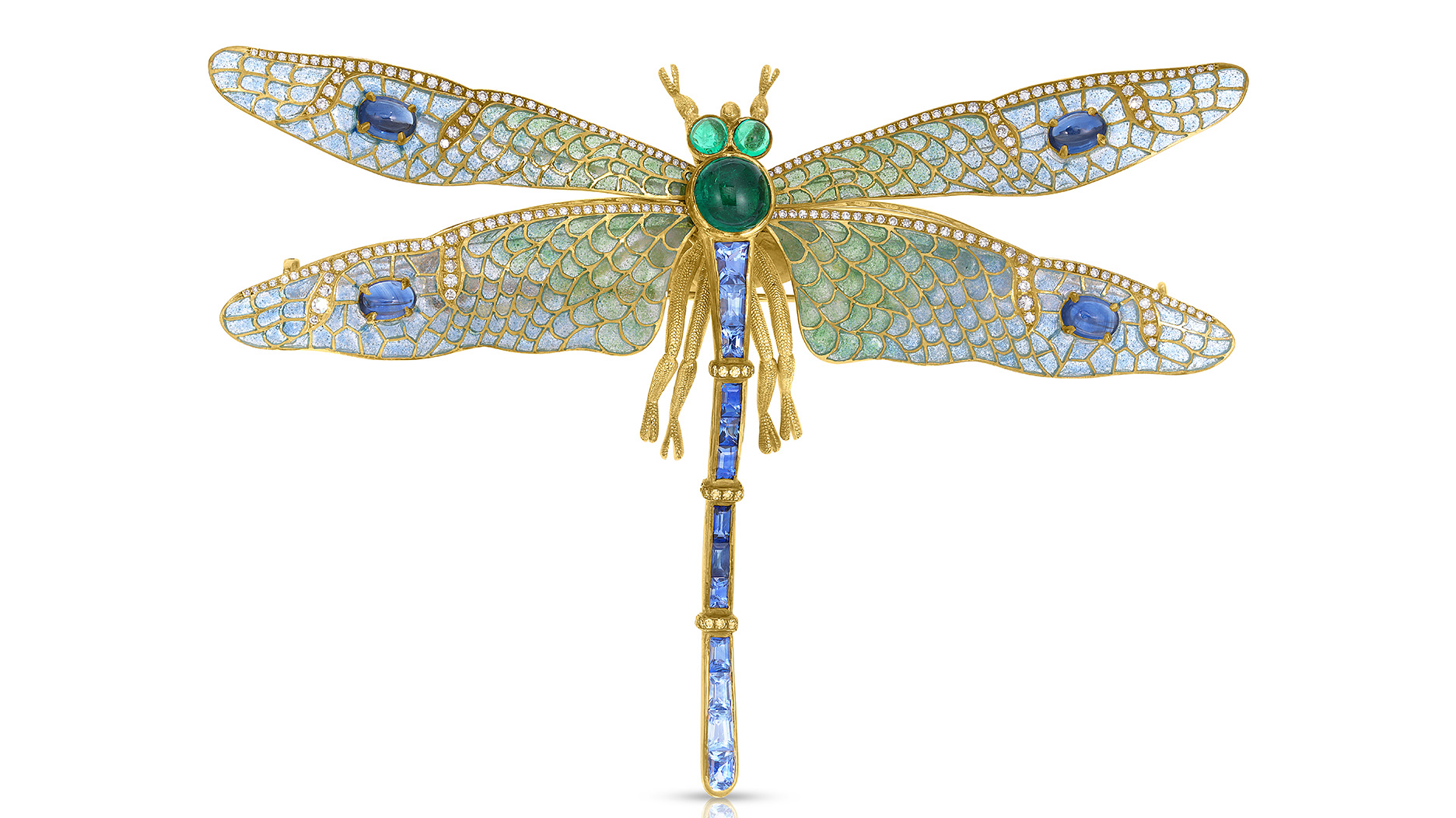
Alongside technical advancements, the very form of the motif has broken free. While botany and the naturalist bestiary—the undisputed pillars of traditional jewelry—retain their status as unshakable references, design studios are venturing down bolder paths. Fauna is losing its original innocence: reptiles coil around the neck in menacing, attack-ready postures, while insects reveal angular shells crafted from black spinels—a far cry from the powdery innocence of the colorful butterflies of yesteryear.
Abstract motifs, architectural lines, and industrial influences are gaining ground on necklaces. Geometry becomes brutal, contrasting sharply with the expected softness of diamond-encrusted curves. In the world of haute couture, houses like Schiaparelli are shaking up conventional proportions. Ornamentation is no longer designed on the scale of a buttonhole; it takes over the torso. Giant padlocks, pairs of hammered brass lungs, or crystal-encrusted eyes devour the black or ecru fabric. The pin disappears entirely behind the excessive volume, giving the impression of a work of art floating in mid-air. The jewel no longer quietly complements the silhouette; it dominates it, throws it off balance, and reconstructs it.
By breaking free from its constraints, the brooch exemplifies the vitality of an object that the fashion world believed it had definitively exhausted. It crystallizes the contradictions of an era that shuns standardized uniformity while seeking strong aesthetic anchors. Choosing to wear such a piece is no longer a mere social ritual, but a refined stylistic statement. This requires studying the geometry of one’s own garment, calculating the perfect asymmetry, embracing the relief of a sharp setting, and braving the stares drawn by the captivating glow of the gemstones. Far from the melancholy of inherited jewelry, it stands as a weapon of massive self-assertion. It defines an allure of precise, metallic brilliance—a precise point of tension where the drape of a fabric meets the audacity of the wearer. The family heirloom is dead; the art of self-expression begins.