Make Texture a preferred source on Google to support us
Add Texture to GoogleThis gesture has all but disappeared from the contemporary watchmaking repertoire. Sliding a fingernail under a thin metal lip, pivoting a hinged flap, and discovering, in the dim light of the case, a moving mechanism or words engraved out of sight. Historically reserved for pocket watches—the famous “savonnette” cases designed to protect the glass from impacts during hunting expeditions—this hinged case back now signifies a unique approach to the wristwatch. It is precisely this ergonomic detail—often confined to pieces of the very highest watchmaking or to special commissions—that the Bangalore Watch Company has chosen to place at the heart of its new creation, the Epoch. Far from aesthetic showmanship and technical one-upmanship, this young Indian watchmaking collective offers a return to classicism, blended with resolutely discreet personalization.
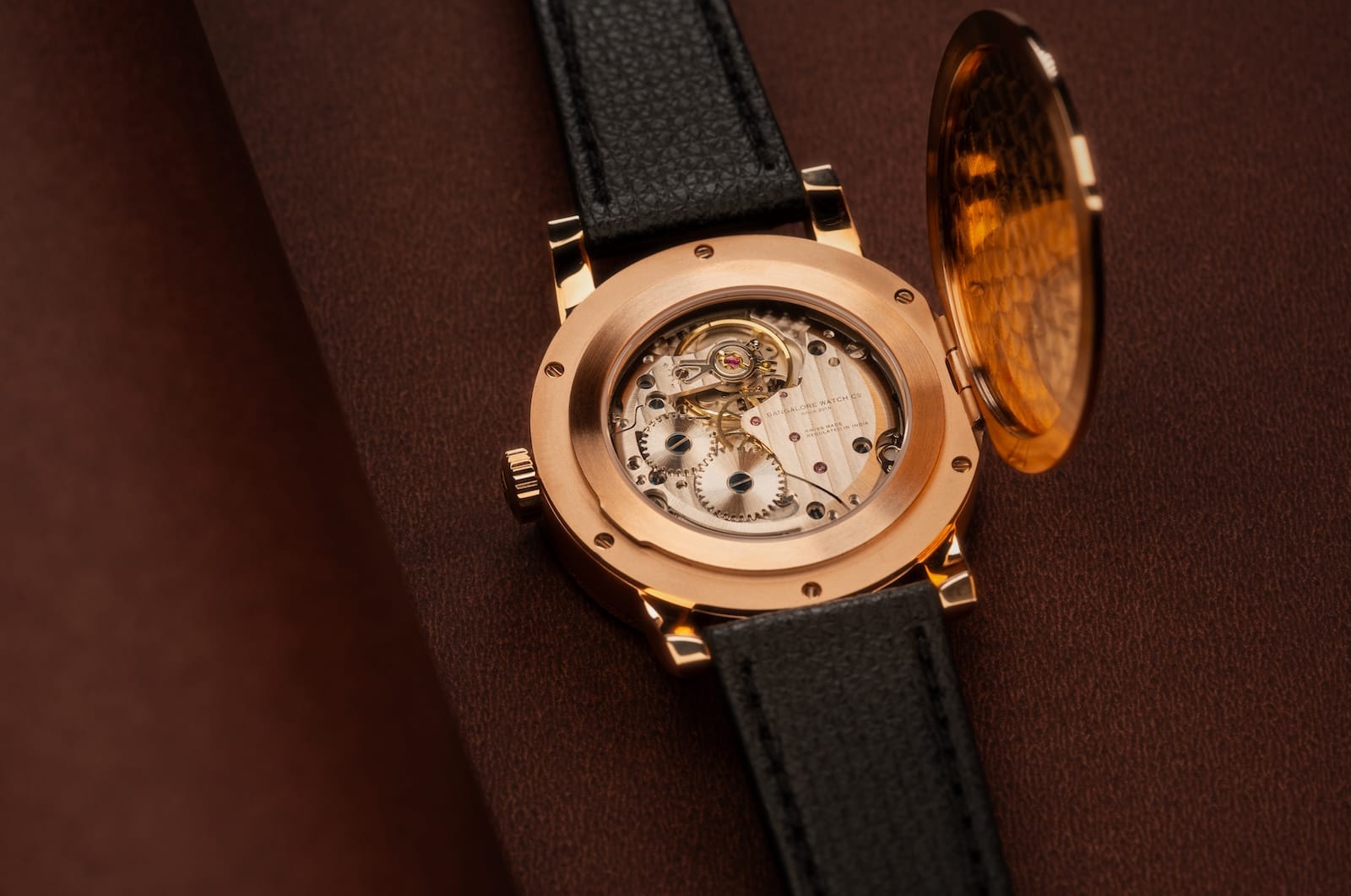
By opting for a medallion-shaped, re-sealable case back, the brand radically alters the physical relationship between the watch and its owner. The inner surface of the case back, finely crafted and adorned with meticulous guilloché work, has been designed as a blank canvas, ready to accommodate a personal engraving. A significant date, initials, or the coordinates of a place of remembrance. This message exists only for those who take the time and make the decision to open the case. Just below, a sapphire crystal reveals the heart of the watch. This duality between the absolute secrecy of the inscription and the total transparency of the movement lends the Epoch an almost sentimental dimension—a rare approach in a price segment where ostentation often takes precedence over intimacy.
The Demands of Hand-Winding
To bring this miniature theater to life, the brand’s founders opted for a hand-wound mechanical movement. The Sellita SW261-1 M caliber fits with unwavering logic into this commitment to reviving mechanical rituals. Unlike an automatic movement, which runs autonomously through the simple swaying of the wrist, the manual-winding caliber demands a regular and deliberate interaction. Winding the watch each morning via the crown becomes the necessary prelude to bringing it to life. This routine gesture resonates directly with the opening of the medallion caseback: the object demands tactile interaction, a conscious effort to reveal its full potential.
Behind the protective sapphire crystal, the Swiss-made caliber displays meticulous traditional finishes, notably featuring blued screws and straight-grained Côtes de Genève. One technical subtlety, however, intrigues readers in the specialized literature surrounding this launch: the exact power reserve of the movement gives rise to slight differences in assessment depending on the observer. While some specialized publications such as WatchTime India and aBlogtoWatch estimate a power reserve of around forty-five hours, Monochrome Watches, for its part, cites a guaranteed minimum of forty-two hours. This discrepancy is worth noting—not because of its actual impact on daily use—since winding the watch daily automatically evens out this variation in amplitude— but because it illustrates the complexity of certifying technical specifications for calibers that, although machined and assembled in Switzerland, are then shipped to and finely adjusted in the brand’s local workshops in Bangalore.
The balance of proportions and the precision of the dial
The Epoch’s design reveals a meticulous study of the codes of the dress watch. The case dimensions lend it a understated presence, steering clear of the trend toward oversized diameters: 39 millimeters wide with a lug-to-lug distance of 47 millimeters, all within a thickness of 11.6 millimeters. These dimensions incorporate the complexity of the hinged case back—a technical challenge, since a side hinge and a double case back inevitably add material and volume to the case’s architecture.
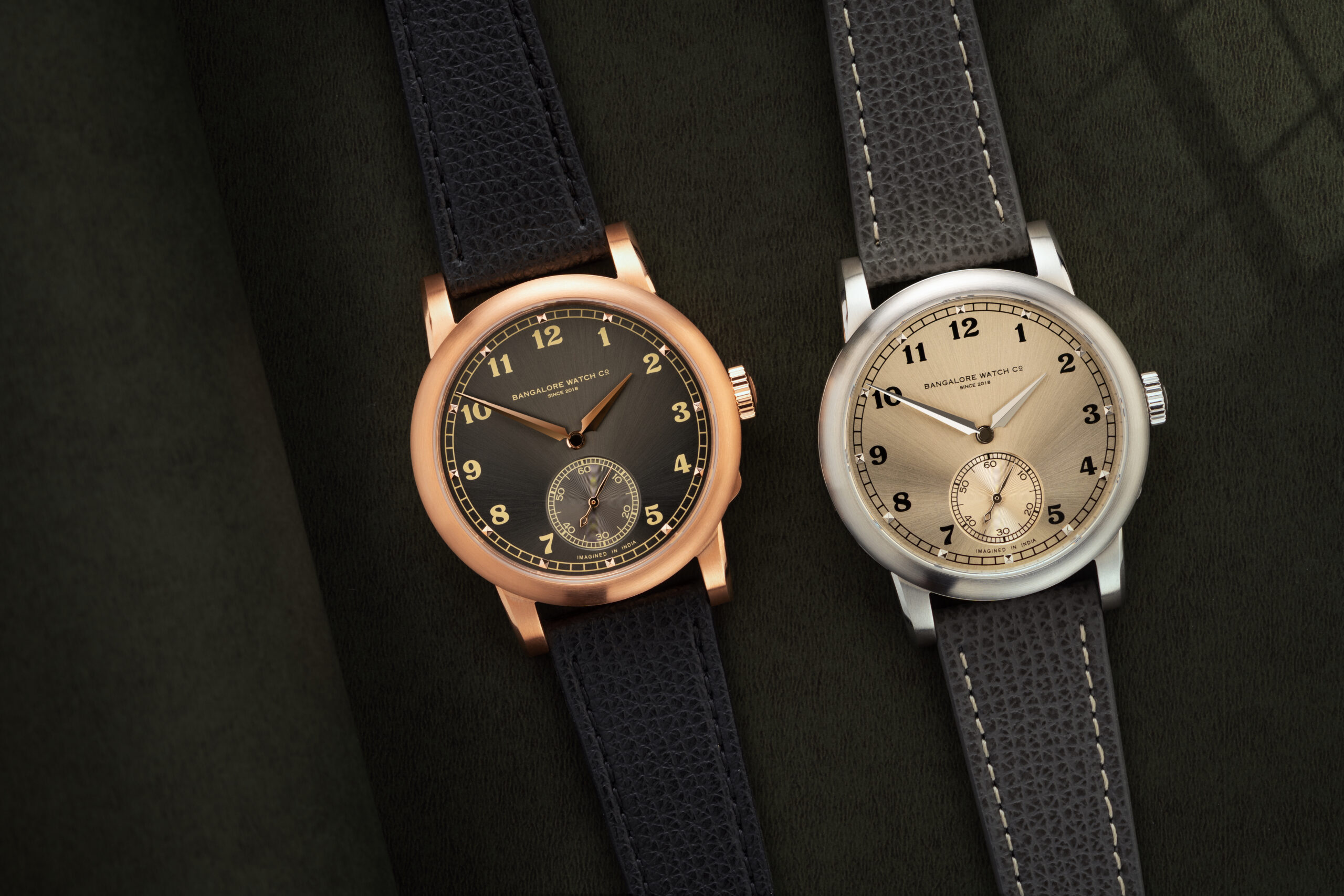
On the front, the eye is immediately drawn to the texture of the dial. Featuring a textured pattern known as “sunrise,” it refracts the light and structures the display area. The time display is organized around a precise peripheral railway-track minute scale, paired with Arabic numerals featuring the classic Breguet typeface, recognizable by its elegant curves. To emphasize the hours more distinctly, pyramid-shaped hour markers, cut into four facets, punctuate the perimeter. The rhodium-plated, diamond-beveled hands glide over the dial, while a sub-dial dedicated to the small seconds anchors the design at the 6 o’clock position. This design is protected by an anti-reflective sapphire crystal, ensuring water resistance tested to 50 meters and safeguarding the watch against everyday splashes.
To complement this design, two radically contrasting color schemes coexist in the collection. The Executive version opts for a look that exudes status: the cool metallic sheen of stainless steel contrasts with the warmth of a champagne-colored dial. In stark contrast, the Statesman version features a rose gold PVD-coated case, framing an anthracite dial whose depth absorbs light. In both configurations, a leather strap featuring the embossed grain of the Epsom pattern completes the watch’s formal look.
Bangalore: Another Chapter in Indian Watchmaking
Beyond the object itself, the Epoch bears witness to the unconventional journey of a young brand founded in 2018 by the duo Nirupesh Joshi and Mercy Amalraj. From the very beginning, they have adhered to a strict creative vision: to produce timepieces from India, while refusing to exploit the visual stereotypes or traditional folklore typically associated with the country in Western luxury imagery.

Before embracing this confident classicism, the Bangalore Watch Company had made a name for itself by exploring modern narratives of the Indian nation. Whether paying tribute to the pioneers of the nation’s military aviation, evoking the subcontinent’s ambitious space research program, celebrating the unifying fervor of cricket, or venturing into the realm of outdoor watches, each collection built a piece of this contemporary pride.
With the Epoch, however, the founders are returning to their roots, bringing full circle the journey that began with their very first creation: the Renaissance. Released at the time in a limited edition of five hundred unique pieces, this first dress watch already forged a link with the local watchmaking heritage, deeply shaped by the historic, mass production of the state-owned HMT factories. However, whereas the Renaissance played a straightforward horological role with a simple transparent case back and a textured dial, the Epoch shifts the focus. The aesthetic design on the front now shares the spotlight with the intricate engineering concealed on the back.
A Financial Position That Stands the Test of Time
As the company matures, its production setup is taking shape. Recent assessments shared by Hodinkee analysts indicate a lean team of about fifteen employees, capable of assembling nearly two thousand watches annually in the Bangalore workshop. This human-scale operation indicates that manufacturing has moved well beyond the experimental stage, without, however, shifting toward large-scale industrial production—though it is difficult to estimate exactly what fraction of this volume will be allocated to the production of the Epoch.
This shift in approach inevitably raises the question of how value is perceived. Priced at 297,600 Indian rupees—approximately $3,100—the Epoch is venturing into an extremely competitive market dominated by long-established Swiss and Japanese brands. At this price point, the conceptual appeal of the hinged case back or the narrative of an emancipated Indian watchmaking industry will not be enough to win over buyers in the end. Prospective buyers will demand surgical precision in the finishes, unquestionable timekeeping accuracy over the long term, and the reliability of responsive after-sales service.
The pre-order launch, already set for November 18, 2026, gives the brand time to structure its offering and consolidate its legitimacy in this premium segment. The challenge remains: to establish, in the midst of a market saturated with expressive designs and immediate social recognition, a timepiece whose ultimate refinement lies precisely in remaining hidden, close to the skin.