Make Texture a preferred source on Google to support us
Add Texture to GoogleIn an interior, a large clock has long commanded its own presence: a vertical piece of furniture, a steady ticking, a presence that organizes both the space and the hours. With the Troja M II, Erwin Sattler brings this tradition into the realm of the contemporary collector. This timepiece does more than simply occupy a wall: it houses, winds, and protects up to sixteen wristwatches, while allowing its movement to become a living element of the decor.
Crafted in the workshop in Gräfelfing, near Munich, this new family of floor clocks for 2026 aptly reflects the German maison’s eclecticism. Erwin Sattler produces everything from nautical instruments to table clocks, wristwatches, and large wall clocks. The Troja M II brings together these diverse areas of expertise in a unique design, conceived to find its place in a home collection rather than in an impersonal display case.
The Piece as a Clock Cabinet
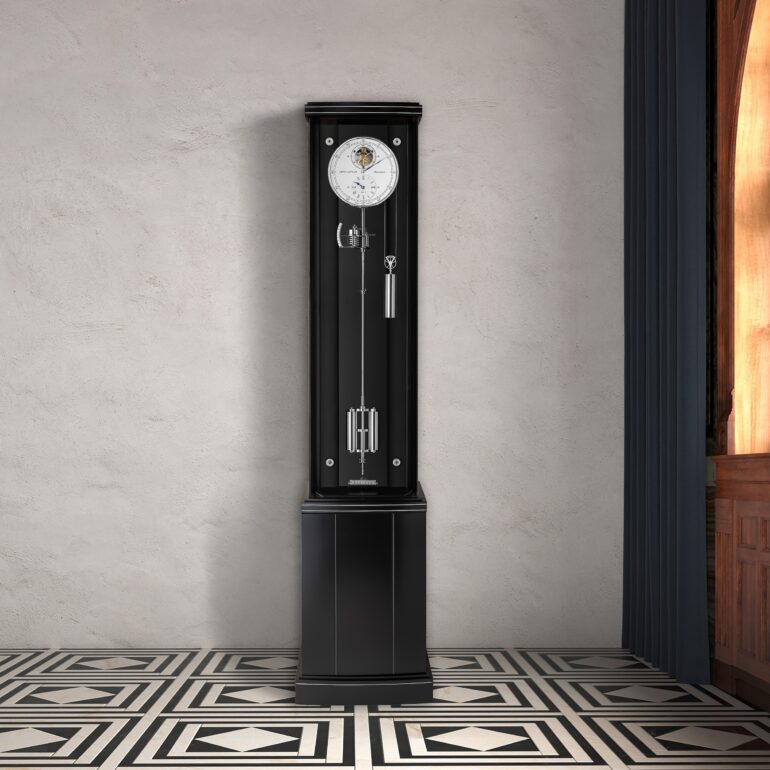
The Troja 16 M II model serves as the starting point for the collection, though it is by no means an entry-level model. Standing 219.5 cm tall, 45.5 cm wide, and 50 cm deep, it resembles a miniature architectural structure. Its case, crafted from varnished black walnut and accented with metal inlays, conceals a function that alone explains the project’s purpose: to transform the grandfather clock into a winding station for wristwatches.
Eight programmable winding mechanisms are installed on each side of the case, for a total of sixteen. They extend remotely, bringing the total width of the piece to 70 cm. This lateral opening gives the clock an almost theatrical appearance: the watches emerge from the cabinet, ready to be wound, then return to their compartments when the panels close.
This storage mechanism is not merely for show. It addresses a practical need for owners of automatic watches: how to keep their timepieces running without leaving them on a display stand or in a separate safe? The Troja 16 M II combines both functions. Its lower section serves as a safe to store other watches, jewelry, or valuable items. Upon request, the cabinet can also be connected to a home security system.
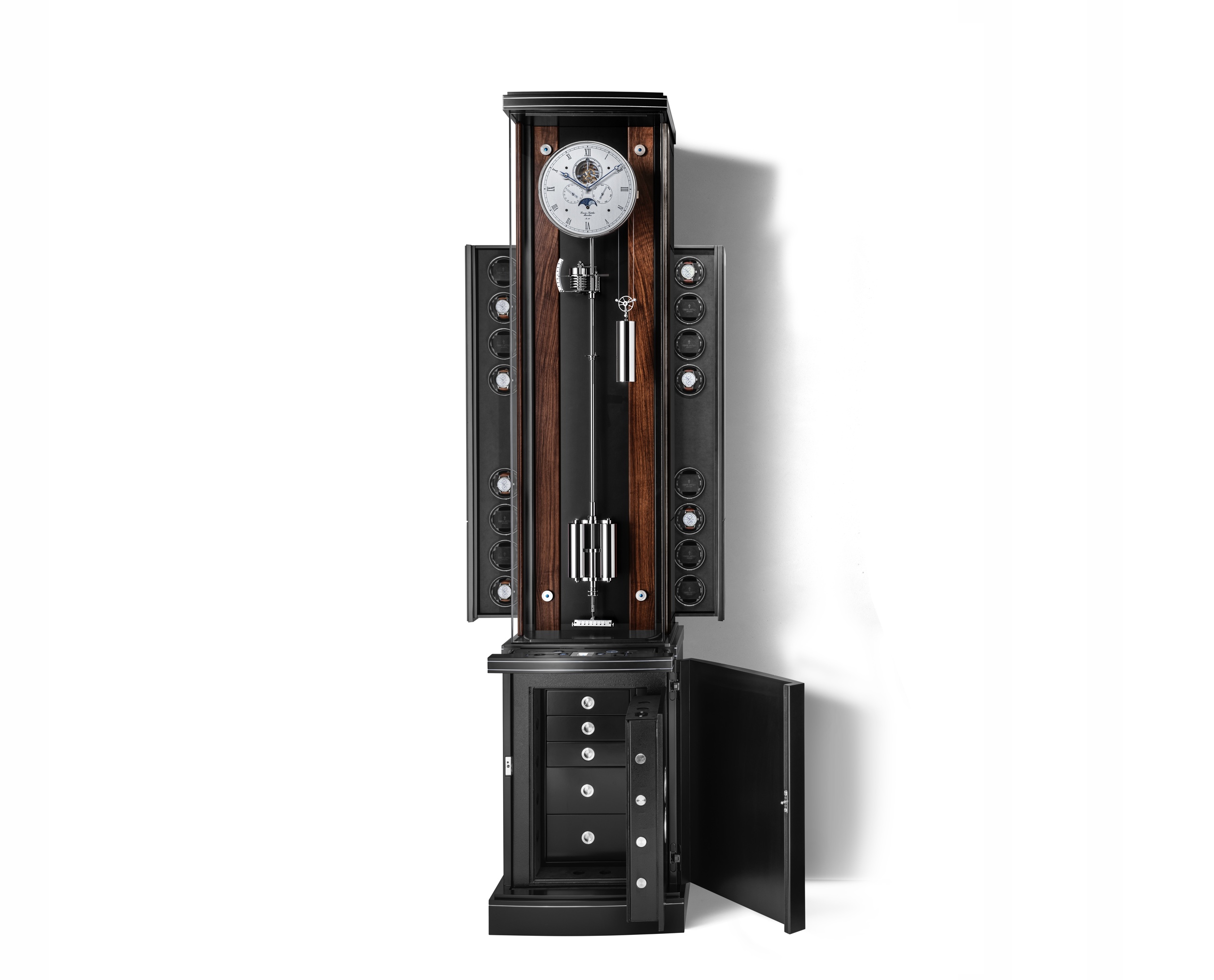
The result is unique: the collection isn’t relegated behind a closet door or into a wall safe. It’s integrated into a standalone timepiece cabinet, placed in the room just like a piece of antique furniture—but with features tailored to a contemporary collection.
A monthly ritual rather than a daily chore
At the heart of the Troja 16 M II beats the Sattler 1965 caliber, derived from the Classica Secunda 1995 M. Its escapement is not enclosed within an opaque case: the openwork dial allows a view of part of the mechanism. At 12 o’clock, the opening in the dial becomes a window onto the movement, reminding us that the clock’s monumental presence rests first and foremost on its mechanical construction.
The one-meter-long pendulum swings once per second. This tempo gives the clock a physical rhythm—visually almost silent—that is quite different from the instantaneous glance at a screen or the brief gesture of looking at one’s wrist. The thirty-day power reserve means the movement needs to be wound only once a month. The relationship with the object is thus established over time, through a monthly ritual rather than daily interaction.
Erwin Sattler opted for a regulator-style display: the hours, minutes, and seconds are shown on separate scales. This separation clarifies the dial’s composition and gives each indication its own space. The model can be ordered with a light-colored, silver, and white finish, or in an all-black version. The finishes of the dial and the interior of the case thus directly contribute to the piece’s character: the light version highlights the contrasts more, while the black version reinforces the continuity between the case and the movement.
Three Ways to Experience Time
The Troja M II family comes in three versions. They share the same desire to create a dialogue between traditional watchmaking and a more contemporary aesthetic, but each chooses its own language. The 16 M II prioritizes storage and serves as a safe. The Lunaris M II adds a calendar display. The Sonata M II, meanwhile, introduces a sonic dimension.

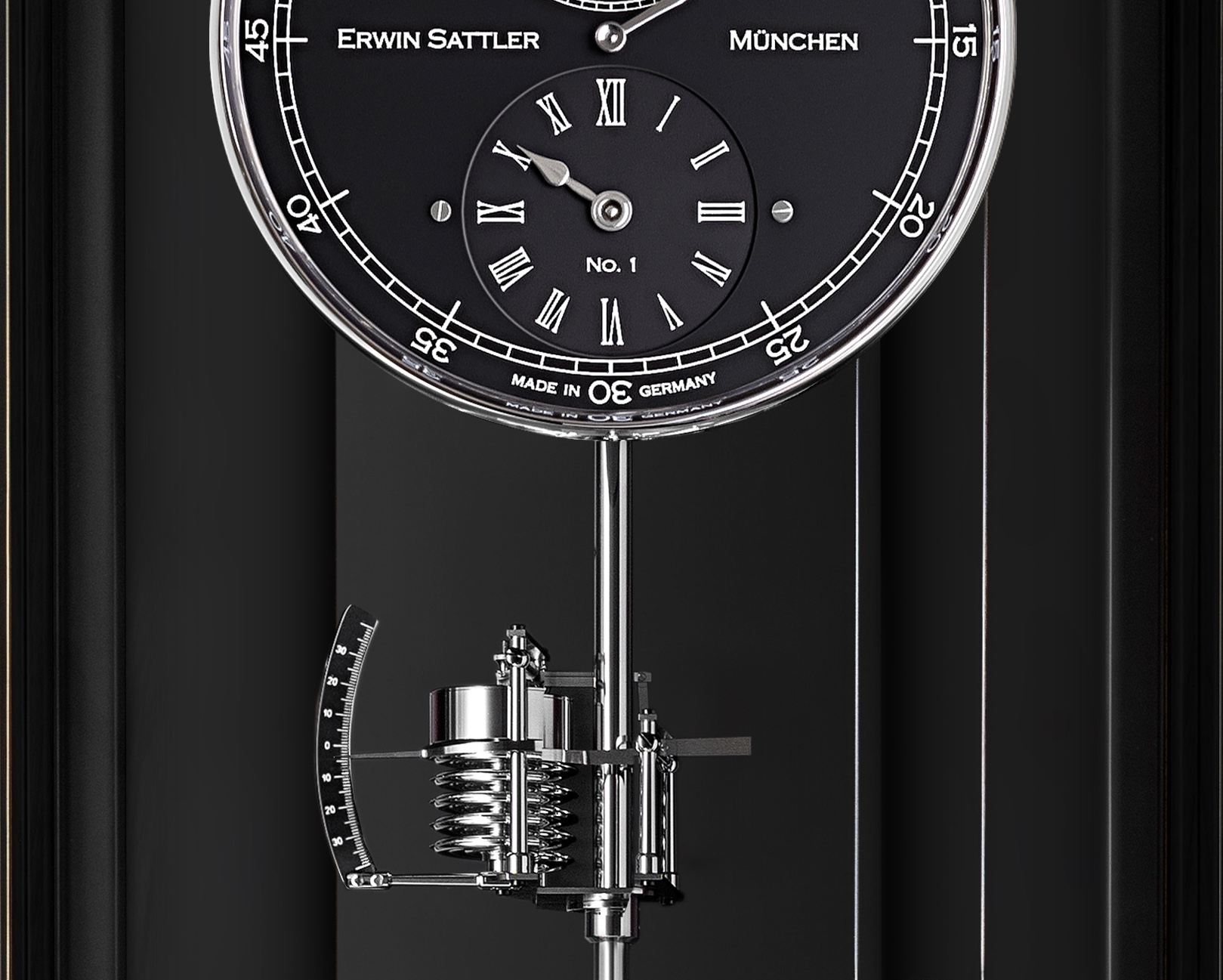
The Troja Lunaris M II is powered by the Caliber 1915. Its dial combines hour, minute, and second hands with a full calendar display: day of the week, date, and moon phase. This abundance of information does not result in a visually cluttered design. The dial’s layout remains organized around highly legible elements: Roman numerals, a railway-track minute scale, exposed screws, and a vertical satin finish. The opening at 12 o’clock maintains a visual connection to the movement, part of which remains visible.
This coexistence of classic references and more industrial details defines the visual identity of the Lunaris M II. The Roman numerals evoke fine domestic timepieces; the boldly displayed screws and the open dial introduce a mechanical candor that rejects illusion. The moon phase, for its part, introduces a different sense of time: it not only measures the passage of the day but also places the watch within a longer cycle.
The Troja Sonata M II takes a different approach. It is equipped with the Sattler 2015 caliber and announces the time with a chime every half hour. Here, the passage of the minutes is no longer merely a visual phenomenon. It makes itself heard in the room at regular intervals, following a principle inherited from parlor clocks. Its dial displays the hours, minutes, seconds, and moon phases. This version is designed for those who believe a floor clock should also be heard, not just seen.
A handcrafted piece, despite its contemporary precision
The lines of the Troja M II eschew historicist ornamentation. The dark surfaces, the clean geometry of the case, and the discreet integration of the winding mechanisms set it apart from the sometimes-overly ornate image associated with traditional grand clocks. Yet it is still crafted by hand. This fact changes the way the object is perceived: behind the controlled appearance of the piece lie time-honored watchmaking techniques, applied to a timepiece whose functions are clearly rooted in contemporary life.
The Troja M II therefore does not seek to reduce the grandfather clock to a decorative accessory, nor to transform a watch cabinet into a technical piece of furniture. It occupies precisely this middle ground. The mechanical movement keeps time, the pendulum sets the rhythm, the winding mechanisms maintain the automatic watches, and the cabinet houses what needs to be protected. Within a single unit, collectible items are no longer scattered across multiple devices.
This positioning is reflected in the pricing: the collection ranges from 133,900 to 171,390 euros, depending on the version and specifications selected. Information on the various configurations is available from Erwin Sattler. The Lunaris, the Sonata, and the 16 M II are all based on the same concept, but ultimately allow you to choose what you expect from a grand clock: preserving a collection, keeping track of the calendar, or filling your home with the chime of the half-hours.