Make Texture a preferred source on Google to support us
Add Texture to GoogleIn the harsh light of a warehouse at Midsomer Enterprise Park, south of Bristol, dozens of rows of unopened cardboard boxes, wooden crates, and pallets are stacked, smothered under meters of plastic wrap. This anonymous industrial setting, punctuated by the constant movement of forklifts, is nonetheless home to one of the most ambitious interiors in London’s recent hotel scene. Beneath this thick protective packaging lie custom-upholstered headboards, sofas with carefully crafted curves, meticulously finished console tables, and designer lighting fixtures. All of this furniture was intended to furnish the 149 guest rooms and the spacious reception areas of the future hotel, The Other House, planned for the heart of Covent Garden. Ultimately, the luxury hotel will never see the light of day in this form. Before it had even welcomed its first guest, polished its brass fixtures, or endured a single night of operation, this monumental interior was sent to the auctioneers’ hammer. A premature end that highlights the silent brutality of business and the hasty overhauls that govern the contemporary luxury real estate market.
The Anatomy of a Prestigious Address Cut Short
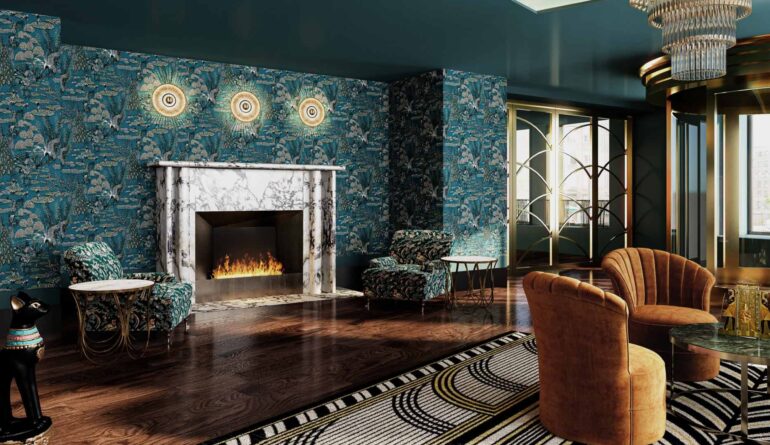
Yet 25–31 Wellington Street offered a prime location, tailor-made to attract a discerning international clientele. Just a stone’s throw from the West End’s major theaters and London’s vibrant cultural scene, the project aimed to replicate the hybrid model that had cemented the reputation of the brand’s first property, which opened in 2022 in the ultra-chic South Kensington neighborhood. The idea was based on the unique “Residents’ Club” concept: a desire to blur the traditional boundaries of short-term hospitality to offer a place for an extended stay. The goal was to foster social interaction and offer residential-style privacy, while incorporating highly personalized services. The presentation materials outlined a vast atrium bathed in natural light, underground spaces dedicated to wellness, and, above all, an extraordinarily bold visual identity, designed to leave a lasting impression the moment guests stepped through the revolving doors.
It is precisely this meticulously crafted visual identity that has now been scattered to the four winds. Conceived as a continuous narrative whole, the furniture being auctioned is the result of a long-term collaboration between TOHID, The Other House’s in-house design studio, and the London-based agency Bergman Design House, led by the design duo Marie Soliman and Albin Berglund. The team had designed a collection that eschewed ostentatious display in favor of a tactile, organic, almost sculptural approach. The design brief resulted in elegant fluted armchairs, dining tables that eschew right angles, and sophisticated material combinations. Heavy tabletops of polished marble or terrazzo were paired with dark-stained wood, all resting on massive legs made of raw cast iron or brushed brass. Subtle references to Art Deco aesthetics gave structure to the overall design, with the aim of creating a fluid dialogue between the upholstered comfort of the suites and the vibrant energy of the dining rooms.
The Fallout of a Capital-Driven Overhaul
But in this highly financialized sector, even the most exquisite artistic vision carries little weight in the face of a shift in shareholder priorities. The fateful shift takes place in July 2026. Just as the Wellington Street location was set to open its doors to the public that same summer month, The Other House group becomes the subject of a high-profile acquisition by Aendre Group. The transaction instantly halts construction. The new owners, reluctant to launch a concept devised by their predecessors, imposed a complete overhaul of the hospitality strategy. They deemed the existing aesthetic—though brand-new—incompatible with the new vision they intended to bring to the venue.
Overnight, thousands of custom-made pieces of furniture—ordered months in advance and barely out of the factories—became obsolete. Lifestyle Hospitality Capital, the firm now managing the project’s positioning and communications, has significantly pushed back the deadline: the London launch is now scheduled for the first half of 2027. This delay of just under a year isn’t simply to fine-tune menus or recruit staff. It marks a complete overhaul of the building, reducing kilometers of stretched fabric and tons of designer furniture to the status of cumbersome logistical surplus. The operation illustrates with striking clarity the clinical pragmatism of hotel investors: interior design is no longer viewed as a finished work, but as a volatile asset—a mere adjustment variable that can be crossed off with the stroke of a pen depending on strategic decisions.
A technical and aesthetic windfall for developers
The Pro Auction auction house has been tasked with the daunting job of clearing out the warehouses to make room. While hotel liquidations are a regular occurrence in the industry, in the overwhelming majority of cases they involve establishments at the end of their lifecycle, seeking to dispose of worn-out mattresses, tired carpeting, or outdated televisions before embarking on major renovations. The mid-November auction stands out completely due to the absolute newness of its inventory. The auction encompasses not only the complete furnishings of the 149 rooms but also the decorative elements of the common areas: complex architectural lighting fixtures, imposing sculptures, curator-selected works of art, and specialized restaurant equipment.
For industry professionals—real estate developers, interior designers seeking inspiration, or operators of independent boutique hotels—the opportunity goes far beyond the prospect of a bargain-priced purchase. The true luxury of this sale lies in the dramatic reduction in lead time. Purchasing several of these lots allows buyers to avoid the endless manufacturing delays, raw material shortages, and transportation uncertainties that chronically paralyze high-end construction projects. Here, the potential buyer acquires a collection with an immediate narrative coherence.

Especially since the collection de facto meets the most exacting requirements of the professional hospitality market. The sales catalog devotes considerable attention to the technical aspects of the inventory. All textile items and seating are Crib 5 fire-rated—an extremely stringent fire safety certification that is mandatory for public-facing establishments in the United Kingdom. Even more significant in the current context, the production of this furniture line has been tailored to meet the stringent criteria of the BREEAM Excellent environmental certification, ensuring traceability, the sustainability of materials, and the ecological excellence of manufacturing processes. This dual technical endorsement transforms this sale of unsold inventory into an unexpected shortcut for any high-end project seeking to quickly furnish its spaces without compromising on safety or eco-responsible standards.
The Final Dispersal of a Hotel Fantasy
The schedule for this luxury auction promises to be tight. A single day of physical inspections is scheduled for November 16 in the Bath area. This session will allow buyers—who will arrive equipped with their blueprints and color charts—to gauge the thickness of the marble, test the density of the foam, and appreciate the patina of the brass that has been kept under cover. The auctions will follow immediately afterward, from November 17 to 19, at a brisk pace, with bidding beginning each morning at 10:00 a.m. To maximize visibility for this extraordinary collection, Pro Auction has implemented a hybrid approach. The bidding will take place simultaneously in the auction hall and on several specialized online platforms, thereby targeting a clientele of international dealers who are fully aware of the rarity of such a sale.
Within a few months, these sculptural headboards, heavy terrazzo tabletops, and bronze-toned wall sconces will inevitably find their place. They will help define the lobby of a Geneva establishment, add warmth to the suites of a Savoyard chalet, or adorn the reception lounges of a private cruise ship. They will tell entirely different stories, fundamentally disconnected from the London buzz and the theatrical legacy of Covent Garden for which they were originally designed.
The fall auction organized by Pro Auction physically erases the first iteration of the Wellington Street project, bringing to fruition the clean slate demanded by Aendre Group. But beyond this logistical footnote, this sale serves as a powerful barometer of the luxury industry. It serves as a stark reminder that behind the dreamlike sketches of architectural firms, behind the promises of a certain lifestyle and the rhetoric of bespoke design, the five-star hotel industry remains a ruthless real estate battleground. A world where a comprehensive concept—the result of months of aesthetic deliberation and millions of pounds in investment—can be swept aside behind closed doors at a board meeting, only to end up stored on pallets before the paint in the hallways has even dried completely.