
Make Texture a preferred source on Google to support us
Add Texture to GoogleIn the Swiss watchmaking industry, there is a traditional way to celebrate anniversaries: a limited edition, a commemorative dial, or a number engraved on the case back. For its 150th anniversary, Audemars Piguet chose to take a different approach. The first face of this anniversary is not that of a watch but that of the people who make them. Engineers, artisans, and employees from offices spread across several continents play the leading roles in the film that kicks off the celebrations. This approach may come as a surprise from a brand whose models are instantly recognizable. Yet it speaks volumes about what enables a watchmaker to endure for a century and a half without ever changing its address.
An address that has never changed
For it is, first and foremost, a matter of geography. From the very beginning, the company has been based in Le Brassus, a village in the Joux Valley, in the Vaud Jura. The valley is considered the cradle of Haute Horlogerie, and this reputation is no accident: long winters, relative isolation, and a long-standing tradition of meticulous work carried out at home or in workshops. This region has fostered a unique kind of expertise—one passed down from hand to hand, from a master to an apprentice, more reliably than through manuals.
The brand likes to highlight this dialogue between people, the landscape, and the passage of time. One might see this as nothing more than a figure of speech. Yet one need only look at the map: in an era of corporate conglomerates and scattered production sites, remaining loyal to a mountain village is a deliberate choice—almost an act of stubbornness. The images released for the anniversary bear witness to this. They show employees against the backdrop of Le Brassus and then gathered in the historic factory building, arranged as a triptych fresco where each panel flows into the next, like a family frieze.
The Village as a Unit of Measure
The message behind this campaign—whose website address echoes the English phrase “The beat goes on”—boils down to a simple idea: 150 years later, the company still sees itself as the same village, populated by the same villagers. There is something paradoxical about this phrase for a company with a global presence, complete with its boutiques and AP Houses. Yet it is not absurd. Here, “village” refers less to a physical location than to a way of working together—a sense of cohesion that the Manufacture presents as its true driving force.
This emphasis on community goes hand in hand with another, more ambitious goal: the desire to constantly push the boundaries of what a watch can achieve, without being rushed by deadlines. In an industry where development timelines span years, patience is far from a mere virtue. It is essential to the success of a complicated movement, the fine-tuning of a mechanism, and the training of a craftsman capable of hand-decorating a timepiece. Taking the time to create something remarkable: that is how the house sums up its approach, and this anniversary offers it an opportunity to publicly embrace it.
A film shot with those who usually remain off-camera
The anniversary film thus reverses the usual hierarchy of watchmaking communication. Typically, the workshop remains in the background, reduced to a few shots of hands and magnifying glasses. Here, the employees are in the foreground, cast like actors. The message is clear: the spirit born in Le Brassus 150 years ago continues to flow today among teams from different cultures and countries, transcending eras and borders.
One might smile at the exercise, which remains a brand campaign. It does, however, have the merit of shifting our perspective. A watch of this caliber is the product of a chain of expertise of which the customer sees almost nothing. Making these faces visible serves as a reminder that a watchmaker is not defined solely by its logo or its flagship models—no matter how famous they may be—from the Royal Oak to the Royal Oak Offshore, from the Royal Oak Concept to the most recent Code 11.59 by Audemars Piguet.
The Perpetual Calendar, Redesigned for the Wrist
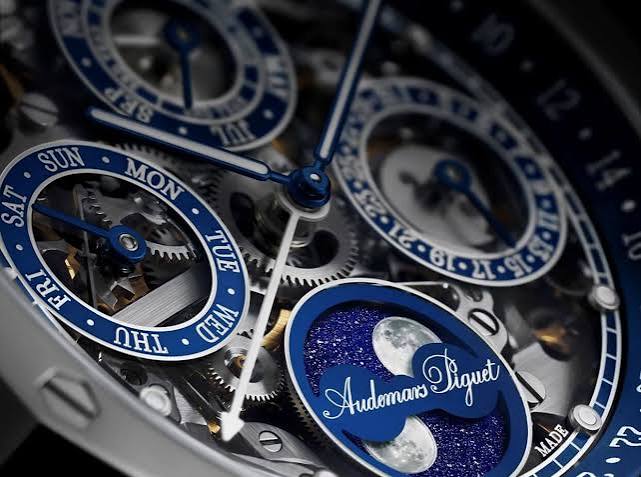
That said, the anniversary celebration does not overlook the watches themselves. The most significant technical innovation concerns the perpetual calendar—one of the most symbol-laden complications in watchmaking, as it accounts for the varying lengths of the months and the occurrence of leap years. Audemars Piguet announces that it has reinvented this mechanism by starting with a question rarely asked first: that of usability. The chosen word is “ergonomic,” and it is telling. For a long time, the sophistication of a perpetual calendar came at the cost of a certain degree of inconvenience in operation, with its correctors requiring a stylus to operate. Putting the user at the center of development means recognizing that the complication must also be practical for everyday use.

Three new models equipped with this calendar accompany the announcement. The brand positions them as a continuation of its previous developments on this complication, while presenting them as forward-looking. This balance is classic in the watchmaking industry, but here it takes on special significance: celebrating 150 years by reworking a movement inherited from the past rather than simply reissuing it is a way of giving heritage an active role.
At the museum, talent takes precedence over trophies
The same thread leads to the Audemars Piguet Museum & Workshop in Le Brassus, which is hosting a unique temporary exhibition titled “The House of Wonders.” The title promises wonders, and there are undoubtedly some to be found in the display cases. But the stated intention aligns with that of the film: to trace the brand’s history through the people who built it, paying tribute to their passion and expertise. The narrative moves away from a gallery of isolated masterpieces to become a story of men and women, which aligns quite well with the reality of a craft where each piece passes through many hands.
“The House of Wonders” also serves as a gateway to the website dedicated to the 150th anniversary, of which it constitutes the first chapter. There, visitors journey through a century and a half of watchmaking mechanics, often daring aesthetic choices, and dedication to a single craft. The choice of the word “chapter” is no accident: it signals a celebration that will unfold in episodes rather than as a single spectacular event.
A year filled with surprises
The brand also notes that the program won’t stop there. The anniversary year will be punctuated by festive events and special editions, as well as other announcements that the company is careful not to detail in advance. This calculated silence is part of the game: it keeps collectors in suspense and allows each milestone time to take center stage.
One question remains that this anniversary raises without really answering it: Can a company that has gone global still call itself a “village”? The answer may lie less in words than in concrete decisions: the manufacture is still in Le Brassus, the museum is located there, and it was in the historic building that the teams posed for the group photo. For enthusiasts who wish to judge for themselves, the new perpetual calendars await in boutiques and AP Houses, where you can also entrust your watch to the brand’s watchmakers for servicing—by appointment or on the spot. As for the next chapter, it has yet to be revealed.