
Make Texture a preferred source on Google to support us
Add Texture to GoogleFriday, September 25, 2026, will be remembered as a pivotal moment for the Milan fashion scene, marked by a shared determination to confront fashion with its own reality. In the space of a few hours, Milano Moda Donna witnessed two radical visions of Italian society unfold one after the other: the hushed, hierarchical world of Gucci’s showrooms, and the raw, kinetic energy of the urban streets at Moschino. At the heart of the day, a common thread emerged, transforming the runway into a mirror held up to the city’s residents, whether they hail from the upper echelons of society or navigate the daily commute.
Gucci: The Theater of the Bourgeoisie According to Demna
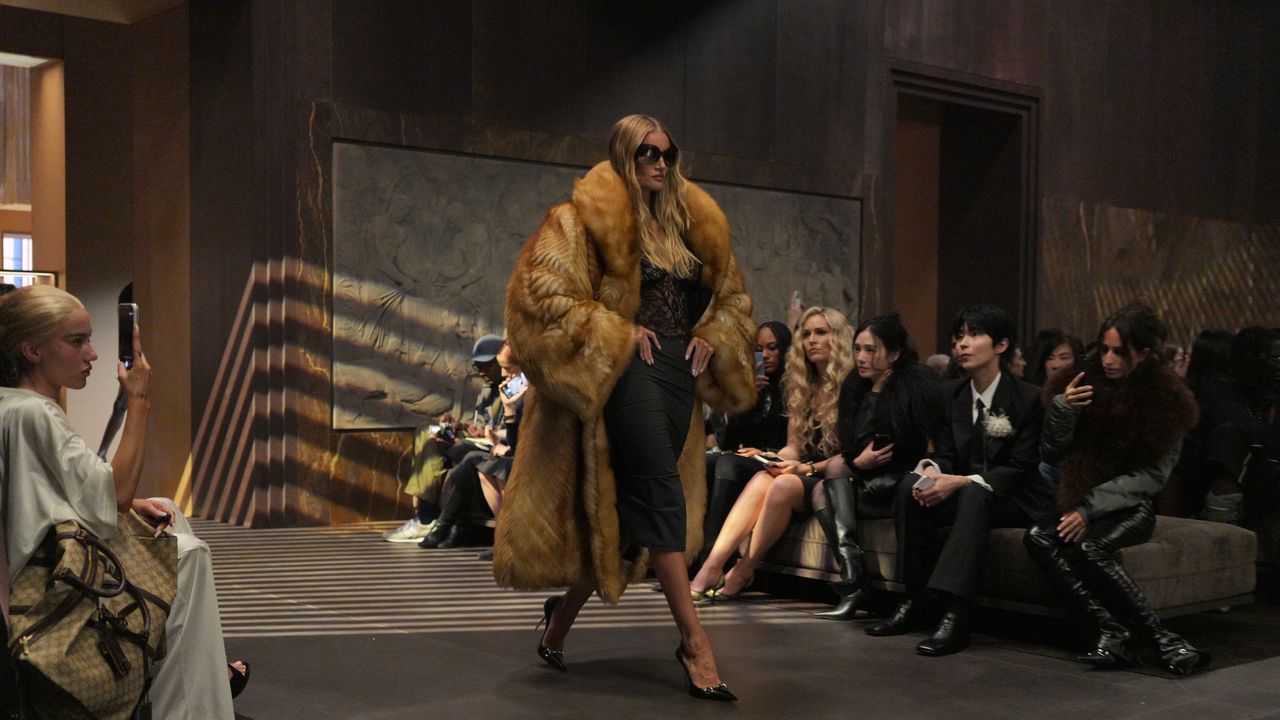
At 2:00 p.m., the gathering took place at Gate 11 on Via Bartolomeo Colleoni. For his Spring-Summer 2027 collection, titled “The Store Show,” Demna chose to transform an exhibition hall into a meticulously detailed replica of a Gucci flagship store. The decor left nothing to chance: Paonazzo marble, rows of clothing racks, accessory display cases, and velvet lounges. This immersive setting was not only a showcase for the collection but also served as a preview of the new architectural concept the brand is set to roll out in its future boutiques worldwide.
In this setting where luxury demands to be seen, the casting team moved away from traditional modeling standards to focus on embodying social figures. The vision of Demna, who has led the brand’s creative direction since 2025, is to structure Gucci’s identity around specific archetypes. Thus, the runway featured “The Rebel Aristocrat,” “The Snob,” “The Eccentric,” and even Milan’s iconic figure, the sciura—that upper-class woman of timeless chic. To bring these characters to life, the fashion house enlisted a mix of socialites and public figures. Among them, the former Duchess of Feria, Naty Abascal; Princess Olympia of Greece; and Rosie Huntington-Whiteley walked the marble runway of the “Store Show.”
In the front row, the audience reflected the ambition behind Kering’s commercial turnaround following a period of decline. Cardi B, Donatella Versace, Anna Wintour, Jannik Sinner, Bianca Jagger, Romeo Beckham, Shawn Mendes, and Edward Norton observed this collection, in which fashion looks at itself through the mirror of its own consumption. The looks presented seek to reestablish a strong identity, playing on the codes of an Italian society that is unapologetically confident and self-assured.
Moschino: The Choreography of Everyday Life
Three hours later, the contrast was stark. For Loris Messina and Simone Rizzo’s debut as creative directors of Moschino, the brand moved to the outskirts of Milan, to the rooftop terrace of a parking garage near Linate Airport. This location, situated near the future site of the 2026 Olympic ice hockey venue, offered an industrial and unobstructed view of the city.
The founders of the Sunnei label, succeeding Adrian Appiolaza, chose to stage an urban flow rather than a traditional fashion show. On the runway, two worlds collided: on one side, professional models presenting the Spring-Summer 2027 collection; on the other, a sea of ordinary passersby walking in the opposite direction. These extras, estimated to number between 400 and 450 people, wore their own street clothes and carried their personal belongings: bicycles, cell phones, shopping bags, strollers, and even dogs. The goal was to recreate the raw and sometimes chaotic energy of a Milanese commute.
Stylistically, the Messina-Rizzo duo engaged in an ironic reappropriation of everyday clothing, moving away from a literal reference to Franco Moschino’s archives. The collection featured pieces with reworked silhouettes, such as T-shirts with generously padded shoulders and dresses that accentuated the curves of the buttocks. Revisited hoop skirts and draping punctuated this wardrobe, complemented by offbeat accessories such as a handbag shaped like a black cat.

Fashion at the Intersection of Social Commentary and Commercial Imperatives
These two presentations, though formally opposed, converge in their desire to anchor luxury in a tangible human context. At Gucci, the goal is to appropriate the codes of social representation and the international bourgeoisie to breathe new life into the brand’s sales. The concept of “luxury that demands to be seen” speaks directly to a clientele that seeks in clothing a clear and identifiable status symbol.
At Moschino, the approach is more sociological. By placing anonymous city dwellers at the heart of the presentation, Messina and Rizzo question fashion’s place in the urban hustle and bustle. They transform the mundane act of getting around the city into an artistic performance, while offering silhouettes that play with irony and the subversion of anatomical forms. This debut collection marks a break from previous directions, favoring a vision more firmly rooted in the immediate reality of contemporary design.
These pieces are scheduled to hit the market in the first half of 2027. While prices for these runway collections have not yet been announced, the stakes for both fashion houses extend beyond the realm of retail. For Gucci, the goal is to validate the aesthetic shift initiated by Demna in order to stabilize its growth. For Moschino, the challenge lies in asserting the identity of the new creative duo while quelling market rumors regarding a potential financial exit or sale of the brand by its parent company, Aeffe—speculation that remains, to date, without official confirmation.
September 25 thus illustrated two ways of bringing fashion down from its pedestal. Whether in the marble-floored showrooms of a luxury store or on the asphalt of a suburban parking lot, “real people” have become, for the duration of a season, the driving force behind Milanese design.