
Make Texture a preferred source on Google to support us
Add Texture to GoogleMonday, October 5, 2026, will go down as a dark day for the artistic heritage of Auvergne. Late in the morning, Christian Karoutzos, an art restorer and owner of the C. Karoutzos Contemporary Art Center, discovered the unthinkable in his exhibition space located on the outskirts of Issoire. During the night between Sunday and Monday, individuals broke into the building after forcing open the entrance gate to steal a major work from 20th-century history: the monumental cover of the Book of Revelation sculpted by Salvador Dalí. This theft, described by the owner as a cultural catastrophe, deprives the public of an object whose value far transcends financial considerations to touch upon the universal.
A colossus of bronze and precious stones
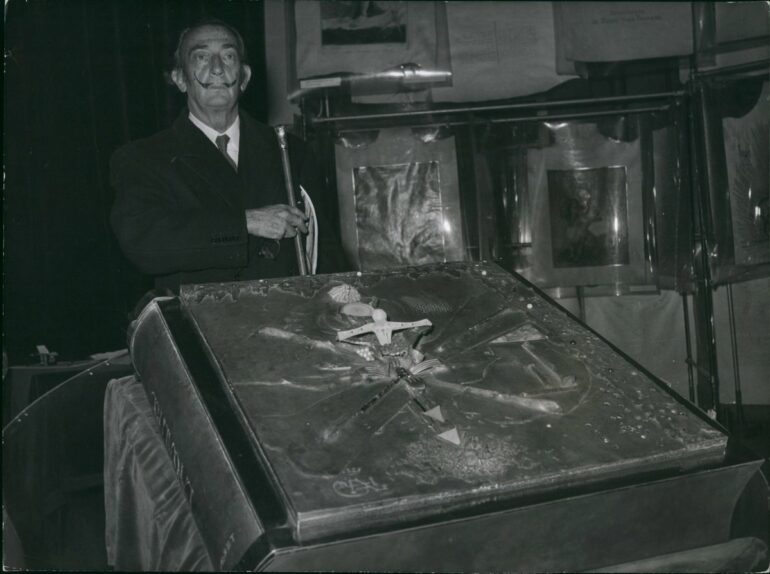
The object of the crime is no ordinary book that one can slip under one’s coat. It is a colossal case, a binding sculpted from solid bronze weighing approximately 150 kg. Salvador Dalí created this work using the lost-wax casting technique, infusing his surrealist genius into a raw and imposing material. Beyond the bronze, the composition incorporates a rich and eclectic array of materials: gold, pearls, precious stones, seashells, and—in a typically Dalí-esque gesture—gilded cutlery and forks arranged around a central crucifix.
This unique piece originally served as the cover for a work weighing approximately 210 kg. While initial reports raised fears that the entire masterpiece had been stolen, the Clermont-Ferrand public prosecutor’s office clarified that only the monumental cover had been taken. Fortunately, the majority of the 150 original parchment folios—which form the very heart of the Book of Revelation by Saint John—were safely stored in a vault at the time of the break-in. The exact modus operandi of the burglars—who had to maneuver a 150-kg mass after smashing the protective display case—remains a key element of the investigation being conducted by the Clermont-Ferrand Gendarmerie’s investigative unit.
The Origins of the World’s Most Expensive Book
To understand the extent of the loss, we must go back to 1958. Joseph Forêt, an art publisher from Mont-Dore, launched a daring project: to create the most sumptuous book of his time based on the text of the Book of Revelation. To this end, he brought together an exceptional circle of fourteen artists. Seven leading painters—Salvador Dalí, Bernard Buffet, Léonard Foujita, Leonor Fini, Georges Mathieu, Ossip Zadkine, and Pierre-Yves Trémois—illustrated these giant pages. They were joined by seven major writers and intellectuals: Jean Cocteau, Jean Giono, Ernst Jünger, Emil Cioran, Jean Rostand, Daniel-Rops, and Jean Guitton.
The result, completed in 1961 and exhibited that same year at the Musée d’Art Moderne de la Ville de Paris, is a masterpiece of bibliophilia. The body of the work consists of 150 parchment leaves spanning nearly 150 linear meters, containing approximately 95,000 hand-calligraphed characters. Upon its creation, the work was valued at 2 million francs, a sum that earned it the title of “the world’s most expensive book.” This sheer scale—both artistic and material—makes it a one-of-a-kind piece in private collections worldwide.

An Odyssey from Switzerland to Japan and On to Issoire
The journey of this work reads like an epic. Between 1961 and 1972, it traveled the globe as part of some 100 international exhibitions before disappearing from the public eye. Stored for a time in Switzerland, it was later acquired by Japanese collectors. In 2003, Christian Karoutzos stepped in to save the integrity of the Book of Revelation. Just as the work was in danger of being dismantled and sold sheet by sheet at auction, the art restorer purchased it to bring it back to its homeland in the Puy-de-Dôme.
Now housed in Issoire, this monumental work had become the crown jewel of his art center. The town’s mayor, Bertrand Barraud, spoke of incalculable damage to the town, while the owner expressed his anguish over what he considers an assault on French cultural heritage. The work, whose current market value is estimated by experts at several million euros, is officially classified by the courts as a work of art of great value, exceptional and unique.
The Investigation into an Unsellable Piece
The question of what will become of Dalí’s blanket remains unresolved. Given its significance and notoriety, the object seems impossible to sell on the legitimate art market. The fear that it might be dismantled for its precious materials or that it was the subject of a covert order looms over the investigation. The Clermont-Ferrand District Attorney’s Office, which has opened a theft investigation, has not yet released any details regarding the identity or number of perpetrators.
The forensic investigation will need to determine how such a massive structure could have been removed from the building without alerting the immediate neighborhood. In the meantime, the art world is holding its breath, hoping that this masterpiece of Dalí’s sculptural work will not be lost forever or defaced by those who saw in it only raw market value, ignoring the spiritual and historical significance of the Apocalypse of Saint John, elevated by the greatest minds of the last century.