
Make Texture a preferred source on Google to support us
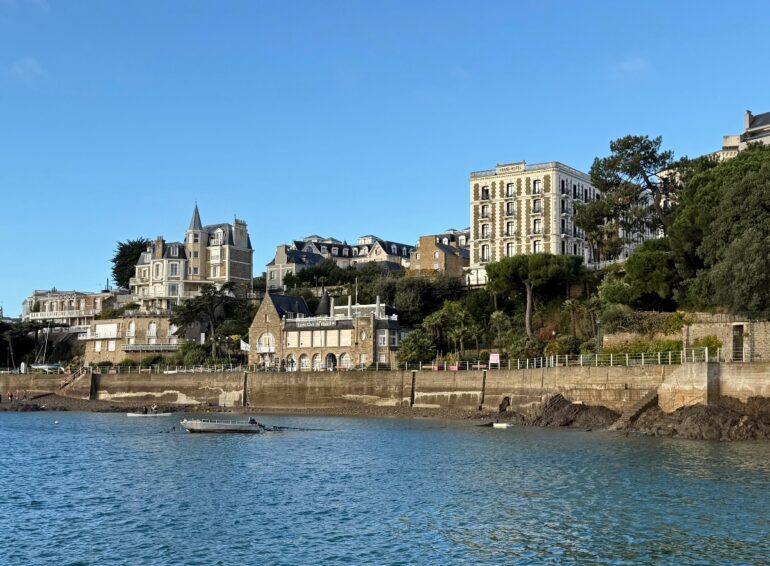
Add Texture to GoogleAll it takes is a short crossing of the Rance Estuary to step into a different century—and, almost, a different country. Facing the austere ramparts of Saint-Malo—constrained by its mineral stone and pirate history—stretches a jagged coastline where architectural eccentricity has taken root with a distinctly sophisticated nonchalance. On this western side of the estuary, Breton granite supports asymmetrical turrets, bay windows opening onto the English Channel, and slate roofs that seem to defy gravity. Dinard was not built through the slow evolution of a fishing port: it was conceived, shaped, and imported by an aristocracy from across the Channel in search of a summer retreat. Even today, bathed in the shifting light that gave the Emerald Coast its name, the resort retains the feel of an island enclave—a fragment of Sussex or Cornwall strangely moored to the European continent.
The Invention of a Social Retreat
The fate of this small fishing village took a dramatic turn in the mid-nineteenth century. Just as the French bourgeoisie was beginning to discover the therapeutic benefits of sea bathing, wealthy British families—fleeing the stifling heat of urban summers—set their sights on this rocky promontory. There they found a climate tempered by the Gulf Stream, vegetation that blended maritime pines with palm trees and mimosas, and above all, a dramatic isolation conducive to romantic contemplation.
Within a few decades, the English community had made the cliffs their own. London’s high society transplanted its customs there with meticulous precision. Tea rooms were opened, regattas were organized, and the Dinard Golf Club was founded in 1887 in the neighboring town of Saint-Briac, carving out one of the continent’s oldest courses on the windswept moor. Services were held in English at St. Bartholomew’s Anglican Church, and social life revolved around the grass tennis courts. Dinard became a haven for an elite that refused to choose between the exoticism of a foreign country and the comfort of its own social norms.
Stone marvels suspended above the void
What immediately catches the eye as you walk along the customs officers’ path, from Pointe du Moulinet to Pointe de la Malouine, is the architectural audacity of the resort’s pioneers. More than four hundred listed villas bear witness to an era when seaside urban planning was driven less by rules of landscape integration than by a desire for self-expression. The clients gave architects carte blanche to bring their eclectic fantasies to life.
The architectural vocabulary offers a showcase of Belle Époque eccentricity: stepped gables, glazed ceramic tiles inlaid into the facade, Norman-inspired half-timbering, neo-Gothic turrets, and Italian-style loggias all coexist on a single lot. The villa Les Roches Brunes, perched at the very tip of the cliff, epitomizes this obsession with the view and this desire to dominate the elements. The unspoken rule was clear: one had to be able to see the sea from every room—and be seen from the beach. The houses are terraced on the rocks, clinging to the terrain, forming a jagged horizon that gives the town its instantly recognizable silhouette from the sea.

The austere aesthetics of the seaside
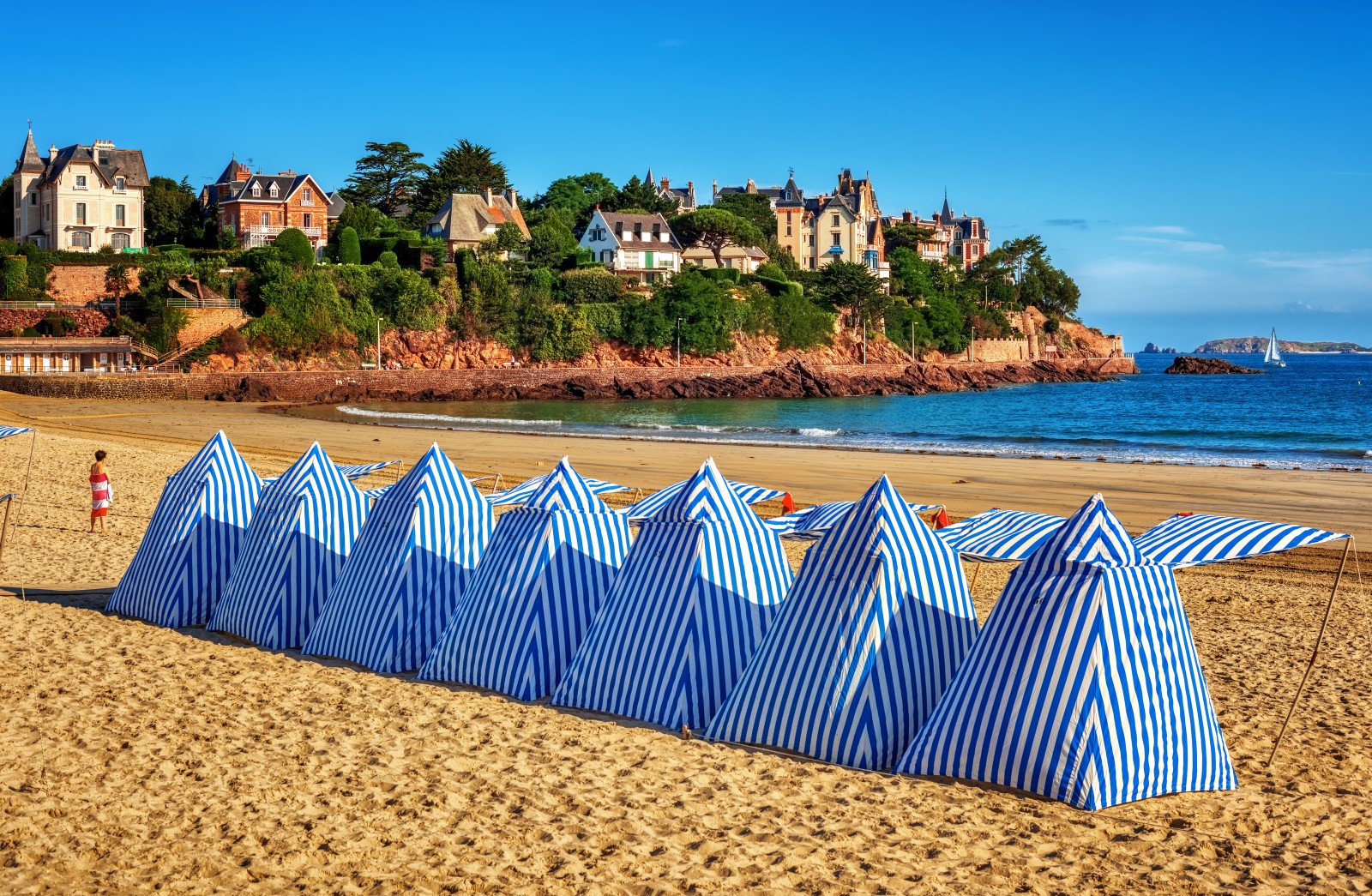
Below these stone watchtowers, Écluse Beach sets a different, more orderly pace. Here, the shore is not a vast, wild expanse at the mercy of the elements, but a geometrically organized social space. The British heritage is evident in the graphic precision of the beach huts and, above all, the famous blue-and-white striped beach tents. Lined up in perfect rows on the fine sand, they define the space and impose a seaside aesthetic of great simplicity—the polar opposite of the garish mass tourism of the late twentieth century.
These thick canvas tents serve not only as shelter from the sea breezes. They embody the persistence of a certain way of life. Renting a tent in Dinard for the season is a family tradition, an unchanging ritual that structures the summer days. People set up their tents at low tide, when the sea recedes far out, revealing a lunar landscape of rocks and mirror-like pools, before heading back up to the seawall a few hours later. The surf sets the rhythm of the day, dictating the schedule for swimmers, beach clubs, and strollers bundled up in sailor sweaters during the first days of fall.
Film Reels, Mist, and Afterimages
It was inevitable that such a setting—at once magnificent and vaguely melancholic as soon as the sky clouds over—would attract the camera. The rugged topography, the shadows cast by the intricately designed villas, and the mist that regularly envelops the bay create an open-air movie set. Local lore, in fact, boasts of a visit by Alfred Hitchcock, who—it is whispered—came here to draw architectural inspiration for the menacing mansion in *Psycho* by observing certain facades at the Pointe de la Malouine.
This cinematic connection is now institutionalized. Every fall, the Dinard British Film Festival reaffirms the unbreakable bond between the resort and its founding country. The movie theaters screen the cream of social cinema, gritty crime thrillers, and dark comedies from across the Channel, while directors and actors stroll through the cozy lounges of the grand hotels overlooking the sea. At this time of year, the low-angled October light accentuates the contrasts. The sea takes on the hues of heavy metal. On the Clair de Lune promenade, sheltered from the prevailing winds, the sound of the waves crashing against the granite foundations serves as a reminder that behind the veneer of imported elegance, the Emerald Coast remains a part of Finistère subject to the whims of the tides.