
Make Texture a preferred source on Google to support us
Add Texture to GoogleA Matter of Survival as Much as of Form
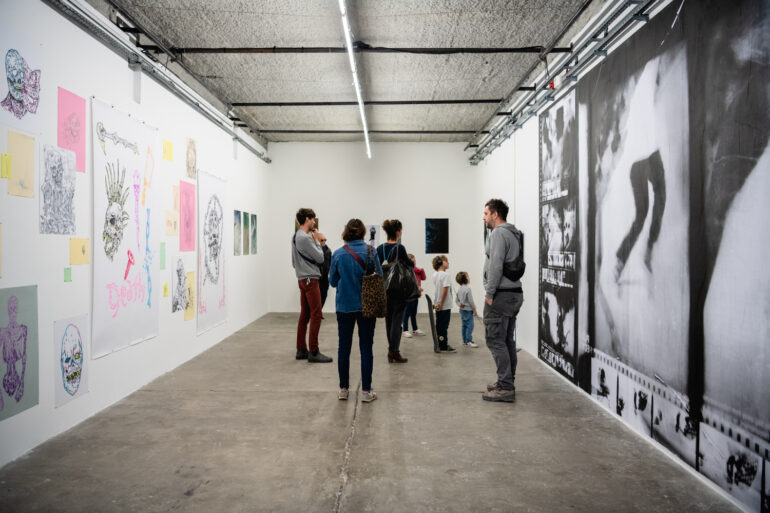
In her column for the Chicago Reader, art critic Lori Waxman raises an issue where the existential takes precedence over the aesthetic: what becomes of a young foreign artist in the United States when their artistic drive collides with a precarious administrative reality? Non Charoenwattananon’s exhibition, presented at the Timeless Art Gallery under the title “What Now?”, takes precisely this uncertainty as its starting point. This exploration, reflecting the exhaustion of a generation that invests itself, creates, and perseveres amid persistent uncertainty, is part of the 60 wrd/min art critic initiative. This welcome initiative by Waxman aims to enrich critical discourse by incorporating profiles that operate on the fringes of institutional circuits. The exercise takes on its full meaning here: it is no longer merely a matter of evaluating works, but of examining a condition—that of an artist who has attained formal maturity and financial stability, while remaining fundamentally vulnerable in the face of the uncertainty of their immigration status.
Formal Layers and an Inventory of Exile
The exhibition unfolds like a portable studio, bringing together ink drawings on delicate glass panels, a long scroll of paper, canvases with tropical motifs, and digital prints. This eclectic body of work offers a meticulous inventory of survival, where the variety of media mirrors that of emotional registers. The absolute darkness of the ink contrasts with the chromatic brilliance of the prints, as if the artist had made a deliberate choice to juxtapose anguish and ornamentation, refusing to separate these two intimately linked realities.
This contrast also permeates the iconographic repertoire. Figures borrowed from animation culture—sometimes rendered with the symbolism of tarot cards—engage in a dialogue with the appearance of a creature with naive contours, absorbed in the repetition of everyday gestures. While Waxman suggests that this slender avatar might embody the artist himself, Charoenwattananon’s true strength lies elsewhere: in the development of a unique visual language where identity subtly oscillates between playfulness, vulnerability, and self-presentation.
The exhibition suggests that today, for many creators, the central question is no longer “what to produce?” but rather “where to anchor oneself?”
The Essence of a Hybrid Practice
Charoenwattananon’s career illustrates the transformations of the contemporary image. By pointing out that many of his recent works circulate at mainstream conventions such as C2E2, Waxman highlights a reality that is often overlooked: an artist’s legitimacy no longer depends exclusively on the hushed filter of the gallery. It also flourishes within a more diffuse, pragmatic, and sometimes far more challenging economy to navigate.
This deliberate blurring of the lines between niche spaces and popular culture gives her practice a texture free from academic conventions. It keenly demonstrates that an artist can navigate between commissions, editions, original drawings, and merchandise without ever compromising the coherence of her vision. In Charoenwattananon’s work, this plurality transcends mere eclecticism; it marks a practice forged by material necessity, elevated by a rare ability to transform this constraint into a true aesthetic signature.
What the Image Protects, What It Exposes
The power of this body of work lies above all in its ambivalence. While the hues of the digital prints exert an immediate power of seduction, they actually function as a mirror of a profound unease, rooted in an elusive temporality and a dotted horizon. This dissonance lends the exhibition its full depth and serves as a reminder that the legibility of a work never exhausts its mystery: the innocence of a motif can conceal a muted anxiety, just as a vibrant palette often hides a discreet melancholy.
The exhibition thus achieves its true resonance by refusing to sensationalize exile, without, however, sidestepping its latent weight. Far from elevating the artist to the status of a heroic figure—a narrative pitfall all too often trodden—"What Now?" reveals an organic process, in a state of perpetual becoming. Through its accelerations, its detours, and its ambiguous bestiary, the work does more than simply make an artistic choice. It crystallizes the central challenge of creative life today: to produce, persevere, and exist, with the impermanence of one’s own visibility as the only certainty.