
Make Texture a preferred source on Google to support us
Add Texture to GoogleThere is a phantom map of the Old Continent. While millions of summer vacationers crowd together in sweltering heat, trying to claim the same stretch of coastline or shuffling through overcrowded airport terminals, a tiny fraction of travelers moves through a parallel reality. For this clientele, whose purchasing power eliminates logistical constraints, luxury no longer consists of accumulating ostentatious experiences, but of buying freedom from the hustle and bustle—freedom from crowds, noise, waiting, and even heat waves. The ultra-high-end travel industry has fully embraced this shift, coining a new concept in the process: “hushpitality.” The principle? To interpose a thick, luxurious cushion between the traveler and the frenzy of the outside world.
Logistics Overshadowed by Theatricality
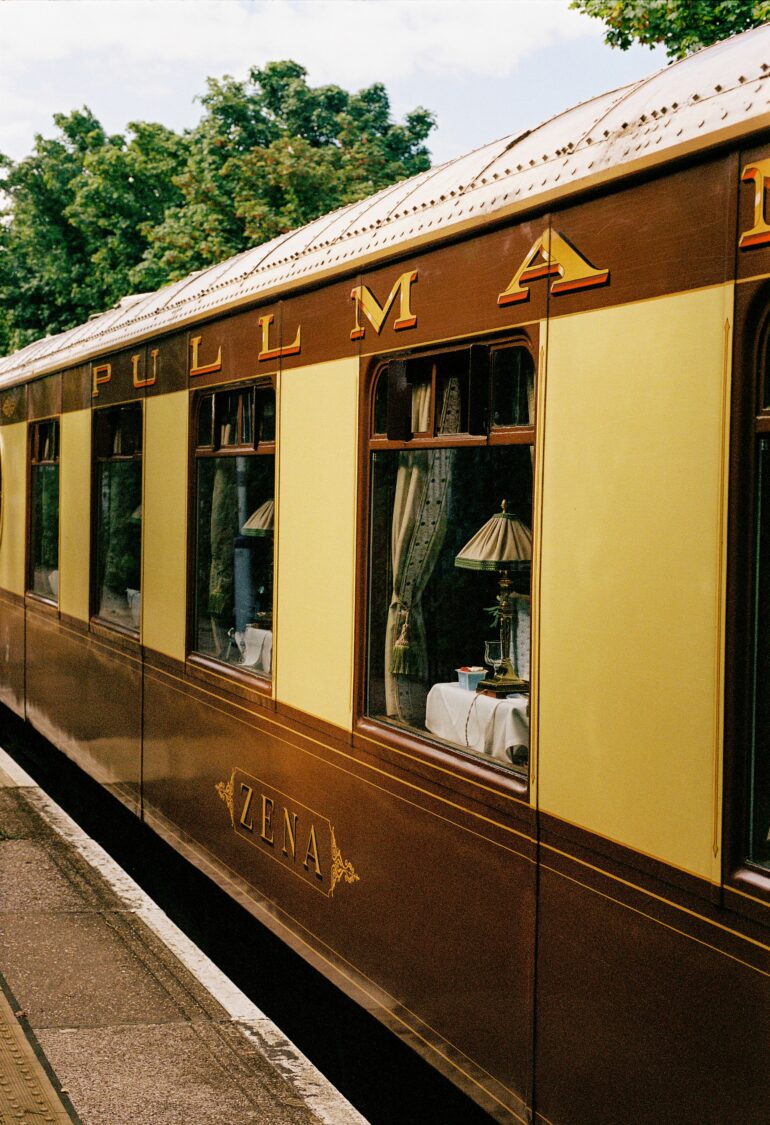
In this quest for absolute isolation, the mode of transportation ceases to be a means to an end and becomes a self-contained destination. The Celia car, part of Belmond’s British Pullman, illustrates this obsession with a self-contained world. Designed for just twelve passengers, this 1932 car was completely reimagined by director Baz Luhrmann and costume designer Catherine Martin. The aesthetic borders on Shakespearean opulence, drawing on the imagery of *A Midsummer Night’s Dream* with its deep velvets and floral arrangements. On board, the staff—chef, butler, steward, and experience curator—outnumber the guests. As for the hassles of ground transportation, they are eliminated as early as Greater London through meticulously coordinated transfers.
This closed-loop concept expands on a larger scale with the Villeggiatura by Train program, which Belmond will launch in 2026. The Venice Simplon-Orient-Express will no longer merely connect train stations but will serve as an exclusive link between the group’s Italian properties: Villa San Michele, the Splendido, the Caruso, and the Cipriani. The highlight of this initiative will be a brand-new route between Paris and Pompeii, accompanied by private archaeological tours outside of regular opening hours. Ultimately, the final destination matters less than the fluidity of the journey.
Floating Real Estate: The Hotel Industry Casts Off
To circumvent the overcrowding along the Mediterranean coast, major hotel chains are literally moving their operations onto the water. Forget the classic aesthetics of ocean liners: the new vessels draw directly from residential architectural styles. In March 2026, the Four Seasons I will set sail—at 207 meters long—in the waters off Saint-Tropez, Bodrum, Montenegro, or Hydra. The ship features 95 suites with terraces, and some residences include private pools. The pinnacle of this floating grandeur is the Funnel Suite, a triplex spanning nearly 930 square meters. With its eleven dining venues, a spa equipped for cryotherapy, and a transverse marina that allows guests to swim without ever setting foot on land, the ship aims for total control over its environment.
The race for space continues at Regent Seven Seas Cruises. In late 2026, the Seven Seas Prestige will unveil a 740-square-meter Skyview Regent Suite, spread over two levels with an interior elevator, a private sauna, and a private gym. The competition is following the same trajectory: The Ritz-Carlton will launch the Luminara (242 meters, 226 suites with terraces), while Oceania Cruises, which traditionally emphasizes fine dining, plans to launch the Oceania Sonata in August 2027, featuring thirteen dining concepts on board, including La Table by Maîtres Cuisiniers de France.
However, the most radical response to contemporary challenges may lie with the Orient Express Corinthian, expected in April 2026. Limited to 110 passengers in 54 suites, this 220-meter sailboat will cruise between the Mediterranean and the Adriatic, with environmental sustainability built into its engineering. Its three SolidSail masts will provide wind-powered propulsion, while a dynamic positioning system will allow it to stabilize without dropping anchor, thereby preserving the seabed. Exclusivity is ensured by a Guerlain spa, a recording studio, and five restaurants helmed by chef Yannick Alléno.
Mastering Time and Redefining the Seasons
Since the wealthy cannot cool down the summer heat, they simply adjust their schedules. Lisa Pile, vice president of sales for Oceania Cruises and Regent Seven Seas, observes a marked shift toward the shoulder season. Ships like the Allura now extend their itineraries into the winter. Exploring Venice in November or strolling through the streets of Dubrovnik far from the frenzy of day-trippers has become the new hallmark of privilege. Seasonal flexibility allows travelers to avoid overcrowding while also escaping sweltering temperatures.
This deliberate slowdown finds its most refined expression on France’s waterways. Chartering private barges transforms the canals into havens. Belmond’s Les Bateaux collection will reach a new milestone in 2026, driven by menus crafted by chef Dominique Crenn. On the Alouette, cruising through the Bordeaux region, schedules give way to improvisation. Passengers alternate between bike rides, lunches inspired by fresh market finds, and ultra-exclusive experiences—ranging from a wine tasting at Château d’Yquem to a reception hosted by a countess at Château Lamothe Bardigues. Slow travel becomes the antidote to the frenzied consumption of these regions.
Eliminating friction, from the tarmac to the bedroom
There remains the thorny issue of air travel, whose constant decline deters discerning travelers. The response is direct: simply bypass commercial terminals altogether. Operators like Abercrombie & Kent and Captain’s Choice orchestrate private jet itineraries connecting Scotland, Sicily, Portugal, and the Greek islands. The flight itself becomes a private club where customs clearance and baggage handling take place behind the scenes, out of sight of the clients.
Upon arrival, the accommodations must extend this sense of seclusion. Historic establishments are stepping up their game to ensure this seclusion. Above Florence, Villa San Michele reopened its doors in April 2026 after a year and a half of renovations, limiting its capacity to 39 rooms and incorporating a Guerlain spa. In Sicily, the Villa Timeo in Taormina (21 rooms) offers complete privacy within its grounds, featuring an infinity pool and unrestricted access to the amenities of the neighboring Grand Hotel Timeo. Venice, a global symbol of overtourism, is seeing its legendary Cipriani inaugurate the lagoon’s first Dior Spa and entrust the culinary direction of its Oro restaurant to Massimo Bottura. Elsewhere, in Mallorca, the Mandarin Oriental has deliberately chosen to isolate itself on a peninsula, far from the hustle and bustle of Palma.
Ultimately, the world of ultra-luxury travel in Europe no longer seeks to deny the reality of overtourism or climate change; it is adapting to it. By adjusting departure dates, chartering ships the size of mansions, and paying top dollar to shut the door behind them, this elite indulges in an intangible luxury: the certainty—at least for a time—of having the world all to themselves.