Make Texture a preferred source on Google to support us
Add Texture to GoogleLight strikes the ruby, penetrates it, bounces off, and passes through the gem without ever catching the shadow of a prong or the sparkle of a bezel. On the workbench, the red petal seems to defy the basic laws of assembly. No setting is visible. The gemstones align, smooth and flush, held in place by a force the eye cannot detect. Behind this perfect optical illusion lies one of the most complex and closely guarded mechanisms in high jewelry. Far from being a mere ornamental variation, the mystery setting constitutes a complete reversal of the classical grammar of jewelry. Traditionally, the metal encases the stone, encircling it to showcase it in the light. Here, the metal recedes into the background. It becomes hidden, transformed into an invisible framework, allowing the stone to reign unchallenged over the visible surface.
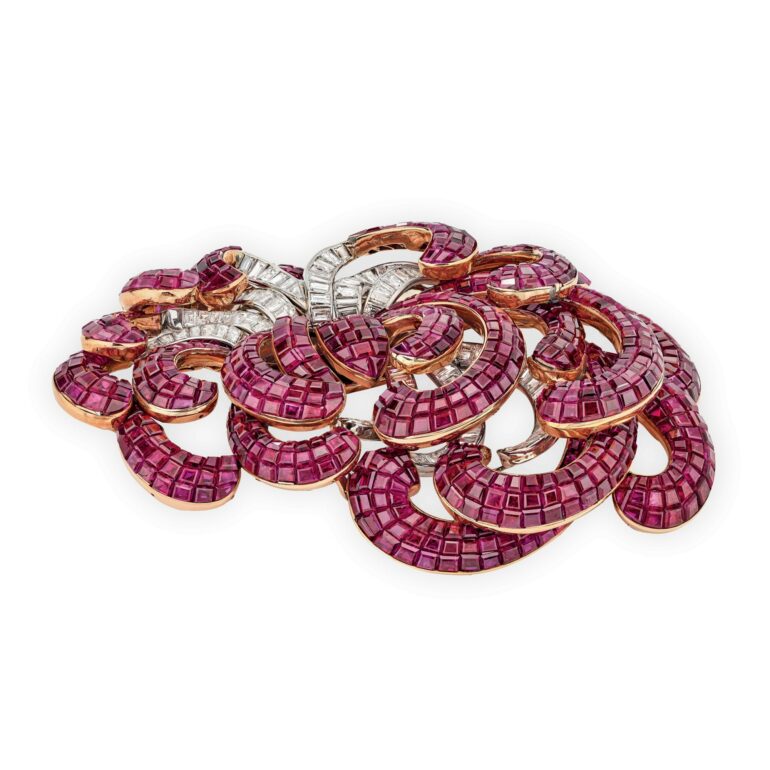
In the early 1930s, the Art Deco aesthetic began to give way to softer lines, calling for drapery, ribbons, and floral motifs. Jewelry designers then encountered a physical limitation: metal, ever-present, made the compositions rigid and fragmented the solid blocks of color. It was in 1933 that Van Cleef & Arpels filed a patent that would revolutionize the field. The Parisian house developed a technique for setting gemstones without any visible fastenings. The surface became a pure tapestry of gemstones. While the first applications focused on flat objects—primarily clutch bags and cigarette cases—the technique soon broke free from two-dimensionality to conquer the third dimension.
The Underground Architecture and the Gold Lattice
The paradox of this technique lies in its relationship to metal. For the gold to disappear completely, one must, paradoxically, design the densest and most intricate framework possible. It all begins with the creation of a mesh. The jeweler crafts a net composed of tiny gold or platinum rails. The thickness of these metal wires rarely exceeds two-tenths of a millimeter. These rails form the skeleton of the piece—a three-dimensional labyrinth calculated with mathematical precision.
The beauty of the work is evident from both the front and the back. When turning over a piece set in this way, the eye discovers a fascinating metal mesh—a honeycomb pattern of absolute regularity. This structural lace serves not only a mechanical anchoring function; it also ensures the passage of light. Without this opening at the back, the gemstones would lose their luster and appear dull. The jeweler must therefore hollow out the metal as much as possible while preserving its rigidity—an extremely delicate balance of forces.
The Gemcutter’s Ordeal and the Geometry of the Stones
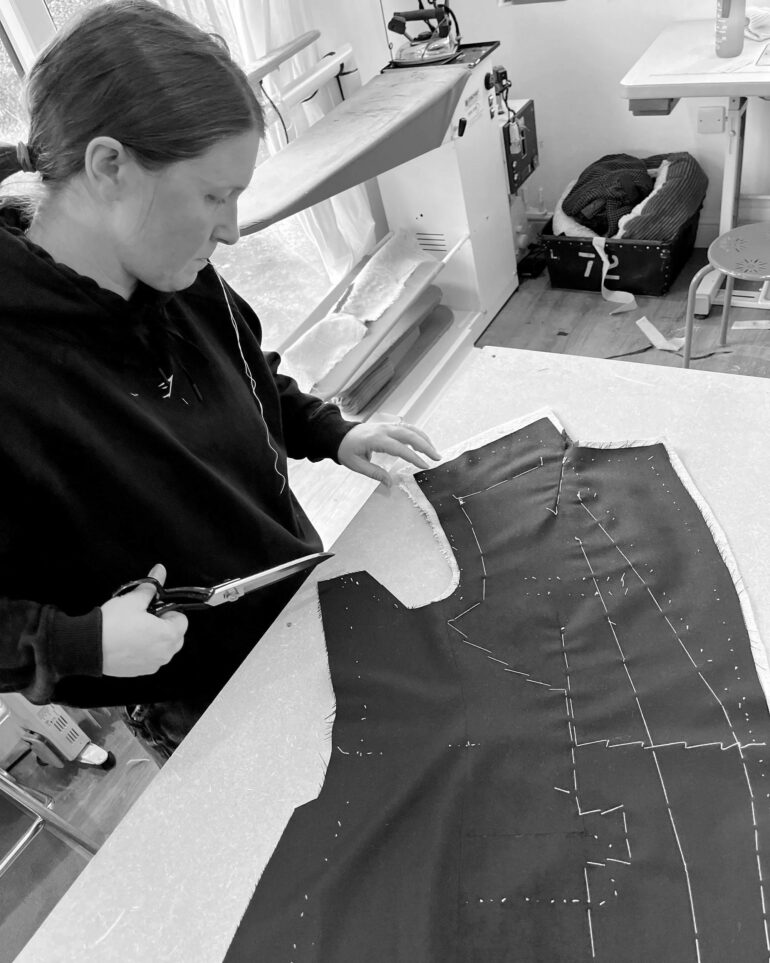
While the metal structure is a feat of engineering, the preparation of the stones borders on the absurd. Every gem intended for insertion into these rails must undergo an extremely meticulous cut. The gem cutter does not merely work on the upper part of the stone to ensure its brilliance; above all, he must carve grooves on either side of the pavilion—the lower part of the gem. These grooves, just a fraction of a millimeter deep, allow the stone to slide along the gold rails.
The tension during this stage is palpable. Rubies and sapphires, corundums with a hardness of 9 on the Mohs scale, are favored for their durability. But carving the pavilion requires working against the stone’s natural crystalline structure. The slightest miscalculation in pressure or an uncontrolled vibration of the grinding wheel, and the stone shatters. Dozens of hours of cutting can be wiped out in a fraction of a second, forcing the gem cutter to start over with a new rough stone. This is why the emerald—naturally marked by frost patterns and inclusions (the famous “gardens”)—is infinitely rarer in this type of setting, as its fragility makes it nearly impossible to groove without causing damage.

Sourcing and selecting the stones add an additional level of difficulty. The mystery setting tolerates no chromatic variation. Since there is no metal space to separate the gems and deceive the eye, the slightest difference in hue, saturation, or clarity between two adjacent stones disrupts the harmony of the block. Matching the stones therefore requires bringing together hundreds of stones that are strictly identical, a process that sometimes takes months or even years of research before the first stroke of the file is made at the workbench.
Mastering Volume and the Art of Fitting
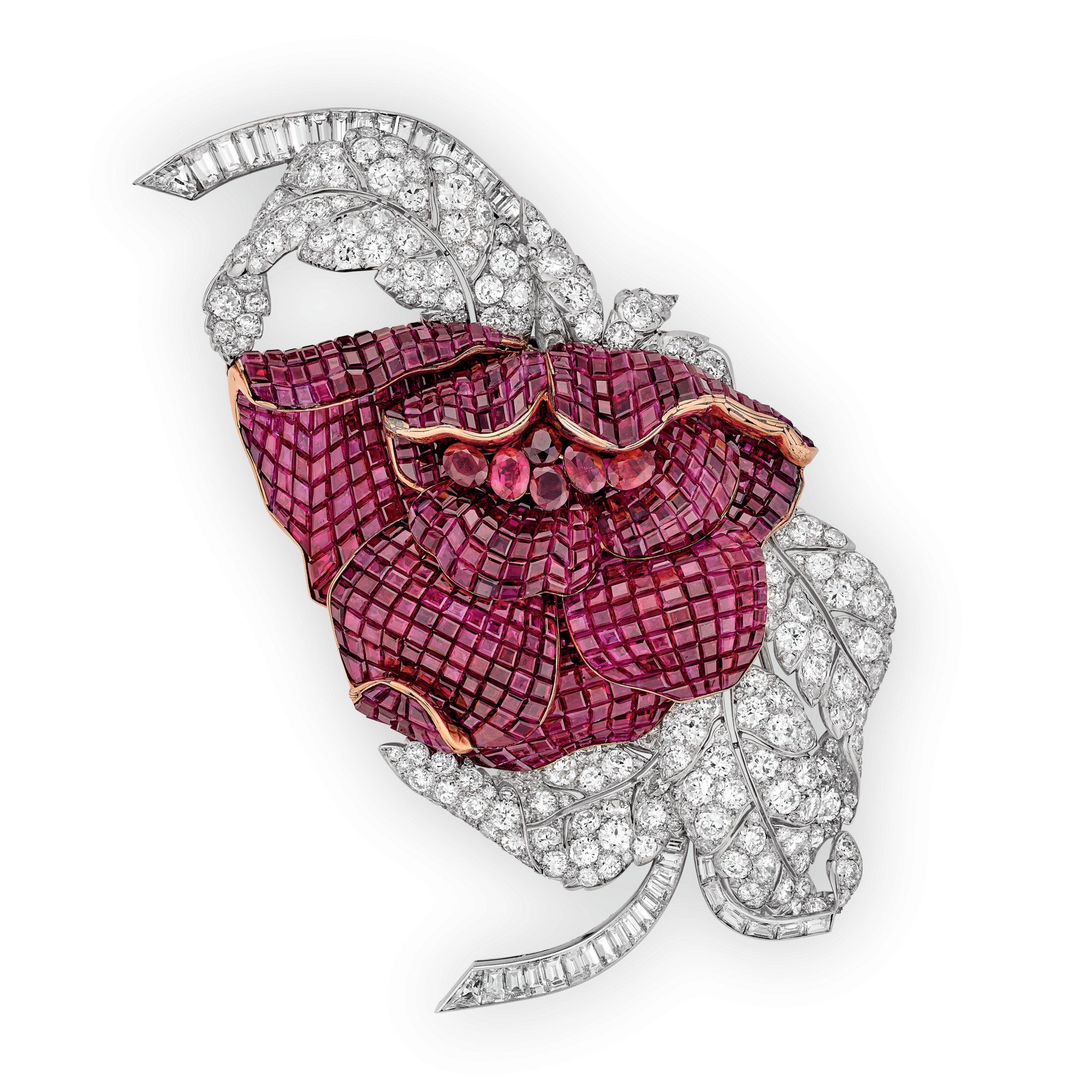
In 1935, the patent was adapted to accommodate curved surfaces, paving the way for sculptural jewelry. Two years later, the house unveiled the Clip Pivoine, a flower with petals curled inward—a masterpiece of fluidity in which the gemstone appears to have been draped like fabric. The transition from a flat surface to three-dimensional form multiplies the challenges tenfold. The jeweler must curve the rails while maintaining their perfect parallelism. The gem cutter, for his part, cuts each stone into a trapezoid or an inverted rhombus, with specific angles corresponding to the exact angle at which the gem will rest on the curve of the petal. Each stone becomes unique, designed for a precise location on the setting, and cannot be inserted anywhere else.
Next comes the decisive moment of fitting. Using tweezers, the artisans slide the stones one by one into the gold channels. The fit must be perfect. The gem must slide in smoothly, without force—otherwise it could scratch the metal or break the stone—while leaving no play whatsoever. When the stone finds its final place, it snaps into position with a very slight, almost imperceptible click, signaling to the artisan’s finger that the assembly is perfect.
This sequence of steps, with no safety net, imposes a unique rhythm on the workshops. The creation of a single piece requires a minimum of three hundred hours of uninterrupted work. For the most imposing and architecturally intricate models, this count skyrockets, easily exceeding a thousand hours. The process does not speed up or become more streamlined. It remains dependent on the patience of a few dozen artisans worldwide, capable of mastering both the forging of microscopic rails and the final fitting. Once the last stone is secured in its groove, the framework disappears for good. The object no longer looks as though it were made by human hands, but rather as though it had crystallized on its own into a single incandescent block.