Make Texture a preferred source on Google to support us
Add Texture to GoogleIn November 1922, a telegram sent from the dusty streets of Luxor abruptly upended the history of the decorative arts. The British archaeologist Howard Carter had just broken through the final wall sealing off Pharaoh Tutankhamun’s burial chamber, unearthing a treasure that had lain dormant for more than three millennia. It took a few days for the news to set Europe ablaze, but its stylistic impact would dominate the scene for years to come. In Paris, a frenzy immediately swept through the design studios. On the Place Vendôme, jewelers momentarily set aside their abstract explorations to turn their attention to the sands of the Valley of the Kings. Van Cleef & Arpels captured this archaeological fever with remarkable insight. Between 1922 and 1925, the house designed a series of Egyptian-style jewels that transcended mere passing fashion to establish an entirely new design language. Ancient Egypt did not serve merely as a theatrical backdrop; it provided a new architectural rigor, blending the frontal symmetry of temples with the bold brilliance of modern gem-cutting.
The Perfect Alignment of Two Eras
To understand the brilliance of this collection, one must look at Paris at the beginning of the Roaring Twenties. High society emerged from the Great War with a thirst for the exotic and a need for radical change. The organic, languid volutes of Art Nouveau, with its dragonflies and vines, had perished in the trenches. The era demanded straight lines, order, and bold chromatic contrasts. Egyptian art, characterized by its flat perspectives, strict profiles, and mathematical geometry, provided the perfect historical justification for this nascent modernism, which was not yet called Art Deco.
Fashion itself paved the way for these new adornments. Women had freed themselves from the corset. Dresses grew shorter, revealing bare arms, and called for wide bracelets to adorn this newly exposed skin. Boyish haircuts left the nape of the neck and ears exposed, calling for long, geometric pendants. The designers on Place Vendôme instantly understood this anatomical shift. Pharaonic motifs—scarabs, sphinxes, lotus flowers, goddesses with outstretched wings—were incorporated into designs dictated by this liberated silhouette. The Parisian house’s Egyptian creations are not replicas of antiquities, but urban adaptations designed to shine under the electric lights of cabarets and private mansions.

The Miniature Architecture of Gems
Translating a twenty-meter-high mural into a brooch three centimeters wide requires a complete rethinking of setting techniques. The workshops employ calibrated cutting, a method that involves cutting each gemstone—ruby, sapphire, or emerald—to exact specifications so that it fits perfectly against its neighbor without any visible metal. This gem-cutting feat recreates the illusion of cloisonné enamel and lapis lazuli or carnelian inlays found on the royal pectorals discovered in Tutankhamun’s tomb.
Contrast becomes the absolute rule. Black onyx, cut into thin baguettes or smooth plates, highlights the colorful motifs, making the cool whiteness of the old-cut diamonds pop. Platinum, the premier metal of the period, is worked into a honeycomb pattern on the back of the pieces to lighten the setting and allow maximum light to pass through, while remaining virtually invisible from the front. The artisans play with the density of the materials. The deep red of the rubies contrasts with the midnight blue of the sapphires, while the emerald adds botanical touches reminiscent of the banks of the Nile. This bold, straightforward color palette foreshadowed by several years the future Indian-inspired creations that would mark the end of the decade.

Narrative Frescoes on the Wrist
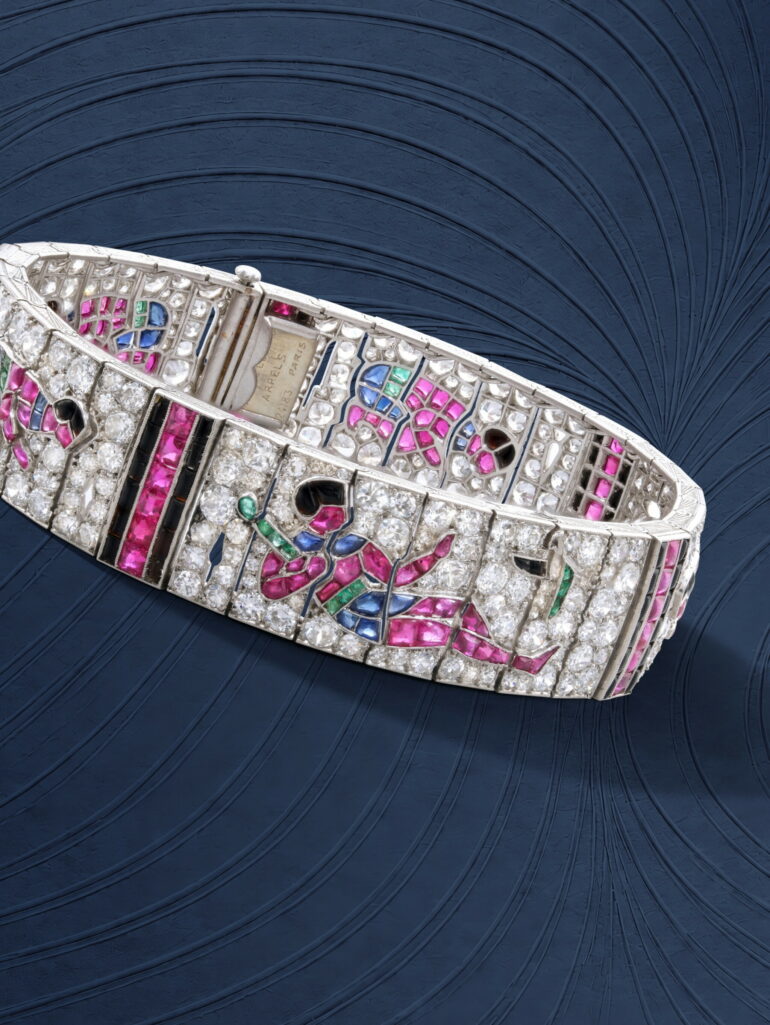
The wide, articulated bracelet emerged as the centerpiece of this stylistic interlude. Designed as a platinum ribbon, it offered an ideal canvas for designers. One of the most spectacular pieces from 1924 literally reads like a papyrus scroll. Stretching several centimeters in length, the piece depicts a meticulously rendered offering scene: figures in profile hold out cups, framed by Horus falcons and friezes of stylized hieroglyphs.
The technical challenge of such a piece lies in its flexibility. To ensure that this stone fresco perfectly conforms to the curve of a wrist without disrupting the design, the workshops devised an extremely complex system of invisible hinges. Each link must slide with absolute fluidity to mimic the texture of a heavy fabric. These bracelets, a new kind of jewelry, appeal to a cosmopolitan clientele—from American heiresses to European aristocrats—who vie for these modernized fragments of history. Wearing a diamond scarab or an onyx sphinx became the rallying cry of a cultured elite, well-versed in the latest archaeological discoveries and eager to display their roots in modernity.
The Legacy of a Brilliant Interlude
Egyptian-inspired production within Parisian high jewelry was intense but brief. By 1926, the craze had subsided. Art Deco lines became more angular and streamlined, gradually moving away from narrative figuration to embrace total geometric abstraction or turn toward the Asian East. This very narrow creative window, concentrated over four or five years, lends these pieces exceptional rarity today.
They appear only exceptionally on the art market, driving up auction prices every time they resurface. Scarab brooches, lotus-flower earrings, and fresco-style bracelets now form the backbone of heritage exhibitions dedicated to the history of jewelry. Behind the bulletproof display cases, the light still catches the polish of a calibrated sapphire or the precise geometry of a diamond’s profile. These creations capture a specific moment in the history of taste: that moment in the 1920s when the shock of an archaeological discovery forced Paris’s finest artisans to reinvent their art, transforming the ancient Egyptian cult of the dead into dazzling adornments for the living.