Make Texture a preferred source on Google to support us
Add Texture to GoogleA Painter’s Cellular Refuge Amid the Turmoil
In the spring of 1939, Paris was suffused with a sense of heaviness that the budding flowers struggled to dispel. From the French capital, Wassily Kandinsky took up his pen in April to capture on paper a state of mind that stood in stark contrast to the prevailing anxiety. In this correspondence, documented by experts, the master of abstraction evokes the renewal of spring and expresses a steadfast determination to maintain his optimism, despite the events gathering on the European horizon. This fragile psychological balance—this tension between an awareness of external chaos and the quest for inner harmony—finds its resolution on the canvas. It is within this specific context that *The Red Circle* was created, a composition in which the artist’s pictorial vocabulary undergoes a decisive transformation. Far from taking refuge behind the intellectual rigor of his earlier years, the painter chose to infuse his work with the quivering vitality of living matter.
Eighty-seven years later, on March 5, 2026, Christie’s auction house transformed this intimate testament into a financial sensation on the London art scene. Sold for 12.545 million pounds, the painting rekindled collectors’ interest in the artist’s late period. But to reduce this work solely to its hammer price would be to overlook the complexity of its creation and the richness of a journey that has taken it through Europe’s most discerning galleries.
Geometry Put to the Test by Marine Biology
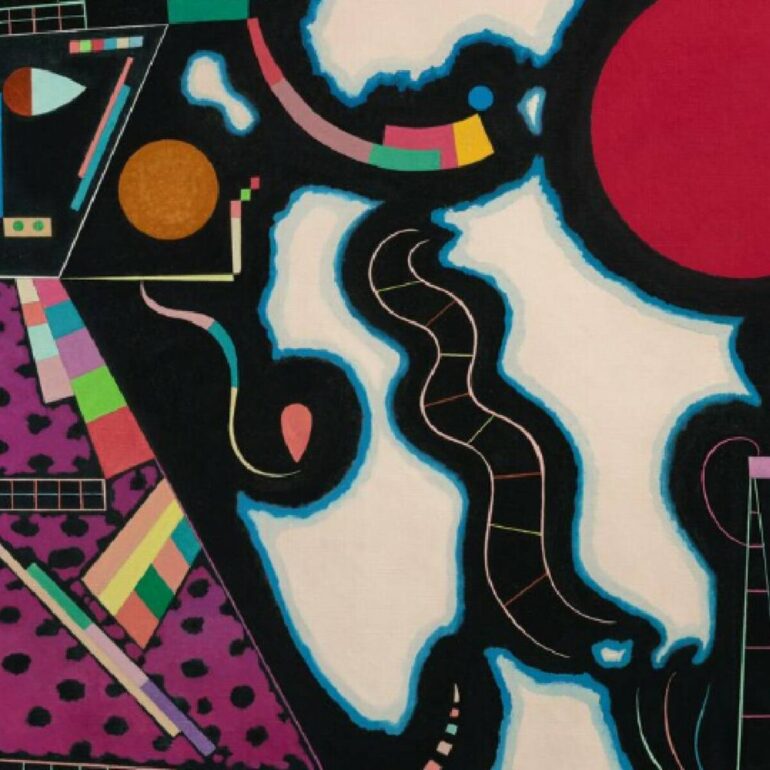
On the canvas’s surface, the eye is immediately drawn to the central element that gives the work its title. A deep red disc dominates, acting as the gravitational core around which a complex choreography unfolds. Around this chromatic mass, Kandinsky unfolds a network of bluish lines and luminous patches that defy any classical perspective. The viewer would search in vain for the horizon line of a familiar landscape. The space constructed here resembles a microscopic view more than a window onto the world.
This aesthetic marks the culmination of the artist’s explorations during his exile in Paris. Strict angles and pure geometry give way to a proliferation of biomorphic motifs. The lot description written by Christie’s experts to accompany the sale also highlights the painter’s growing fascination with the life sciences, and more specifically with biology and marine life. The elements orbiting the central circle seem to pulsate, constantly wavering between the coldness of a mathematical symbol and the irregularity of a cellular organism. The work offers no narrative, no scene to decipher. It simply orchestrates forces. Color relationships, the dynamics of forms, and the constant search for balance take the place of traditional narrative, offering a dizzying plunge into a microscopic ecosystem invented from scratch.
The Mechanics of London Auctions
The auction of this painting in March 2026 offers a precise snapshot of the current reception of the abstract master’s late works. In the London auction house, expectations were precisely quantified: the low estimate had been set at 10.5 million pounds, while the high end of the range reached 15.5 million—amounts calculated without taking ancillary fees into account. The final hammer price, setting the price at 12.545 million pounds, includes the buyer’s premium.

This figure reflects clear market validation, as the work surpassed its low estimate by a comfortable margin. However, the fact that it did not reach the most optimistic projections demonstrates a measured approach on the part of buyers. While this financial result ensures the sustainability of the artist’s market value for his Parisian period, it also illustrates the difference in valuation that can exist between a painting’s historical value and its immediate speculative potential. The April 1939 letter and the formal innovation of the cellular motifs provide an invaluable framework for historians, but the logic of auctions is governed by other factors, dictated by current market liquidity and trends among major private collections.
A Painting’s Pedigree in the Public Eye
Beyond the recent transaction, the historical depth of *The Red Circle* rests on its lineage of owners and its prolonged exposure to critical scrutiny. Kandinsky’s attachment to this organic composition was absolute: the painting never left his studio during his lifetime. Upon the artist’s death in 1944, his widow, Nina, became its custodian, thereby extending the intimate connection between the work and the painter’s direct estate.
Its entry into the art market took place through prestigious channels. The Maeght Gallery acquired it, marking the beginning of its journey in the hands of discerning connoisseurs. The painting then made its way to Switzerland to join the collection of Gustav Zumsteg, a figure renowned for his discerning eye, before finding its place in the Fridart collection. This succession of private transfers could have condemned the work to the seclusion of safes and closed salons. But that was not the case.
The year 1986 marked a decisive milestone in the work’s institutional recognition with its presentation at the Venice Biennale. This establishment in the public sphere was subsequently confirmed and extended in London. Between 2002 and 2018, the Courtauld Gallery hosted the painting on loan. For sixteen years, visitors to the British institution were able to scrutinize the details of this living geometry, putting Kandinsky’s cellular ambition to the test of time. This long stay on the walls of a museum forged the work’s reputation, definitively setting it apart from paintings that only reappear in the public eye when they are resold. The fall of the hammer at Christie’s does not erase this museum history; it simply adds itself as a new, quantifiable milestone in the physical existence of a painting conceived, one spring day in 1939, as an act of resistance through color.