Make Texture a preferred source on Google to support us
Add Texture to GoogleThe value of a timepiece is no longer measured solely by the regularity of its escapement. At the pinnacle of the collectible watch market, gold and steel now require a rich narrative to justify their presence. The most discerning collectors no longer seek merely instruments of timekeeping; they seek to acquire fragments of intimacy, human journeys, and objects that have weathered the passage of time. A simple scratch on a bezel or a letter unearthed from private archives now has the power to transform a rare timepiece into a true cultural artifact.
For Ziyong Ho, a senior international specialist at Phillips, the market has definitively shifted. The auction house is no longer content to act merely as a commercial intermediary; it has taken on the role of historian and investigator. Its mandate requires mapping the provenance of pieces, cross-referencing sources, and situating these objects within the broader chronology of design and society. This rigorous documentation process draws a clear line between a watch that is simply old and one that is historically significant.
Proof from the archives: the emperor’s wrist
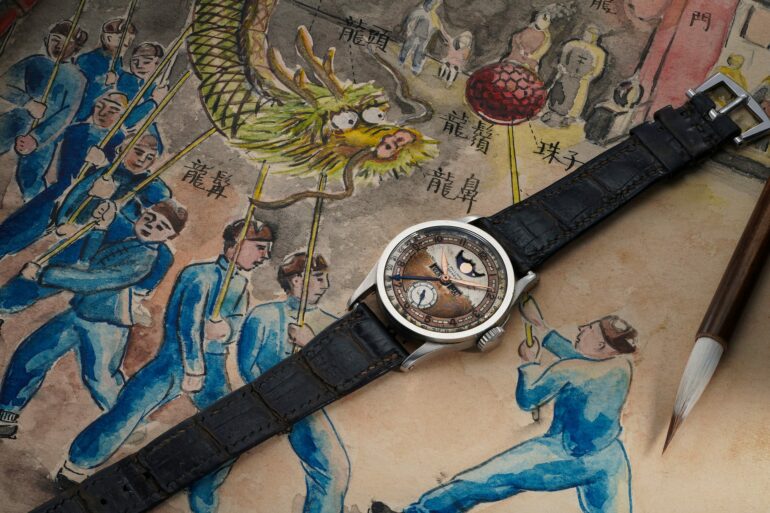
The journey of the Patek Philippe Reference 96 Moon Phase watch illustrates the intensity of this authentication process. This particular timepiece accompanied Aisin-Gioro Puyi, the last emperor of China, even into his captivity in the Soviet Union, before being given to his Russian interpreter, Georgy Permyakov. Simply recounting this transfer was not enough; it had to be proven. Phillips conducted years of research, enlisting a team of specialists and historians to comb through testimonies, records, and valuable physical evidence.
The turning point in this meticulous investigation came in particular from photographs taken in 2001 at Permyakov’s home. The images revealed the watch sitting among other personal belongings linked to Puyi, definitively confirming the object’s authenticity. Offered for sale in Hong Kong in May 2023, the timepiece sold for 49 million Hong Kong dollars, or approximately 6.2 million U.S. dollars. During this same auction session dedicated exclusively to Patek Philippe, all eleven lots offered were sold, generating a total of 51.898 million Hong Kong dollars. These spectacular figures validate the thoroughness of the investigation, though they alone cannot fully capture the staggering significance of such a relic.
The Myth Put to the Test
The fate of the Rolex Cosmograph Daytona, reference 6239, follows the same logic of embodiment. For many decades, the watch’s existence was attested only by press photographs showing actor Paul Newman wearing the chronograph on his wrist. The physical object itself had vanished, fueling speculation among an entire generation of collectors.
The mystery was dramatically solved when it was revealed that the actor had given it in 1984 to James Cox, then the partner of his daughter Nell Newman. When Phillips finally presented the piece for the first time at the New York auction “Winning Icons – Legendary Watches of the 20th Century” in 2017, the market went into a frenzy. With an initial estimate set between one and two million dollars, the bidding war ended with a resounding hammer fall at 17,752,500 dollars. This stratospheric sum does not merely reflect the design of the dial. It quantifies Newman’s cultural impact and the realization of an urban legend finally verified. However, while provenance heightens desire, it never negates the necessity of physical examination. The condition of a movement and its structural authenticity remain the foundation without which no story holds water.
The Ethics of Restoration and Respect for the Scar
This quest for integrity finds its direct extension in the secrecy of the workshops. Establishing a history also depends on the material itself, and the restoration of a vintage piece now resembles an archaeological excavation. At Vacheron Constantin, a watchmaking house founded in 1755, no restoration begins without first delving into the archives to identify the original characteristics of the model on the workbench.
The approach has changed radically. It is no longer a matter of erasing the passage of time. When a component is damaged, the artisans prioritize repair using traditional techniques rather than outright replacement, and only craft a new one as a last resort. The ultimate goal is to restore the movement’s rhythm while respecting the watch’s physical form. Subtle discoloration and slight wear on the case are no longer treated as imperfections to be eradicated beneath the polishing discs. These are the marks of a lifetime—traces that attest to the object’s authenticity. Any intervention requires constant restraint. A restoration that is too aggressive risks destroying these physical traces, stripping the piece of a part of its soul to the detriment of the future custodians of this heritage.
Geometric Aesthetics and the Spirit of Independence
Acquisition criteria are evolving as new demographics enter the market. Driven by the visual culture of social media and the influence of public figures, young buyers are shaking up the traditional hierarchy. Ziyong Ho notes that this generation often enters the world of watchmaking through the direct lens of design or the resonance of a human story, even before examining technical specifications and condition—reflexes that remain the preserve of seasoned collectors.

The massive craze for vintage Cartier creations perfectly illustrates this shift. Enthusiasts are drawn to the bold geometric designs and radical visual identity of the Parisian house. This approach does not negate traditional market standards; it expands them. Emotional attachment now blends with an appreciation for the quality of craftsmanship.
The same phenomenon is propelling independent watchmakers into the spotlight. Timepieces by Philippe Dufour, Ludovic Ballouard, F.P. Journe, and those from the MB&F design studio captivate with the purity of their hand-finished details, the design of their movements, and the radical nature of their vision. Phillips highlights a strong trend: collectors of antiques are increasingly adding these contemporary creations to their collections. They see this as an opportunity to acquire watchmaking history at the very moment it is being written. Numerical rarity is giving way to the creator’s uniqueness.
Passing on the craft: an absolute priority
Beyond pure mechanics, Ziyong Ho reminds us that high-end watchmaking relies on extremely fragile skills: the Métiers d’Art. Enamel work, guilloché, engraving, and marquetry transform a dial into a space for artistic expression, at the cost of slow, meticulous, and highly specialized techniques.
Historic houses such as Patek Philippe and Vacheron Constantin devote considerable resources to preserving these disciplines. The challenge lies not only in preserving watches that have already been produced. It lies in the physical transmission of these techniques. It is imperative to train new generations of artisans capable of mastering, applying, and restoring these decorative arts. A watch can only continue to exist if expert hands are still capable of understanding its language. Without this transfer of knowledge, no matter how beautifully the market documents these stories, the craft will inevitably fall silent.