Make Texture a preferred source on Google to support us
Add Texture to GoogleThe Irrationality of Gemstones in the Face of the Weight of History
The arithmetic of auction houses sometimes follows a logic that defies all financial rationality. When a Belle Époque brooch, estimated at a high of $72,300, goes under the hammer for approximately $1.35 million, the fine jewelry market demonstrates that it is no longer just about carats, but about pure desire. This staggering discrepancy made a strong impression in Geneva during the Royal & Noble Jewels auction organized by Sotheby’s on November 11, 2026. The reason for this surge? A piece dating from around 1910, centered around a 23.64-carat padparadscha sapphire. The auction house’s lot description links this piece to two figures from the Nordic elite: Princess Sibylla of Saxe-Coburg and Gotha, and Princess Birgitta of Sweden. But it was above all the expert analysis by the Swiss laboratory SSEF—confirming the stone’s Ceylonese origin and the complete absence of heat treatment—that transformed this brooch into a fiercely contested prize. This result set the tone for the Geneva auction, where colored gemstones, backed by illustrious lineages, consistently defied expectations.
A Romanov Sapphire in a Contemporary Setting
The excitement reached its peak around a lot whose history reads like a Baltic spy novel intertwined with the archives of the Place Vendôme. Initially estimated at between 1.35 and 1.8 million Swiss francs, a Cartier bracelet was ultimately acquired by an anonymous collector for more than 4.1 million Swiss francs—nearly reaching the $5 million mark (approximately 4.97 million). The centerpiece alone justifies this staggering price: a Ceylon sapphire boasting a titanic weight of 197.80 carats, which, according to gemmological reports, has also never been artificially heated.
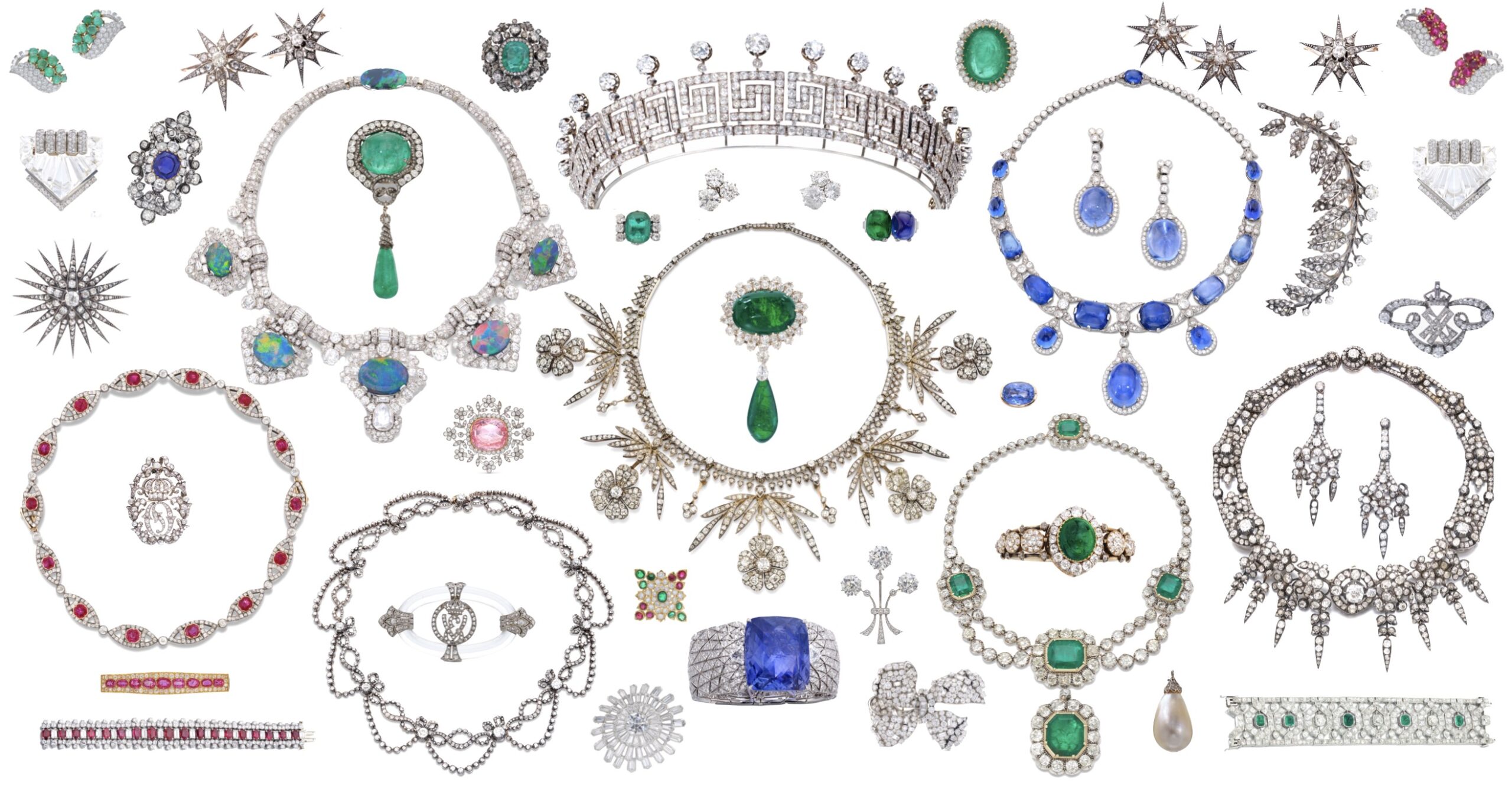
The paradox of this piece lies in its temporal anatomy. The setting, which incorporates an interchangeable engraved rock crystal element, is a recent Cartier creation dating from around 2015. The gem, on the other hand, carries with it the ghosts of the Russian imperial court. Documents compiled by Sotheby’s trace a fascinating history: the stone is said to have been part of the Russian Crown Jewels. The Associated Press, as reported by the Washington Post, even states that Empress Dowager Maria Feodorovna is said to have worn it in 1903 at a lavish ball held at the Winter Palace in Saint Petersburg. The sapphire’s journey then crossed paths with the worlds of entertainment and high society, as it was acquired by the opera singer and collector Ganna Walska from Cartier in 1927. The auction house also hints at the possibility of an even older Mughal origin, though it is careful to emphasize that this is merely conjecture. Between the precision of the gemologists’ microscope and the tales of the tsars, the bidder has chosen to treat himself to both.
The Modular Architecture of the 1930s
Aristocratic provenance also served as a catalyst for other gemstones, some of which were more unexpected in royal commissions than traditional sapphires. A Cartier tiara crafted around 1937 and from the collection of the Duchess of Devonshire far exceeded its high estimate of $1.33 million, reaching approximately $2 million. What makes it unique? It is built around black opals from Australia. In addition to the prestigious designer and the British origins of the client, it was the very engineering of the piece that captivated buyers. Designed to transform according to outfits and eras, the tiara can be taken apart to give its components a second life; they can be worn as a necklace or detached as individual brooches. This capacity for transformation—a technical hallmark of the great workshops of the interwar period—adds an exceptionally rare practical value to its collectible value.
Intertwined Signatures and Archival Details
In this play of light and shadow, collectors seek out the details that make a piece unique. Such is the case with an imposing necklace that sold for $1.93 million. Its centerpiece is a 43.07-carat Ceylon sapphire, but it is its dual provenance that intrigues. The documentation reveals Bucherer’s signature on the front of the piece, while Adler’s is hidden on the clasp. The auction catalog went so far as to note the absence of a small pearl from the ensemble. This absolute transparency regarding the piece’s condition did nothing to dampen the bidding, proving that buyers at this level seek the authenticity of an object that has stood the test of time, complete with its marks of age and manufacturing mysteries.

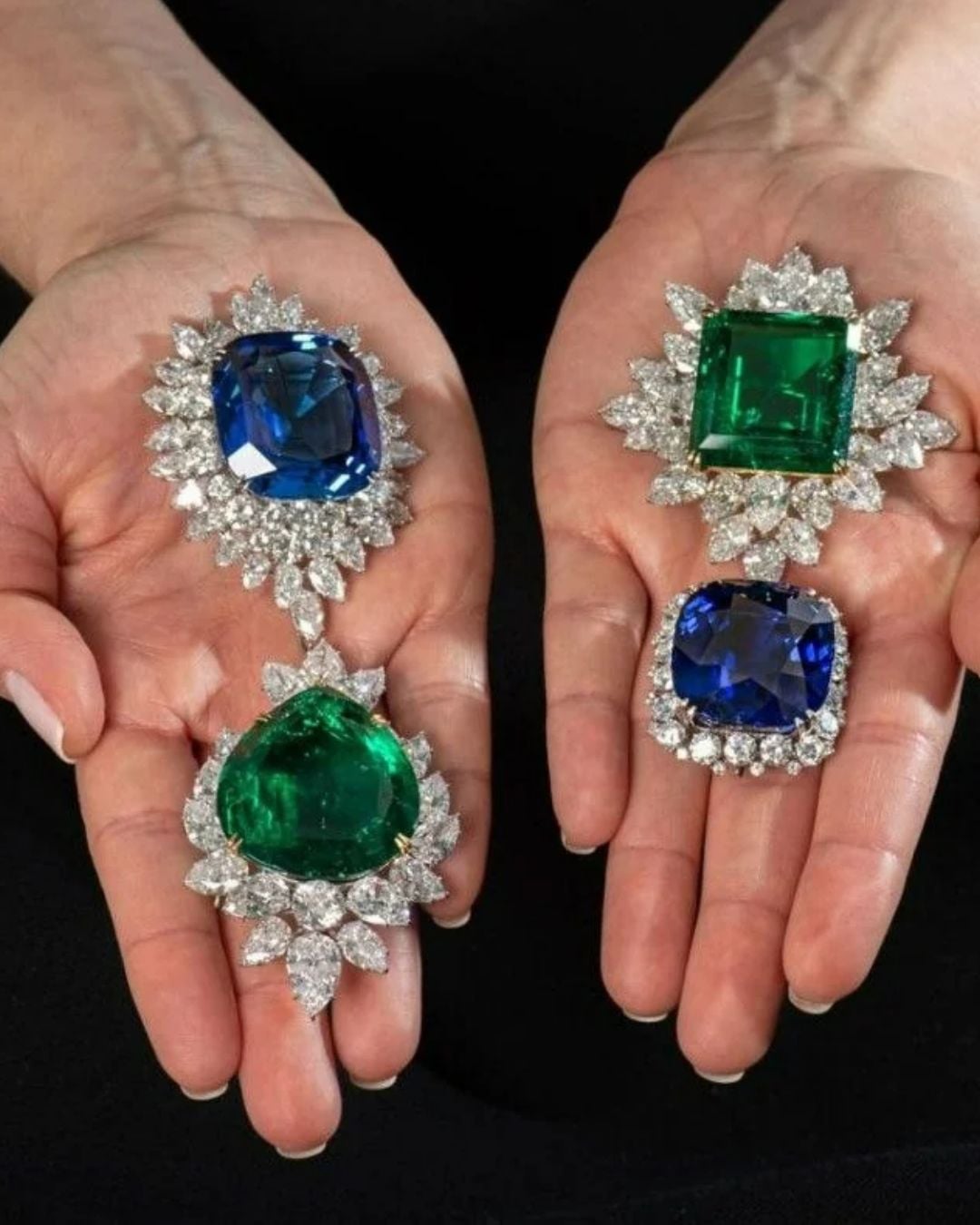
The catalog for this Geneva auction offered a comprehensive overview of the leading names in jewelry design. A Passe-Partout set by Van Cleef & Arpels, studded with blue sapphires, yellow sapphires, and rubies, sold for approximately $786,600. Elsewhere, the classic aesthetic of a diamond tiara by Mellerio fetched as much as $617,000, while Bulgari’s Roman opulence was showcased in a bracelet combining rubies and diamonds, which sold for over $277,000. Even more understated pieces, yet set with exceptional gemstones, followed this upward trend, such as an antique bracelet featuring a 27.38-carat Colombian emerald, which fetched nearly $247,000, or a long necklace typical of the Roaring Twenties, which sold for $956,300. A classic half-set, combining sapphires and diamonds, crossed the symbolic $1 million mark.
The Price of Storytelling
A look at these spectacular auction results—amounts converted to dollars for illustrative purposes and including the buyer’s premium, but excluding applicable taxes—reveals the new contours of desirability. It would be simplistic to attribute this surge to a single factor. The contemporary equation for luxury combines the chemical purity of an untreated gemstone—certified by independent laboratories—with the technical mastery of a setting, whether historic or bearing the signature of a major 21st-century designer.
But beyond weight and size, provenance asserts itself as the extra touch of soul that drives auction houses wild. These stories of empresses, duchesses, and princesses—passed down by auction houses and their sources—act like a powerful drug on the market. They transform a simple mineral extracted from the earth into a cultural and political artifact. Yet while an aristocratic pedigree fuels bidding wars, it remains a narrative construct that adds to the material’s value. The anonymous buyer of the Cartier bracelet for nearly $5 million did not merely treat himself to 197.80 carats of blue corundum; he purchased the right to own a fraction of a 1903 ball that now exists only in the memory of the stones.