
Make Texture a preferred source on Google to support us
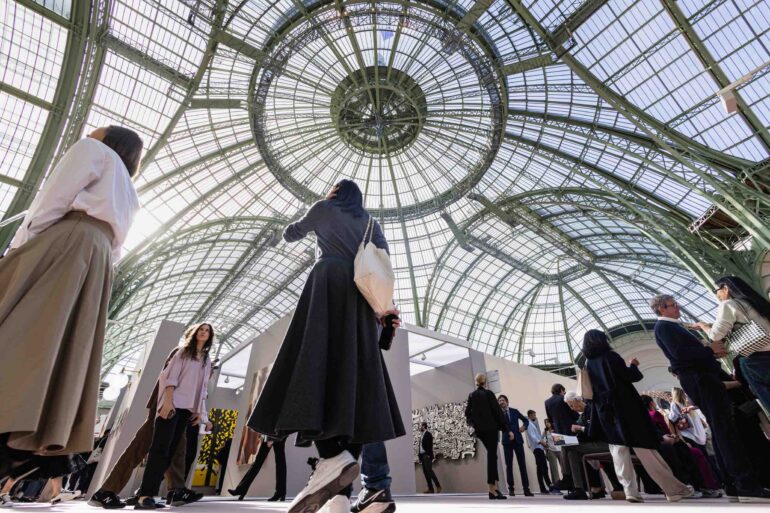
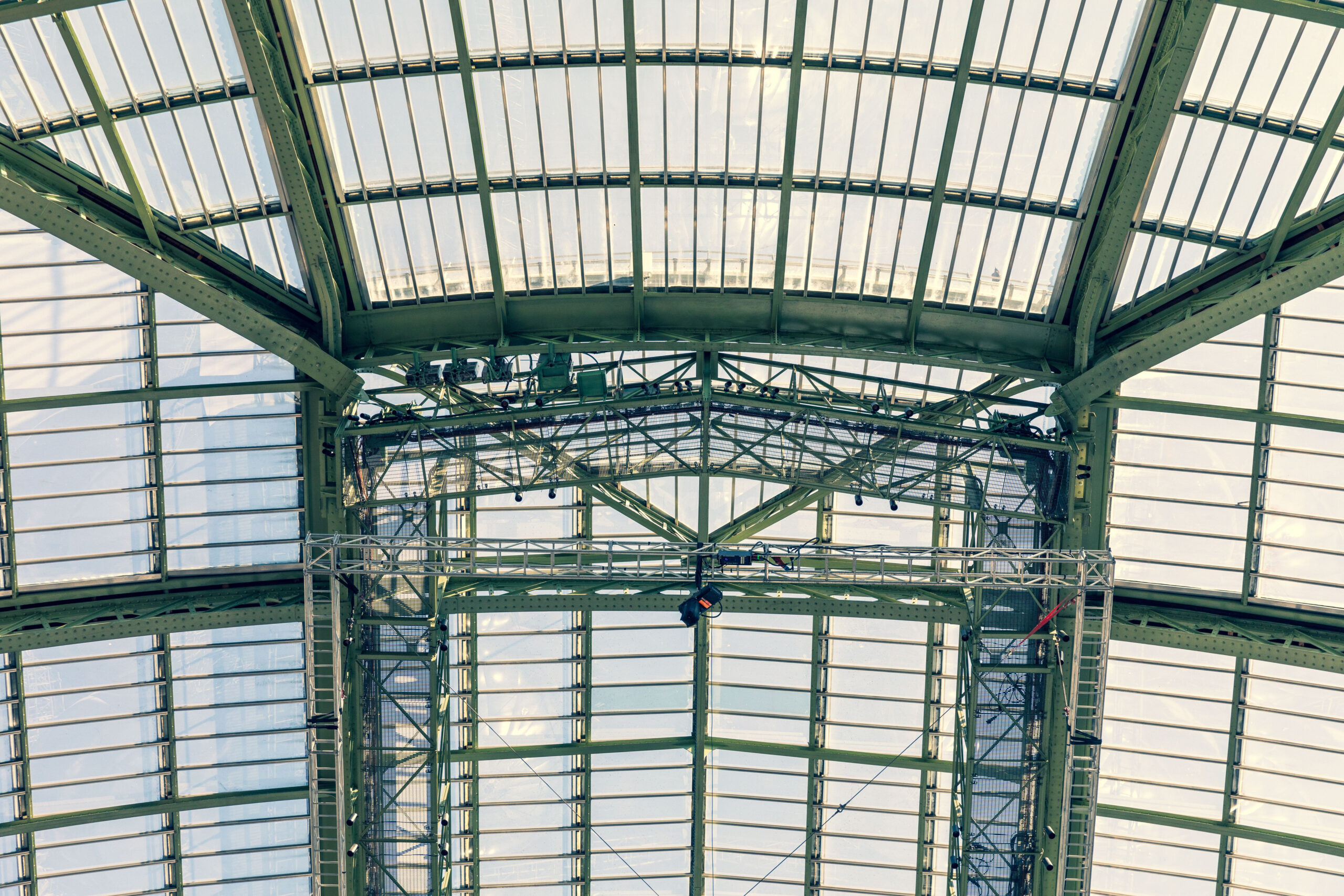
Add Texture to GoogleJust a stone's throw from the Champs-Élysées, the Grand Palais's metal-and-glass nave stands with its late 19th-century silhouette, like a translucent fortress. Outside, the French capital is in an uproar. Recent social unrest forced the Louvre to barricade its doors earlier this week, a precautionary measure already adopted the previous weekend by the Jeu de Paume and the Paris branch of the Hauser & Wirth gallery. Inside, however, time seems to stand still. Since Tuesday, holders of the famous VIP passes have been strolling through the aisles of the fall’s premier contemporary art event. Their phones vibrate with emails from the organizers detailing the security measures put in place in response to public unrest, but Art Basel Paris’s motto remains unwavering: stay open at all costs.
At the helm of this heavily guarded ship, Karim Crippa—a 35-year-old director and former communications manager for the event—navigates the situation with calculated composure. His stated priority is to ensure the physical safety of the public, the staff, and the exhibited works. It appears to be working. No disturbances made it past the building’s gates during the trade days leading up to the official opening on October 23. Beneath the glass roof, the crowd of international collectors, curators, artists, and critics was just as dense as at the previous edition. This exclusive, gilded gathering bears an overwhelming responsibility: to set the financial tone for the entire global market in the months to come.
Paintings as a Safe Haven
In this climate of geopolitical and economic instability, buyers are seeking tangible certainties. The time for disembodied conceptual experiments has passed; instead, there is a massive return to painting and sculpture. The pre-opening day immediately made a huge splash with the display of a Modigliani painting nearing the staggering mark of 100 million euros—a strategic move orchestrated jointly by the galleries PDS, Pace, Di Donna, and Schrader. The appetite for historic names was quick to emerge.
The giant Hauser & Wirth quickly closed out stratospheric deals, selling a Gerhard Richter and a Georg Baselitz for approximately ten million euros each, while a composition by Mark Bradford found a buyer for 3.5 million. At the New York-based gallery Yares Art, a Frank Stella changed hands for 6.7 million euros. Yet these dizzying figures mask a complex economic reality. While indicators for 2025 point to an overall 4% increase in the market after two years of contraction, the sector remains on a knife’s edge. Money is circulating, but it is concentrated almost exclusively at the very top of the artistic hierarchy.
Lorena Pérez-Jácome, a Spanish-Mexican patron of the arts who traveled from Madrid, confirms this shift in buying behavior. In her view, the term “global crisis” lacks nuance. Rather, she observes a process of consolidation—an infinitely more selective approach in which collectors prioritize the security of tangible works.
The Hegemony of the Giants and the Battle for Floor Space
This conservative tendency is evident right on the ground-floor gallery walls, where multinational art dealers deploy a flawless arsenal. Pace plays its Julian Schnabel and Jean Dubuffet cards; David Zwirner pulls out Josef Albers; and Thaddaeus Ropac orchestrates a face-off between Alex Katz and Pablo Picasso. Sculpture makes its presence felt just as clearly, driven by Alexander Calder’s mobiles, Yayoi Kusama’s polka-dot obsessions at Victoria Miro, and the magnetism of Louise Bourgeois and Cristina Iglesias at Hauser & Wirth. The Mennour Gallery showcases Alicja Kwade’s balanced compositions, while Chantal Crousel makes a bold statement with a work by Pierre Huyghe priced at 800,000 euros. Gagosian even indulges in the luxury of creating a dialogue between a Marcel Duchamp urinal and the dazzling aesthetic of Jeff Koons.
A few meteoric rises from the younger generation—such as Pol Taburet at Mendes Wood DM or Manuel Mathieu at Poggi—manage to carve out a path in this crowded epicenter. But to breathe a more forward-looking air, one must step away from the central aisle. The “Émergence” and “Premise” sections, tucked away in the side corridors and upstairs, house the pulse of tomorrow’s creativity. Brands like Blue Velvet from Zurich, Mariposa from Los Angeles, and the Parisian label LoBrutto Stahl are taking calculated risks there. The Mexican brand Labor stands out with a cutting-edge exhibition pairing the Madrid-based painter Jerónimo Elespe with the Irish visual artist Yuri Pattison.
The Linguistic Shift and the Soft Power of Luxury
Ever since the relentless Art Basel machine swallowed up the now-defunct FIAC in 2022, the makeup of the visitors has changed radically. English and German have supplanted the language of Molière in commercial exchanges. Rebeca Blanchard, of the Spanish gallery PratsNogueras Blanchard, offers a lucid analysis of this shift. The Swiss brand’s clout has reshaped the fair’s demographics, forcing her own gallery to adapt its offerings. Rather than focusing on French artists as it did during the FIAC era, the gallery brought works by Latin American artists Belkis Ayón and Ana Mendieta to the fair, securing a major sale of Ayón’s work even before the opening. She nevertheless points to a glaring imbalance in the geography of the exhibitors: only three Spanish galleries made it past the screening process of a selection committee that she considers to be biased toward French and Anglo-Saxon interests.
If Paris aims to permanently snatch the European crown from a London weakened by its post-Brexit isolation—and to shake up Basel’s historic spring fair—its secret weapon lies in its luxury industry. This sector, too, is navigating a period of turbulence. Between a slowdown in Chinese consumer spending and a pricing policy many consumers find off-putting, the major fashion houses have a vital need to restore their cultural reputation. Art patronage offers them invaluable symbolic credibility, while injecting massive amounts of capital into artists’ work.

Miu Miu has thus taken on the fair’s public program and is staging, beneath the vaults of the Palais d’Iéna, a performance conceived by director Alice Diop. The institutional giants are showcasing their ambitions: Ibrahim Mahama is taking over the Fondation Cartier, while the Fondation Louis Vuitton is spotlighting Gustave Fayet. At the Bourse de Commerce, redesigned by Tadao Ando, François Pinault is presenting a masterful photographic installation. Media magnate Paul-Emmanuel Reiffers, who is currently bringing Théo Mercier and Thomas Houseago face-to-face in his own space, highlights the power of this ecosystem. According to him, the friction between the fashion avant-garde and the art world generates a magnetic pull that Basel cannot replicate. Dealers have, in fact, grasped the stakes, now setting aside key pieces specifically for their appearance along the banks of the Seine.
A New Generation Shaped by Experience
This Parisian appeal must attract a new generation of decision-makers to ensure the sustainability of its model. The report “The Art Basel & UBS Survey of Global Collecting 2026” reveals a counterintuitive reality: fortunes amassed by Generation Z now sit at the top of the art spending pyramid. These heirs or entrepreneurs operate by their own rules. They prioritize time spent on research, are open to recommendations from their family circle, and place the intensity of the aesthetic experience far above mere material accumulation.
Karim Crippa perfectly captures this perspective. A stroll beneath the Grand Palais’s glass roof is marketed as a visceral immersion in Parisian mythology. It is undoubtedly to appeal to this audience, raised on the aesthetics of social media, that the fair launched the “Oh Là Là” program. Scheduled for the end of the week, this initiative encourages exhibitors to shake up their exhibition designs under the guidance of actress Philippine Leroy-Beaulieu, the iconic face of the haughty Parisian in the American series *Emily in Paris*.
To capture the most experimental segment of these young collectors, however, one often has to venture away from the city center. On the banks of the Canal Saint-Martin, Paris Internationale offers a different kind of platform. Bringing together some sixty participants, the event attracts galleries such as the Spanish firms Cibrián and Bombon, which are seeking a more raw format. Ana Ramírez finds it an indispensable counterpoint to the industry’s giants, while Goyo Cibrián sees it as the ideal melting pot for forging connections with millennial buyers, whose relationship with art requires new modes of mediation.
Within the hyper-secure confines of the Grand Palais, the commercial buzz thus forges a strange bridge between the leading figures of traditional collecting and the avant-garde of a wealthy youth. A striking paradox when one considers that, on the other side of the glass and steel, it was precisely a segment of this same age group that was setting the streets ablaze just a few days ago.