Make Texture a preferred source on Google to support us
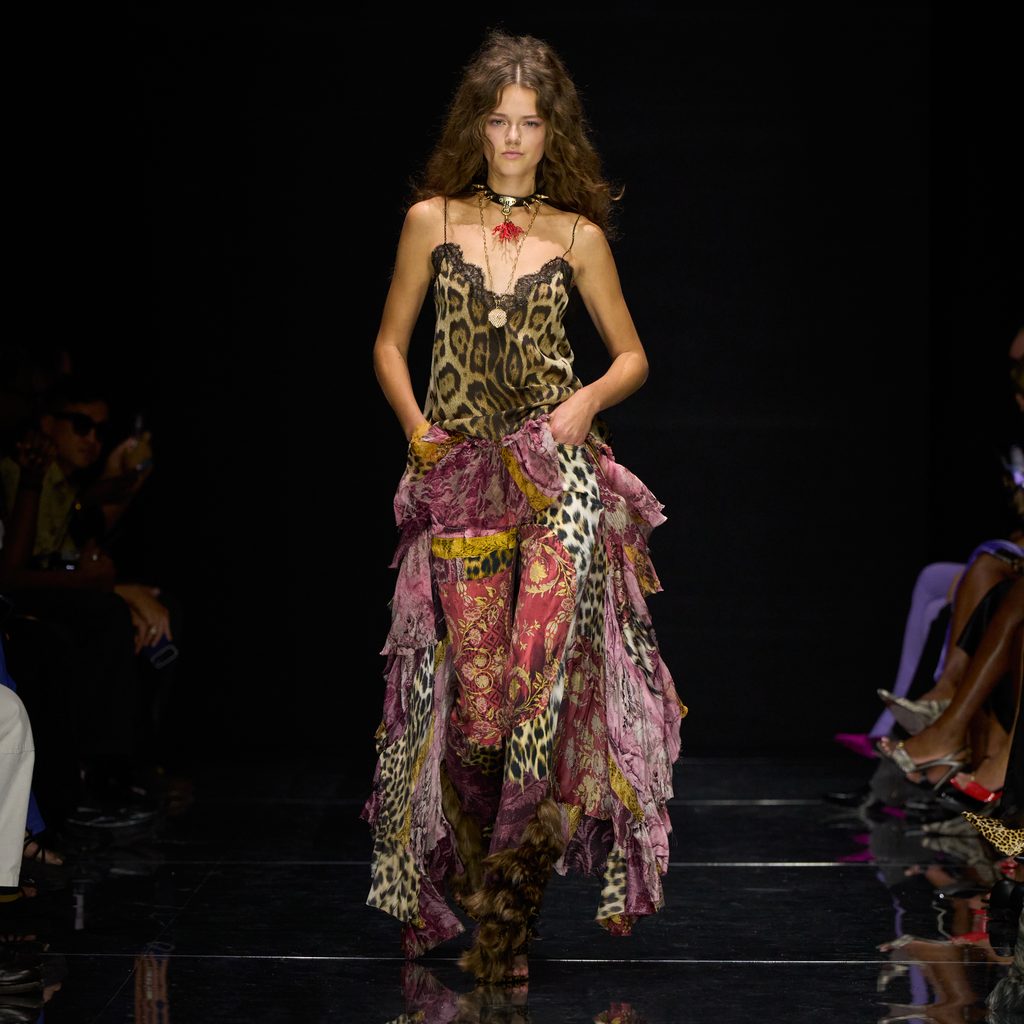
Add Texture to GoogleRoberto Cavalli now serves as a bridge between two worlds that do not naturally speak the same language: that of a fashion house founded more than half a century ago and that of investors focused on margins and cash flow. Since Marquee Brands, in partnership with Damac Group, acquired a majority stake in May, the Italian label has marked the American group’s first foray into the luxury sector. For its CEO, Heath Golden, it must also demonstrate that a model based on external partners can find its place in this sector. It’s a challenge worth examining: how can a brand be developed without confusing the strength of its name with the mere efficiency of its operations?
A Brand, Not Just an Acquisition
In Heath Golden’s remarks, Cavalli holds a special place. The executive does not present this acquisition as merely adding another brand to a portfolio. He sees it as the starting point for Marquee Brands’ luxury business and considers the fashion house particularly well-suited to this ambition. This first transaction will therefore serve as a test, even though, based on the information he provides, no results are yet available to gauge its full scope.
To explain his choice, Golden first invokes a human story: that of Roberto and Eva Cavalli, whose romantic bond, he emphasizes, lies at the heart of a journey spanning more than fifty years. It is this narrative that the group intends to bring to life and strengthen. The emphasis is telling. Before detailing the inner workings of his organization, the buyer affirms his attachment to what came before his arrival.
The challenge now is to bring these two timeframes together. A brand’s history is built over time; a business model must be able to respond quickly to market shifts. At Cavalli, Marquee aims to bring the two together. The editorial significance of this transaction lies precisely in this tension: the group is acquiring a majority stake, but its project also depends on its ability to preserve the uniqueness of the brand it seeks to develop.
What Is Streamlined, What Is Delegated
The term “asset light” may seem abstract. In the organizational model described by Heath Golden, it refers to a concrete choice: relying on external companies for production and distribution. Marquee Brands works with specialized partners, selected for their knowledge of a specific product category or geographic region. The group therefore does not seek to centralize all operations under one roof.
This shift in responsibilities changes the way growth is approached. Rather than handling everything directly, Marquee relies on the expertise of operators who are already in touch with their markets. According to Golden, this proximity makes it possible to identify growth opportunities and adapt decisions more quickly when conditions change. The value of the network, then, lies less in its sheer size than in the relevance of each of its partners.
For a luxury brand, however, the issue goes beyond the efficiency of the organizational structure. Entrusting production and distribution to third parties makes the relationship with these partners crucial. Their specialization is the argument put forward by Marquee; the coherence of the whole, in turn, becomes a clear challenge. The model does not eliminate complexity. It shifts it to the choice of operators and the coordination of their efforts.
It is in this regard that the Cavalli project must be judged. A network can open up new possibilities; it does not, in and of itself, constitute proof of success. Golden advocates a method whose inner workings he understands, but which he is applying to a luxury brand for the first time.
Flexibility as a Response to the Slowdown
The current context lends this method particular significance. The luxury sector is experiencing a slowdown, and Heath Golden maintains without hesitation that Marquee’s organizational structure is better equipped to respond to it than a traditional model. This is indeed his conviction, not a statistical comparison presented to support his argument. His reasoning is based on the ability to react.
Geopolitical upheavals are among the challenges he cites. In the face of these challenges, working with local operators should make it possible to understand changes in a region and adjust course without delay. The goal is not merely to weather the storm where business becomes difficult. It also involves seeking growth wherever opportunities arise.
This perspective paints a less uniform picture of growth. Not all markets are viewed as a single bloc subject to the same trends; each partner provides an assessment of its own environment. For Golden, this ability to adapt helps preserve the brand’s health. This is the model’s operational promise: to prevent an overly rigid organization from turning every change in context into a lasting obstacle.

Caution is still warranted regarding what conclusions can be drawn for Cavalli. The executive’s explanations shed light on a management approach. They do not describe either a detailed rollout schedule or results specific to this new acquisition.
Italy as a Growth Reserve
Cavalli may not remain the sole embodiment of this ambition in the luxury sector for long. Heath Golden mentions other Italian brands whose presence, in his view, remains limited in much of the world. He believes that some possess qualities that Marquee would be better able to showcase and translate into growth.
No specific names are mentioned. It would therefore be premature to interpret this as an announcement of an upcoming acquisition. The statement nevertheless reveals a selection criterion: the gap between a brand’s potential and its international footprint. From this perspective, a still-limited reach is not merely a weakness. It can represent an opportunity for growth for a group that bases its strategy precisely on specialized regional partners.
This reasoning extends the rationale behind the Cavalli acquisition without reducing it to a formula that can be replicated exactly. For Marquee, the challenge would be to find fashion houses whose characteristics align with its organizational structure. For these brands, the key issue would be gaining access to new markets. In between, everything would depend on the quality of the alignment between a brand’s identity and the resources mobilized to expand it.
Investors: Another Audience to Win Over
Behind this industrial ambition lies a financial equation that the company clearly embraces. Marquee Brands is currently controlled by two private equity funds. Golden describes a company focused on continuous growth, whose asset-light model would allow it to maintain a high EBITDA margin and strong cash flow generation. No figures are provided to support these assessments.
In his view, these characteristics serve as selling points to attract other investors. The CEO hopes to see new funds join the venture in the coming years. Portfolio expansion and changes in the shareholder base thus appear to be two aspects of the same project, though no specific transaction has been announced.
An initial public offering (IPO) also remains a possibility. Golden has not set a date or made a firm commitment regarding this: Marquee will monitor the capital markets and make a decision based on its partners’ interest. Cavalli thus opens up a new category for the group, while the group retains several options for financing the next phase. The next step could involve either another Italian fashion house or its owner’s personal capital.