
Make Texture a preferred source on Google to support us
Add Texture to GoogleThe LVMH Group is breaking new ground by assigning a book value to the art of repair. Going beyond simple after-sales service, this initiative reveals a new, virtuous financial dynamic, generating nearly 500 million euros in revenue for the year 2025.
From Invisible Maintenance to Measurable Value
Long relegated to the status of a post-purchase convenience, repair has now emerged as a strategic pillar. In 2025, the world’s leading luxury brand reported generating nearly 500 million euros through more than 10 million maintenance, recharging, or trade-in transactions. This figure, the cornerstone of its new policy of creative circularity, demonstrates that a luxury item transcends its initial sale. The item lives on, returns to the workshop, is restored, and then re-enters the brand’s economic cycle.
Far from being limited to mere environmental rhetoric, this phenomenon reflects a sharp financial logic. Maintenance and refurbishment are shedding their status as hidden costs. LVMH now characterizes this part of its business as measurable—a major step forward in an industry that has historically been more inclined to emphasize its aura and image than its maintenance records.
The Industrialization of Creative Circularity
This transformation is no accident. Created in 2023, the group’s “Repair and Care” task force now supports eighteen fashion houses in harmonizing their restoration services. The goal is clear: to extend the lifespan of creations while forging an unbreakable bond with customers. In the world of luxury, customer loyalty extends beyond store windows; it crystallizes when a bag, a timepiece, or a ready-to-wear item calls for a second life.
LVMH is also rolling out an ecosystem of tools that goes beyond the scope of mere repair. Nona Source repurposes unused fabrics from fashion houses, Cedre channels unsold inventory into processing networks, while Weturn processes non-reusable textiles. With 41% of materials sourced from recycled sources last year, the group is giving circularity a truly industrial scale, marking a break from the often vague promises of eco-friendly fashion.
The Rediscovered Nobility of Craftsmanship
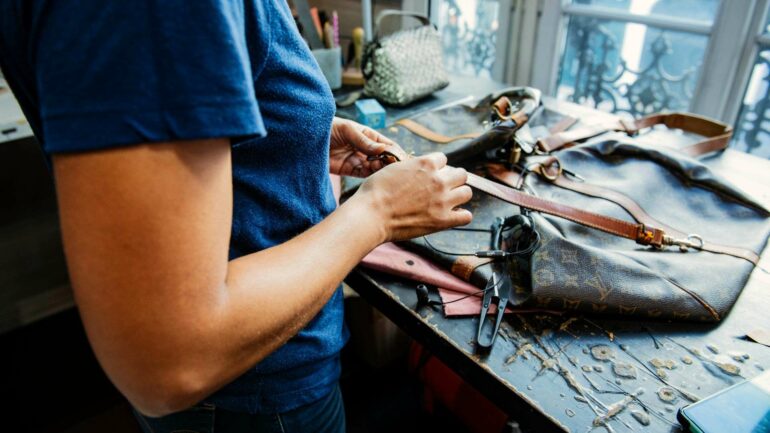
While this approach is gaining momentum, repair has long been the hallmark of excellence since the dawn of the luxury industry. Louis Vuitton, which established its maintenance service as early as 1860, now relies on nearly 1,200 artisans spread across twelve dedicated workshops. The luggage house notes that 98% of repairs are carried out locally, thereby limiting the carbon footprint associated with transportation. The customer experience has also been modernized, combining drop-off at a physical location with digital tracking via an app, before the item is processed at the nearest workshop.
This trend is sweeping the entire industry. Burberry has dedicated its ReBurberry service to its iconic trench coats and knitwear; Coach has launched (Re)Loved to offer restored styles; Hermès continues to maintain its leather goods and watches behind the closed doors of its own workshops; and Chanel combines restoration and alterations through the Chanel & Moi program. The challenge shared by these major brands is highly strategic: retaining customers within the brand’s ecosystem and countering the appeal of the gray market or independent repair shops.

Anticipating Regulations and New Metrics of Desirability
This fundamental shift is taking place against the backdrop of a rapidly evolving legislative landscape. Starting in July 2026, the European Union will impose new standards regarding the right to repair, coupled with increased transparency requirements regarding product sustainability. Faced with these imperatives, the luxury sector is pursuing a two-pronged approach: it is adapting to compliance while transforming this constraint into a highly lucrative services market. Repair thus becomes a source of value at the very moment it is elevated to an absolute virtue.
As Hélène Valade, Director of Environmental Development at LVMH, points out, this financial quantification is the culmination of a deep-seated conviction, responding to a clientele seeking exceptional services to extend the life of items that are sometimes severely damaged. Christelle Capdupuy, Head of Sustainable Development at Louis Vuitton, confirms that this focus on the object fosters brand loyalty rather than being viewed as a mere additional cost.
Longevity is now emerging as a true performance indicator. In an industry long polarized by the frenzy for novelty alone, the sector is making an elegant return to its roots: the value of a creation is no longer fixed the moment it leaves the workshop, but is measured by its ability to stand the test of time, to be reborn, and to be passed down. Luxury, which has always sought to escape obsolescence, is finally beginning to quantify its reality.